That's a myth worth busting. Studios producing children's TV, mobile games, explainer videos, and advertising content still rely heavily on 2D artists, and that demand hasn't disappeared.
This blog breaks down what 2D animators actually do, the career paths and job titles you can pursue, the skills studios expect, realistic salary ranges in India, and how to build the education and portfolio that gets you hired.
Key Takeaways
- 2D animation remains vital in OTT kids' shows, mobile gaming, and advertising
- 2D animators in India start around ₹3.9 lakh/year, rising with specialisation
- Career paths run from Inbetweener to Animation Director, with lateral moves into 3D
- A strong portfolio and demo reel often matter more than the degree itself
- Toonz, Digitoonz, and Green Gold Animation actively hire 2D talent for global projects
What Does a 2D Animator Do?
A 2D animator brings flat, hand-drawn or digitally illustrated characters to life through movement, expression, and timing. The work involves far more than "drawing frames."
Depending on the project, a 2D animator might:
- Sketch storyboards that map out scene action and camera angles
- Design characters, props, and backgrounds
- Animate frame-by-frame or through digital rigging
- Clean up rough sketches into final line art
- Add colour and lighting cues before compositing
This work shows up across film, television, mobile and PC games, and advertising, wherever a brand or studio needs illustrated motion.
The Three-Stage Production Process
Every animated project, whether a 30-second ad or a full TV series, moves through three phases:
- Pre-production - Scripting, storyboarding, character and background design, and creating an animatic (a rough video version of the storyboard) before actual animation begins
- Production - Animators create the animation using traditional, paperless (digital), or cut-out techniques, depending on the studio's pipeline
- Post-production - Editing, compositing, colour correction, sound design, and final assembly before delivery
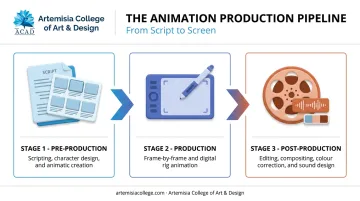
A junior animator typically works within the production stage, while experienced artists move between pre-production design work and production supervision.
Where 2D Animators Work
2D animation talent isn't confined to film studios; you'll find 2D animators at:
- Animation studios producing TV series and films
- Advertising agencies creating branded content
- Gaming companies building mobile or hybrid titles
- OTT platforms producing original animated series
- Freelance, on short-term client projects
That variety keeps 2D animation relevant because it isn't tied to one industry's fortunes.
2D Animation Career Paths & Job Roles
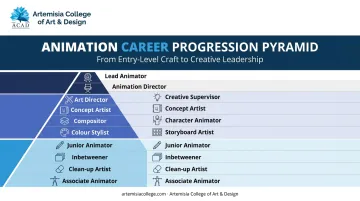
2D animation careers follow a fairly clear progression, though exact titles vary by studio.
Entry-Level Roles
Most animators start in one of these positions:
- 2D Animator / Junior Animator - handles basic animation tasks under supervision
- Inbetweener - draws the frames that create smooth motion between key poses
- Clean-up Artist - refines rough animation into polished, consistent line art
- Associate Animator - assists senior animators on production tasks
Mid-Level Specialisations
With two to four years of experience, animators often specialise into:
- Concept Artist - designs the visual look of characters, props, and worlds before production begins
- Character Designer - develops character appearance, proportions, costumes, and personality for the production bible
- Storyboard Artist - translates scripts into visual sequences that map action, timing, and camera angles
- Layout Artist - plans scene composition, camera framing, and staging so animators know how each shot is blocked
- Background Artist - paints or draws the environments and settings characters move through
- Character Animator - focuses on performance and acting through movement
- Compositor - combines animated layers and effects into final shots
- Colour Stylist - defines the palette and mood of a scene
Senior & Leadership Roles
Experienced animators move into roles overseeing entire productions: Lead Animator, Animation Director, Art Director, and Creative Supervisor each carry increasing creative and managerial responsibility over a project or studio.
Many animators also make lateral moves into motion graphics design, video editing, or 3D animation, since fundamentals like timing and storytelling transfer directly between disciplines.
This flexibility matters because the hiring pool behind it is large and growing. India's broader AVGC-XR sector (animation, VFX, gaming, comics, and extended reality) is projected to create more than 160,000 new jobs annually, reaching roughly 2 million jobs by 2030, according to a CII-Grant Thornton industry report.
2D specialists represent a meaningful share of that demand.
Essential Skills You Need to Succeed
Technical Proficiency
Studios expect working knowledge of industry-standard software:
- Toon Boom Harmony - the professional standard for 2D animation production
- Adobe Animate - widely used for digital 2D animation and rigging
- Adobe After Effects - for compositing and motion graphics work
- Adobe Photoshop - for concept art, backgrounds, and clean-up
Artistic Fundamentals
Software is only half the equation. Studios hire for drawing ability first. You'll need:
- Strong freehand drawing and figure construction skills
- A working grasp of the 12 principles of animation - timing, spacing, weight, squash and stretch, anticipation, and follow-through
- An eye for visual storytelling, knowing how to convey emotion through a single pose or sequence
Soft Skills That Matter in a Studio Pipeline
Technical polish gets you hired; collaboration keeps you employed. Studios consistently look for:
- The ability to take director feedback and revise work quickly, without ego
- Comfort working within tight, often unforgiving production deadlines
- Clear communication with storyboard artists, animators, and compositors on the same project
Job postings for 2D animator roles consistently ask for drawing skill, storytelling instinct, staging and composition sense, and the discipline to hit deadlines on international productions. Studios building for global markets expect all four, whether the production is based in Mumbai, Los Angeles, or Toronto.
Salary & Industry Demand for 2D Animators in India
What You Can Expect to Earn
Reliable, India-specific salary data for 2D animators is limited, but here's what's verifiable:
| Career Stage | Salary Insight |
|---|---|
| Entry-level (~1 year experience) | ₹3.9 lakh/year (~₹32,400/month), per AmbitionBox |
| Experienced 2D Animators | Reported highs of up to ₹6.9 lakh/year, per AmbitionBox |
| Mid-level & senior roles | No standardised India-wide average exists; pay varies by studio, city, and specialisation |
Animators who move into specialised roles, such as storyboard artist, character animator, or lead animator, tend to command higher pay than those who stay in generalist production roles. Growth tracks specialisation and portfolio strength more than years on the job alone.
Is 2D Animation Dying? No, Here's Why
Salary growth means little if the field itself is disappearing. This question comes up constantly, usually after someone claims 3D "replaced" 2D. It hasn't. 2D animation continues to power:
- OTT children's content: platforms need a steady pipeline of original animated series
- Mobile games: many top titles use 2D art for style and performance reasons
- Explainer and advertising videos: brands favour 2D for its speed and cost-efficiency
Indian studios like Toonz Media Group produce more than 10,000 minutes of combined 2D and CGI content annually for international markets. That volume reflects a thriving production pipeline serving global clients.
The Outsourcing Opportunity
India's animation industry is heavily service-based, and international studios continue routing 2D character-animation work for TV series and feature films to Indian production houses. Studios such as Digitoonz actively hire 2D animators in Noida and Kolkata specifically for this kind of international client work.
That said, the sector isn't immune to global disruption. Broader animation-and-VFX revenue dipped in 2024, largely due to the Hollywood writers' strike and slower international commissioning.
Like most creative industries, animation demand moves in cycles tied to global production activity.
How to Build a Career in 2D Animation: Education & Training
Degree, Diploma, or Certification?
You have three broad routes into 2D animation:
- Bachelor's degree (like a B.Des in Animation & VFX) - typically 3-4 years, covering fundamentals plus specialisation
- Diploma programmes - often 1-2 years, faster and more focused
- Short-term certifications - quickest route, best for upskilling in a specific tool
Here's the thing most students overlook: most studios care more about your portfolio than which route you took to get there. A strong demo reel showing solid drawing, timing, and character work opens doors that a degree alone won't.
The Practical Learning Path
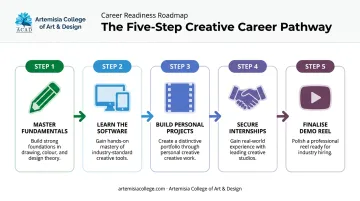
Regardless of which programme you choose, the path to job-readiness looks similar:
- Master the fundamentals - drawing, anatomy, and the core principles of animation
- Learn the software - Toon Boom, Adobe Animate, After Effects, Photoshop
- Build personal projects - short animated pieces that show range, not just technical skill
- Secure internships - live production experience often leads directly to job offers
- Finalise a demo reel - your single most important hiring asset
How Artemisia College Approaches Animation Training
Artemisia College's Animation & VFX programme is built around this exact progression. Rather than treating 2D as a standalone module, the curriculum weaves 2D fundamentals - sketching, lightbox animation principles, and Animate-based 2D production - into a broader pipeline.
That pipeline also covers 3D modelling, rigging, and VFX compositing tools like Nuke and Houdini. Students graduate understanding the full production pipeline, not just one piece of it.
Mentorship comes from working professionals, and the college runs an in-house production studio where students work on live industry projects after their second year, giving them real production experience before they graduate.
Placement Support That Goes Beyond Job Listings
Artemisia's Placement Cell runs a structured process starting well before graduation:
- Faculty review and approval of student portfolios
- Company mapping based on specialisation
- Portfolio sharing with relevant studios
- Mock interviews and one-on-one mentoring
- Guidance on evaluating offers and negotiating starting salaries
Students like Vikas Digvijay Kori, who landed a role as a 2D Generalist at Art Attack Animation, and Anushkar Thokchom, placed as a Junior Concept Artist at Zebu Animation, went through exactly this pipeline before receiving offers.
Top Studios & Companies Hiring 2D Animators
Global Studios
Big international names still hire for 2D-specific and hybrid work:
- Disney - accepts portfolio and demo reel submissions for story, background, and character design roles across TV and film
- Pixar - reviews portfolio and demo reel submissions for story and animation roles within its feature film pipeline
- Sony Pictures Animation - currently hiring Story Artists, and released Fixed, its first hand-drawn feature, in 2025
Indian Studios Actively Hiring
Closer to home, several Indian studios maintain steady 2D production pipelines:
- Green Gold Animation - known for franchises like Chhota Bheem
- Toonz Animation - produces over 10,000 minutes of combined 2D and CGI content annually
- Digitoonz - hires 2D animators in Noida and Kolkata for international TV and film projects
- Zebu Animation - currently co-developing new animated series with international partners
Getting in Front of These Recruiters
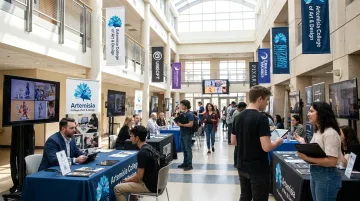
Cold-applying to studios is one route. A faster one is having recruiters come to you. Artemisia College's placement partnerships bring recruiters from animation and gaming companies directly onto campus, drawing from its network of 100+ hiring partners that includes the four studios above. That direct access often shortens the gap between graduation and a first job offer.
About Artemisia College of Art & Design
Studio demand is real, but it is portfolio-led hiring, which is what the training is built around. Artemisia College of Art & Design was set up under Tryambakam Education Foundation to make high quality art and design education affordable without thinning it out. Roughly 90% of the teaching staff come from working industry, bringing between five and thirty-five years of practice into the studio. The college runs ACAD Studios, its own animation and game production house, and students join it as paid interns from their fourth semester onward.
Animation runs at three levels: the Certificate in 2D & 3D Animation, the Diploma in 3D Animation & VFX and the four-year B.Design in Animation. Alongside it the college awards B.Design degrees in Game Design, Interior Design and Fashion Design, BFA and MFA routes in Painting and Sculpture, and a Certificate in Photography.
Fees are deliberately low so cost is not what decides whether a creative student can study, and scholarships are available. Have a look at the fee structure, or go through early admission if a portfolio suits you better than an entrance test.
Frequently Asked Questions
Is 2D animation a good career?
Yes. OTT children's programming, mobile gaming, and advertising all continue to actively hire 2D talent. What matters more than the medium you choose is the quality of your portfolio.
What jobs can I get with a 2D animation degree?
Common roles include Storyboard Artist, Character Animator, Concept Artist, Clean-up Artist, and Compositor. Many graduates also move into motion graphics design or transition into 3D animation.
Do major studios (like Disney) hire 2D animators?
Yes. Disney, Pixar, and Sony Pictures Animation continue hiring for storyboarding, story art, and style-driven or hand-drawn projects, alongside their 3D productions.
Is a formal degree necessary to become a 2D animator?
Not strictly. A degree helps build fundamentals, but most studios prioritise a strong demo reel and portfolio over the credential itself when making hiring decisions.
What is the difference between 2D and 3D animation career paths?
2D relies on drawing and frame-by-frame or rigged illustration skills, using tools like Toon Boom or Adobe Animate. 3D uses modelling and CGI software like Maya, with more focus on spatial and lighting fundamentals.
How long does it take to become job-ready as a 2D animator?
Diploma programmes typically run 1-2 years, while bachelor's degrees run 3-4 years. Internships and live industry projects during your course speed up job-readiness well beyond classroom timelines.