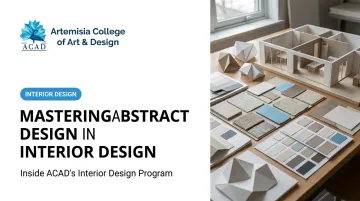
Many homeowners and aspiring designers find this style intimidating. There's no rulebook, no "if this, then that" formula like you'd get with farmhouse or Scandinavian design. It runs on instinct, colour theory, and a feel for proportion that seems impossible to teach.
Here's the good news: it can be taught. This article breaks down where abstract design comes from, the elements that hold it together, and how structured training turns raw creative instinct into a skill you can actually master.
Key Takeaways
- Abstract design borrows from 20th-century art movements, translating colour, shape, and emotion into livable spaces
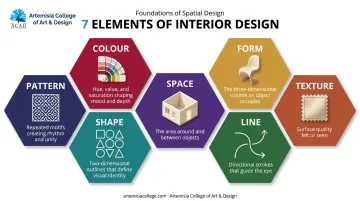
- Seven core elements (colour, form, shape, line, texture, space, pattern) give the style its structure
- Success depends on trained skills in colour theory, proportion, and spatial balance, not just bold choices
- Formal design education bridges the gap between creative instinct and client-ready professional work
What Is Abstract Design in Interior Design?
Abstract interior design pulls its DNA directly from the 20th-century abstract art movement. Think Vasily Kandinsky, who believed colour and form could communicate emotion directly, without needing to represent anything recognisable.
MoMA notes that Kandinsky saw line as something expressive rather than merely descriptive. That philosophy shows up today in the sweeping, sculptural furniture found in abstract interiors.
Piet Mondrian took a different route, reducing everything to grids, primary colours, and rectangular planes. His influence lives on in interiors that use bold colour-blocking and asymmetrical layouts instead of symmetry.
The core philosophy is simple: treat a room like a canvas. Prioritise emotion and visual impact over strict realism or period-accurate styling.
How It Differs From Contemporary, Modern, and Minimalist Design
- Contemporary design borrows from multiple eras and stays trend-forward, but doesn't demand the same emotional, non-representational approach
- Minimalist design leans on restraint and few materials; abstract design can be restrained or wildly exuberant
- Modern design often follows cleaner, more predictable lines; abstract design deliberately breaks from predictability
Demand for this kind of individuality is rising across global design markets. NAHB's 2024 design trends report found buyers increasingly value personalisation and authenticity, wanting homes that feel made specifically for them rather than replicas of a neighbour's layout.
Here's the catch: abstract rooms that look effortless rarely are. Getting bold shapes and colours to sit together in harmony takes a trained eye for colour theory, proportion, and spatial balance. That's exactly what the next section unpacks.
The 7 Elements of Abstract Design in Interior Spaces
Abstract interior design, much like abstract art, is built on foundational elements designers manipulate to control mood and visual impact. Different design schools frame these slightly differently (some substitute "value" or "light" for pattern), but for practical interior application, seven lenses work well:
| Element | How It Shows Up in a Room |
|---|---|
| Colour | Bold, contrasting, unexpected pairings, balanced with neutral tones so the room doesn't overwhelm |
| Form | Sculptural, three-dimensional furniture and fixtures that add depth and a sense of movement |
| Shape | Geometric or irregular shapes in furniture, rugs, and architectural features that create structure or playful asymmetry |
| Line | Straight, curved, or broken lines that guide the eye and build rhythm or tension |
| Texture | Layered materials, such as concrete, metal, wood, and fabric, that add tactile richness |
| Space | Negative space and open layouts that let bold elements breathe instead of competing |
| Pattern | Repeating or clashing patterns in textiles, wallpaper, and flooring that add visual complexity |
No single element carries an abstract room on its own. The result depends on how they interact.
A sculptural chair (form) against a clean wall (space) with a single textured throw (texture) reads intentional. Six competing patterns in one corner read chaotic.
How to Master Abstract Design Techniques in Your Home
Applying abstract principles isn't about scattering bold pieces around a room and hoping they click. It requires intentional choices across furniture, lighting, art, and materials.
Architectural Digest's review of art-filled interiors found a consistent pattern in the strongest rooms: designers coordinated abstract artwork with the scale, colour, and texture of surrounding objects. In one San Francisco high-rise, a large abstract painting anchored the living space while a chandelier was deliberately repositioned to protect its view, and ceramics nearby echoed the painting's colours and surfaces.
Here's how to apply that same logic at home:
- Statement furniture: Reimagine an ordinary piece with unconventional shape and bold finish. An asymmetrical coffee table with a raw, sculptural base does more work than a dozen small accessories.
- Sculptural lighting: Geometric pendant lights or abstract chandeliers double as functional lighting and artistic centrepieces. Choose one striking fixture rather than several competing ones.
- Abstract wall art and sculpture sets the tone for an entire room. A large-scale painting or textured 3D piece should anchor your colour and material choices, not the other way round.
- Curated colour palette: Stick to two or three bold accent colours against a neutral base to keep the room cohesive instead of chaotic.
- Material and texture mixing matters too — combine metals, woods, glass, and fabrics with intention. Two or three well-chosen materials add dimension; six create clutter.
Start with one anchor piece, then build outward from its colours, shapes, and textures.
Where Abstract Design Works Best
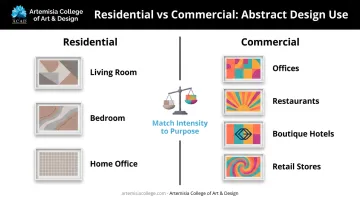
Abstract elements don't behave the same way in every space. Scale and intensity should shift depending on the room and its purpose.
In residential settings:
- Living rooms handle bold statement pieces well, since they're social, high-traffic spaces built for visual interest
- Bedrooms benefit from softer, muted abstraction, think gentle curves and quiet colour palettes that support rest rather than stimulation
- Home offices suit structured, grid-based abstract patterns that support focus without visual clutter
In commercial settings:
- Offices, restaurants, and boutique hotels increasingly lean on abstract design to build brand identity and create a guest experience visitors remember
- For instance, some restaurants build interiors around abstract logo concepts, and boutique hotels use Escher-inspired layouts to surprise guests
- Retail stores use abstract displays to differentiate their brand and draw customers inward
Quick tip: Scale abstract elements to the room's size and function. A sprawling sculptural installation that works in a hotel lobby will overwhelm a small home office. Match intensity to purpose, not just personal taste.
Common Mistakes to Avoid When Designing with Abstract Elements
Abstract design fails fastest when it's treated as "more is better." A few patterns show up again and again in rooms that don't quite work:
- Overcrowding the space: piling on multiple bold elements at once creates visual chaos, leaving the eye with nowhere to rest.
- Skipping neutral balance — vibrant, sculptural pieces need breathing room. Neutral tones and negative space keep the look expressive rather than overwhelming.
- Copying a trending look straight from a design blog without adapting it to your own space defeats the purpose, since individuality is the whole point of abstract design.
- Ignoring scale: a piece that looks dramatic in a photo can overwhelm a small room or barely register in a larger one.
From Appreciating Abstract Design to Building a Career In It
Loving abstract design and executing it professionally are two different things. Turning instinct into a marketable skill takes structured training in colour theory, spatial planning, and material science. That's exactly the foundation built into Artemisia College of Art & Design's Interior Design programmes.
At Artemisia College of Art & Design, courses are built so students learn all forms of interior design, including abstract art. That breadth means you do not have to pick one narrow style early on; you can explore bold, non-representational approaches alongside more traditional methods, then carry the same trained eye for colour, form, and space into whichever direction your practice takes.
The curriculum builds this knowledge in layers:
- Colour Theory and Perspective introduces the principles abstract design leans on hardest, teaching students to pair bold and neutral tones with intention rather than guesswork
- Form and Space, Sketching, Basic Design, and Graphics build the visual foundations - composition, manual drafting, orthographic projections, and perspective sketching - so bold shapes read clearly on paper before they reach a room
- Anthropometrics, Elements of Interior Space, and Scheme Detailing develop the spatial planning skills needed to know when negative space works and when it doesn't, including working drawings for furniture, floorings, plumbing, and ceilings
- Material and Construction and Ergonomics, expanded at the diploma level into advanced materials for commercial and hospitality interiors, give students the technical grounding to mix concrete, wood, metal, and fabric without creating clutter
- Interior Services and Lighting cover the systems and luminaires that make expressive spaces livable - electrical, plumbing, air conditioning, fire safety, and how light shapes form and mood
- Furniture Design and Interior Landscape Design train students to treat furniture and planted elements as sculptural pieces within a composition, not afterthoughts
- History of Art and Architecture (and History of Interior Design at diploma level) situate abstract approaches within a longer design lineage, from classical periods through the modern era
- Digital visualization tools - AutoCAD and SketchUp at certificate level, then 3DS MAX, Photoshop, and Revit in diploma and B.Design study - turn abstract concepts into precise drawings, 3D models, and rendered presentations
- Sustainable Design, Acoustics, Estimation and Costing, and Project Management round out professional practice so bold ideas stay buildable, budget-aware, and client-ready through studio projects across residential, commercial, hospitality, and public interiors
- Design Projects let students experiment with different design languages including abstract design, turning colour, form, and spatial training into portfolio pieces that show a personal voice
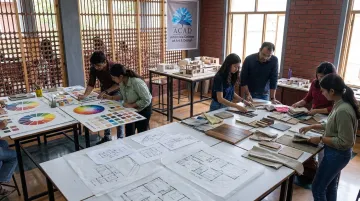
Beyond the classroom, Artemisia College's dedicated Placement Cell connects Interior Design students with studios including Livspace, HomeLane, Godrej Interiors, Urban Ladder, and Bonito Designs for internships and full-time roles.
The support doesn't stop at introductions, either. Students get help finalising their portfolios, one-on-one mentorship, and mock interview sessions that prepare them to walk into a client meeting with confidence.
That combination of technical grounding and real placement support turns a passion for bold, expressive spaces into an actual career designing them.
About Artemisia College of Art & Design
Instinct is a starting point; colour theory, spatial planning and materials are what make it sellable. Artemisia College of Art & Design runs under Tryambakam Education Foundation, built around one idea: strong fundamentals make a designer, software familiarity makes a computer operator. Around 90% of its faculty come from the animation, game, interior and fashion industries.
Interior design runs at three levels: the Certificate in Interior Design, the Diploma in Interior Design and the four-year B.Design in Interior Design. The college also awards B.Design degrees in Animation, Game Design and Fashion Design, BFA and MFA routes in Painting and Sculpture, and a Certificate in Photography.
The college keeps tuition low and offers scholarships to bright and needy students. The current fee structure is published online, and early admission lets you apply on a portfolio and interview instead of an entrance test.
Frequently Asked Questions
What is abstract in interior design?
Abstract interior design uses non-representational shapes, bold colours, and asymmetry inspired by abstract art to create unique, expressive living spaces. It prioritises emotion and visual impact over realistic or traditional decor.
What are the 7 elements of abstract art?
Colour, form, shape, line, texture, space, and pattern are the core elements designers use to build visual interest. Different frameworks sometimes swap in "value" or "light," but these seven cover the essentials for interiors.
What decor style pairs well with abstract design?
Abstract design blends well with modern, minimalist, and eclectic styles, depending on how bold or subtle the elements are. A muted abstract piece suits minimalism, while vivid, clashing patterns lean eclectic.
Can abstract design work in small spaces?
Yes. Scaled-down elements, such as a single statement piece or one textured accent wall, work well in compact rooms without overwhelming them. The key is choosing one focal point rather than several.
Is abstract interior design expensive to achieve?
It doesn't have to be. DIY art, an accent rug, or a bold paint colour can bring abstract design into a budget-friendly project. Premium materials and commissioned pieces simply push the same principles into luxury territory.
How do I start incorporating abstract design into my home?
Start with one focal point, such as an abstract painting or a bold rug, before layering in colour and texture. Building outward from a single anchor keeps the room cohesive rather than cluttered.