That's the point. Flat, sprite-based games still compete commercially and creatively against far more technically demanding productions.
2D game development is the process of building games that operate on a flat X-Y plane, where characters and objects move left, right, up, and down rather than through three-dimensional space. It's the natural entry point for indie developers, students, and small studios, since it demands less computing power, smaller teams, and faster iteration than 3D production.
This guide walks through the full 2D development pipeline, the skills and career roles behind it, the tools professionals actually use, and realistic cost and timeline expectations.
Key Takeaways
- 2D development is faster and cheaper to learn than 3D, ideal for students and small teams
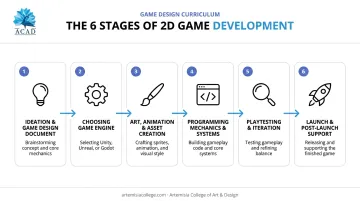
- Most games follow the same arc: ideation, engine choice, art, programming, testing, and launch
- Unity, Godot, GameMaker, and Construct 3 each suit different skill levels and project scopes
- Career roles span design, art, programming, and sound, each blending creative and technical skill
- Structured training, like Artemisia College's Game Design program, turns hobbyists into hired professionals faster
The Complete 2D Game Development Process: From Concept to Launch
Tools and team sizes vary, but most 2D games funnel through a similar production arc. GameMaker's official breakdown of the game development lifecycle names planning, pre-production, production, testing, pre-launch, launch, and post-launch as its core phases.
For clarity, this guide groups that arc into six practical stages worth understanding before writing a single line of code.
Stage 1: Ideation & Game Design Document
Every project starts with a core gameplay loop, meaning the small cycle of actions a player repeats: jump and dodge, match and clear, explore and collect. Developers pick a genre, whether platformer, puzzle, strategy, or visual novel, and draft a lightweight game design document (GDD) covering:
- The core mechanic and win/lose conditions
- Target audience and tone (playful, dark, satirical)
- Player goals and progression structure
- Rough scope: how many levels, characters, or hours of content
Keep the first GDD short. It should guide production, not become a novel nobody reads.
Stage 2: Choosing Your Game Engine
This decision shapes everything downstream. Consider:
- 2D-specific support — does the engine treat 2D as a first-class citizen or bolt it onto a 3D core?
- Scripting language — C# for Unity, GDScript for Godot, GML for GameMaker, event sheets for Construct 3
- Community and asset store — how easily can you find tutorials, plugins, and pre-built assets?
- Learning curve — some engines favour coders, others favour visual, no-code workflows
There's no universal "best" engine, only the one that fits your skills and project.
Stage 3: Art, Animation & Asset Creation
Production work begins here: sprites, tilesets, backgrounds, UI elements, and character animation cycles. Developers typically settle on one art style early, since switching mid-project is costly:
- Pixel art — retro, efficient, popular with solo developers
- Hand-drawn — distinctive but time-intensive
- Vector art — scales cleanly across screen resolutions
The art style should reinforce the game's tone, not just look nice in isolation.
Stage 4: Programming Mechanics & Systems
This is usually the most time-intensive stage. It covers player movement, collision detection, physics behaviour, scoring systems, save states, and menu navigation. Even a "simple" platformer needs careful tuning of jump height, gravity, and hit detection to feel responsive rather than sluggish.
Stage 5: Playtesting & Iteration
Real players expose problems developers can't see themselves. Common issues surface quickly during testing:
- Confusing controls that feel intuitive to the developer but not to newcomers
- Unbalanced difficulty spikes that frustrate rather than challenge
- Mechanics that seemed obvious on paper but don't translate in practice
Most successful indie titles go through multiple rounds of feedback-driven polish before reaching a final build. Skipping this stage is one of the most common reasons promising prototypes never ship as finished games.
Stage 6: Launch & Post-Launch Support
Publishing options include Steam, itch.io, and mobile app stores, each with different submission requirements and revenue splits. Launch day isn't the finish line. Post-launch patches, community engagement, and content updates often determine whether a title sustains player interest or fades within weeks of release.
Formal training compresses this learning curve. Artemisia College's Game Design programme guides students through all six stages hands-on, pairing classroom prototypes with placement support at studios such as Ubisoft, Electronic Arts, and Lakshya Digital.
Essential Skills & Career Roles in 2D Game Development
Solo hobby projects can be a one-person show. Professional 2D game development almost never is. Understanding the roles on a typical team helps aspiring developers pick a specialisation rather than trying to master everything at once.
Core Skills Every 2D Game Developer Should Build
- Visual design and composition — understanding colour, silhouette, and readability at small sprite sizes
- Animation principles — frame-by-frame or skeletal rigging (tools like Spine), plus timing and weight
- Basic programming logic — variables, loops, conditionals, and event-driven thinking
- Game design theory — pacing, difficulty curves, and player psychology
Key Career Roles on a 2D Development Team
| Role | Focus |
|---|---|
| Game Designer | Mechanics, level structure, pacing, and player experience |
| 2D Artist/Animator | Sprites, tilesets, character animation, and visual style |
| Programmer | Movement, physics, systems, and technical implementation |
| Sound Designer | Music, sound effects, and audio feedback |
These roles don't operate in isolation. A designer's level layout shapes what the artist draws, and that sprite sheet then determines what the programmer animates.
Those event triggers, in turn, decide when the sound designer's effects play. Mobile and indie studios especially value artists and designers who can move fluidly across these disciplines instead of staying siloed in one lane.
How Formal, Industry-Integrated Training Accelerates This Career Path
Self-teaching works, but it's slow. Structured mentorship, portfolio-building, and direct studio exposure shorten the gap between "I can build a game" and "I have a job building games."
Artemisia College's Game Design program is one example of this integrated approach. Instead of leaving portfolio preparation to chance, the college runs a dedicated Placement Cell that supports:
- Portfolio finalisation and CV creation
- Mock interviews and one-on-one mentoring
- Direct coordination with hiring studios, including Ubisoft, Krafton, Zynga, Electronic Arts, and Rockstar Games
This structured pathway matters most for students breaking into an industry where hiring managers often weigh a strong portfolio above formal credentials alone.
Best Engines & Tools for 2D Game Development
Game Engines to Consider
| Engine | Scripting | Best suited for |
|---|---|---|
| Unity (2D mode) | C# | Developers wanting cross-platform reach and a large asset store |
| Godot | GDScript (beginner-friendly) | Budget-conscious developers wanting a dedicated, open-source 2D workflow |
| GameMaker | GML (visual blocks or code) | Beginners through professionals; strong 2D-specific tooling |
| Construct 3 | Event sheets, optional JavaScript/TypeScript | Non-coders who want a visual, no-code start |
Pricing breaks down as follows:
- Godot: engine and licence are free and open source, with no revenue-based restrictions
- Unity Personal: remains free below a revenue threshold
- GameMaker: offers a free non-commercial tier plus a one-time paid commercial licence
- Construct 3: runs on a free edition plus paid subscription tiers for larger projects
Art, Animation & Audio Tools
Common software choices, split by budget:
- Adobe Photoshop: industry-standard for concept art and sprite work (paid subscription)
- Aseprite: purpose-built pixel art and animation tool (one-time paid licence)
- Spine: skeletal animation for smoother character movement (free trial, paid tiers for full features)
- Krita: free, open-source painting software, solid for concept art
- Audacity: free, open-source audio editor for sound effects and music cleanup
Beginners on a tight budget can build an entire toolchain using Godot, Krita, and Audacity without spending anything on software licences.
2D vs 3D Game Development: Which Should You Choose?
The core difference comes down to how movement and space work:
- 2D relies on sprite-based movement along the X-Y axis, requiring lighter art pipelines and smaller teams
- 3D requires polygon modelling, rigging, lighting, and larger, more specialised teams
Genre tendencies follow from there: platformers, puzzles, strategy games, and visual novels lean naturally toward 2D. Open-world exploration, first-person shooters, and simulations tend to demand 3D's spatial depth. These are tendencies, not hard rules; plenty of successful games break the pattern in both directions.
Choose based on your target audience, available budget and timeline, and the core gameplay concept itself, not because 3D "feels" more impressive. A tightly designed 2D puzzle game will outperform a clumsy 3D project every time.
Cost & Timeline: What to Expect When Building a 2D Game
Costs vary enormously depending on team size, scope, and whether assets are outsourced, self-made, or bought from an asset store. There's no single "average" figure that applies across projects, but the main cost drivers are consistent:
- Art and animation is typically the largest variable cost, especially when outsourcing sprite work or animation
- Programming stays an internal cost if you're self-taught, or becomes a contractor fee once you bring in outside help
- Licensing and platform fees: Steam charges a flat $100 per submitted product through Steam Direct, billed in US dollars regardless of where you're based
- Sound design ranges from free stock libraries to commissioned original scores
- Marketing and publishing get underestimated most often, yet they're critical for visibility after launch
Realistic Timelines, Based on Real Projects
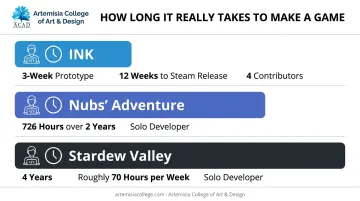
Published postmortems show just how wide the range really is:
| Project | Prototype phase | Time to release | Team |
|---|---|---|---|
| INK | 3 weeks | 12 weeks total, concept to Steam | 4 contributors |
| Nubs' Adventure | Not specified | 726 hours over 2 years | Solo developer |
| Stardew Valley | Not specified | 4 years, roughly 70 hours/week | Solo developer |
The takeaway from INK's postmortem and similar case studies: a quick prototype tells you almost nothing about final release timing. Content volume, iteration rounds, and team bandwidth dominate the schedule far more than initial planning estimates. Simple prototypes can come together in weeks. Polished, commercially released 2D titles typically take several months to well over a year.
About Artemisia College of Art & Design
Getting through all six stages once teaches more than reading about them ten times. Artemisia College of Art & Design runs under Tryambakam Education Foundation, built around one idea: strong fundamentals make a designer, software familiarity makes a computer operator. Around 90% of its faculty come from the animation, game, interior and fashion industries. Students join ACAD Studios, the college's own production house, as paid interns from the fourth semester, so they graduate with credits on work that actually shipped.
Game design runs at two levels: the Certificate in Game Design and the four-year B.Design in Game Design, taught in Unreal Engine under the college's Unreal Engine Academic Partner recognition. The college also awards B.Design degrees in Animation, Interior Design and Fashion Design, BFA and MFA routes in Painting and Sculpture, and a Certificate in Photography.
The college keeps tuition low and offers scholarships to bright and needy students. The current fee structure is published online, and early admission lets you apply on a portfolio and interview instead of an entrance test.
Frequently Asked Questions
How are 2D games developed?
Most 2D games follow six stages, from ideation and engine selection to art creation, programming, playtesting, and launch with post-launch support. See the process breakdown above for details on each stage.
How much does it cost to develop a 2D game?
Costs range from near-free solo projects using open-source tools to large budgets for polished commercial releases with outsourced art. Team size, art complexity, and platform fees (like Steam's $100 charge) drive most of the difference.
What skills do I need to become a 2D game developer?
Core skills include visual design, basic programming logic, animation fundamentals, and an understanding of game design theory and player psychology. Most professionals specialise in one area while staying conversant in the rest.
Which game engine is best for 2D game development beginners?
GameMaker and Godot suit beginners best, thanks to gentler learning curves and dedicated 2D tooling. Unity works well too, but its 2D-in-3D workflow feels more complex for beginners.
How long does it take to make a 2D game?
Quick prototypes can be built in a few weeks. Fully polished, commercially released titles generally take several months to over a year, depending on scope, team size, and testing rounds.
Is 2D game development a good career choice in India?
Demand for mobile and indie 2D games continues to grow globally, and India's game development sector is expanding with it. Industry-integrated programs like Artemisia College's Game Design course help students build job-ready portfolios and connect with hiring studios.