Introduction
Ask a Class 12 student whether they're "arts" or "science," and most will pick one without hesitation. That binary choice has shaped Indian education for decades. It's also increasingly out of touch with how creative industries actually work.
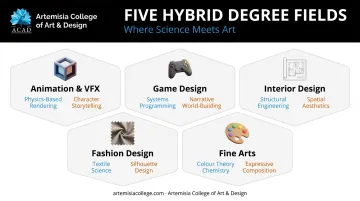
Fields like Animation & VFX, Game Design, Interior Design, Fashion Design, and Fine Arts aren't purely creative pursuits anymore. They're hybrid disciplines that demand technical fluency:
- A 3D animator needs physics-based rendering knowledge
- An interior designer needs to understand structural loads and lighting calculations
- A fashion designer works with fibre chemistry as much as sketching
This blog breaks down what "art and science courses" actually mean, which degrees combine both worlds, and how to pick the right one for your strengths.
Key Takeaways
- Art and science aren't opposites—most creative careers need both skills
- Animation, Game Design, and Interior Design merge science with art
- A BA is a humanities degree, yet arts careers now use scientific methods
- Match your strengths to a curriculum's technical-creative balance
Understanding Art and Science Courses: Where Creativity Meets Technical Skill
"Art and science courses" describes academic programs where creative work is built on scientific, mathematical, or technological foundations. Think of a game designer writing gameplay logic, or a fashion technologist testing fabric tensile strength before draping a garment.
This isn't a new idea. Leonardo da Vinci moved fluidly between painting, anatomy, geometry, and mechanical invention between 1485 and 1490, sketching everything from the Vitruvian Man to flying machines and hydraulic devices.
His anatomical studies informed his portraits, and his engineering sketches used the same observational precision as his art. Art and science were never separate silos for him; they fed each other.
Modern education has caught up to this idea, formally merging creative and technical learning into single curricula rather than treating them as competing tracks.
What Is the "Science of Art" Called?
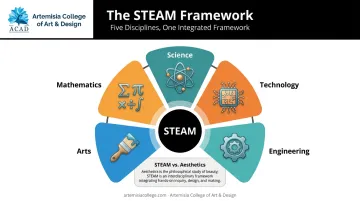
The umbrella term is STEAM — Science, Technology, Engineering, Arts, and Mathematics. The Rhode Island School of Design has championed this framework since 2010, adding art and design to the traditional STEM model to reflect how creative and technical education increasingly overlap.
STEAM differs from Aesthetics, which is the philosophical study of beauty and art itself, not a technical framework. In fields like Animation/VFX and Game Design, "science" shows up very literally: physics-based rendering, light-bounce calculations, and the programming logic behind every frame you see on screen.
Is a BA an Arts or a Science Degree?
This same blending of disciplines raises a related question: how do degree titles actually classify these programs? A Bachelor of Arts is classified under the humanities/arts stream. That holds true even when subjects within a BA, like psychology or economics, rely heavily on scientific research methods, statistics, and empirical testing.
This is exactly why many creative-technical fields have moved away from the BA label:
- Fashion technology programs are often offered as BSc degrees
- Animation and Game Design are increasingly structured as B.Des programs
- These formats signal technical rigor that a traditional BA classification doesn't fully capture
Top Degrees and Courses That Combine Art and Science
If you're wondering what degrees combine art and science in a career-oriented way, these five stand out.
Animation & VFX
Animation and VFX blend character design and storytelling with hard science, and a B.Design in Animation is the degree route into it. Rendering engines like Pixar's RenderMan use physically based lighting, ray-traced global illumination, and subsurface scattering to make a scene look real. Behind every convincing shadow or reflection sits a mathematical model of how light actually behaves.
Studios recruiting for this talent, including Rockstar Games, Electronic Arts, and Ubisoft, look for candidates who understand both artistic composition and the technical pipeline. Artemisia College's placement partnerships with these studios reflect the industry's emphasis on this dual skill set.
Game Design & Development
Game design pairs programming logic with visual storytelling. Engines like Unreal use a node-based scripting system called Blueprint, letting designers build gameplay mechanics without writing raw code, while still relying on C++ architecture underneath. Unity's physics system simulates gravity, collisions, and force, directly shaping how a character jumps or a car crashes on screen.
Character art and level design carry the creative weight. The engine mechanics carry the science.
Interior Design
Interior design merges spatial science with aesthetic judgment, which is what a B.Design in Interior Design is built to train. Industry accreditation standards require students to understand:
- Natural and artificial lighting, and how light affects colour perception
- Acoustics, thermal systems, and indoor air quality
- Structural systems, construction methods, and how to read building documents
- Human perception, ergonomics, and inclusive design principles
Colour theory and composition matter, but so does knowing whether a wall is load-bearing.
Fashion Design
Fashion design combines textile science with pattern-making and trend forecasting. A B.Design in Fashion Design works through garment construction and draping alongside textile study, so you learn fibre classification, yarn construction and fabric evaluation next to the silhouette work.
A designer sketching a silhouette also needs to know how a fabric will drape, stretch, or hold dye.
Fine Arts (Painting & Sculpture)
Fine arts looks purely creative from the outside, but material science runs through it, and that is the ground a BFA in Painting or a BFA in Sculpture covers. Conservation research from institutions like the Smithsonian catalogues how pigments, resins, and metals behave chemically over time. Colour itself is physics: an object's apparent colour depends on which light wavelengths its pigments absorb versus reflect.
Beyond creative-industry programs, other well-known hybrid degrees include architecture, psychology, and culinology, each requiring technical grounding beneath the creative or applied work.
Skills Required to Excel in Art-Science Hybrid Careers
Succeeding in these fields means building skills on both sides of the ledger.
Technical skills:
- Software proficiency (Maya, ZBrush, Substance Painter, Unreal Engine, Unity)
- 3D math and spatial reasoning
- Material or structural knowledge specific to your discipline
Creative skills:
- Sketching and visual storytelling
- Aesthetic judgment and composition
- Design thinking and concept development
These combined skills matter because the market is expanding fast. India's AVGC (Animation, Visual Effects, Gaming, Comics) sector currently employs roughly 1.85 lakh professionals directly. A Government of India task force report projects the sector will need to add close to 20 lakh jobs by 2030, opening a massive skills gap for professionals who can move fluidly between creative and technical work.
Adaptability matters as much as any single tool. Software changes fast; the artists who keep learning stay employable.
Career Scope and Industry Demand for Art-Science Graduates
India's creative-tech industries are growing, though not uniformly. Animation, VFX, and post-production together generated ₹10,700 crore in 2024, with projections reaching ₹14,700 crore by 2027 at roughly 13% CAGR.
However, the animation and VFX segment saw a 9.4% year-on-year decline in 2024, tied to global demand weakness. Growth isn't guaranteed everywhere, but the medium-term trajectory is upward.
Gaming tells a stronger short-term story. According to an IBEF industry report, India's online gaming market hit US$3.8 billion in FY24, up 23% year-on-year, with forecasts above US$9.2 billion by FY29.
This growth is creating new job titles that didn't exist a decade ago:
- Technical Artist: bridges artists and programmers, making sure complex art functions within a game engine
- Gameplay Designer: shapes mechanics, rules, and player experience
- Design Technologist: turns abstract design concepts into testable, interactive prototypes
Landing one of these emerging roles takes more than a good portfolio and technical training. Artemisia College's dedicated Placement Cell works with students on interview preparation, company coordination, and offer evaluation. This support helps graduates translate classroom skills into roles at studios and design firms across the country.
How to Choose the Right Art and Science Course for You
Start with an honest self-assessment.
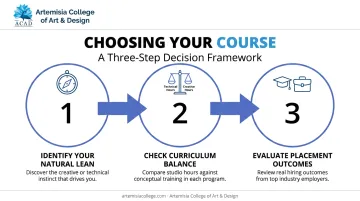
- Identify your natural lean: Are you drawn to problem-solving and logic, or do you gravitate toward visual expression first? Most hybrid careers need both, but knowing your starting point helps you pick a specialization.
- Check the curriculum balance: Look at how much time is spent on technical training (software, math, materials) versus creative studio work (portfolio projects, design critiques). A lopsided curriculum in either direction can leave gaps.
- Evaluate placement outcomes: A college's industry partnerships and placement record show how well its hybrid training converts into real jobs. Artemisia's students, for instance, have gone on to studios like Studio 56 and Electronic Arts through structured placement support.
Interest and aptitude should drive your decision more than which stream you sat in during Class 12.
About Artemisia College of Art & Design
Choosing between an art and a science route is easier with a clear view of what each programme contains. Artemisia College of Art & Design was set up under Tryambakam Education Foundation to make high quality art and design education affordable without thinning it out. Roughly 90% of the teaching staff come from working industry, bringing between five and thirty-five years of practice into the studio.
The college awards four-year B.Design degrees in Animation, Game Design, Interior Design and Fashion Design, BFA and MFA routes in Painting and Sculpture, and shorter certificate and diploma routes including the Certificate in 2D & 3D Animation, the Certificate in Game Design, the Certificate in Interior Design, the Certificate in Fashion Design and the Certificate in Photography.
Fees are deliberately low so cost is not what decides whether a creative student can study, and scholarships are available. Have a look at the fee structure, or go through early admission if a portfolio suits you better than an entrance test.
Where Artemisia College Fits In
Every discipline above sits inside what Artemisia College of Art & Design (ACAD) actually teaches. The degree routes are the B.Design in Animation, B.Design in Game Design, B.Design in Interior Design, B.Design in Fashion Design, and the BFA in Painting and BFA in Sculpture for fine arts, with certificate and diploma routes alongside them.
What makes the technical half of these careers stick is practice rather than theory. Around 90% of ACAD's faculty come from working studios with 5 to 35 years behind them, the campus stays open from 8 AM to 11 PM including Sundays, and from the fourth semester students take paid production work at ACAD Studios, so the portfolio you leave with already contains credited work. If you are weighing the cost, the fee structure is published, and early admission is open for the coming term.
If you are still deciding which side of the art-science line suits you, that is worth a conversation rather than a guess. Reach out to an ACAD counsellor and talk through where your aptitude actually points.
Frequently Asked Questions
What degrees combine art and science?
Animation & VFX, Game Design, Interior Design, Fashion Design, and Architecture all combine technical and creative skills. Each requires both software or scientific knowledge and strong artistic judgment.
Is BA art or science?
A BA is classified as an arts/humanities degree. Some BA subjects, like psychology or economics, use scientific research methods, but the degree itself remains under the arts stream.
What is the science of art called?
The broad framework is called STEAM (Science, Technology, Engineering, Arts, Mathematics). Aesthetics refers specifically to the philosophical study of beauty and art, which is different from STEAM's practical, skills-based approach.
Which is better for creative careers: the arts or science stream in school?
Most creative-technical degrees accept students from either stream. Interest and aptitude for the specific field matter far more than which stream you chose in Class 11 or 12.
Can science students pursue art and design courses after 12th?
Yes. Science students regularly join design, animation, and fine arts programs, and their analytical background often becomes an advantage in technical-creative coursework.
What skills are needed for art and science hybrid careers?
You need technical skills like software proficiency and material or structural knowledge, alongside creative skills like sketching and aesthetic judgment. Adaptability to new tools matters just as much as either skill set alone.