Introduction
India's residential renovation boom, commercial fit-outs, and expanding urban real estate are creating steady demand for trained interior designers. Many students want to enter this field but can't relocate to Mumbai, Bangalore, or Delhi for a full-time design school.
That's where online learning comes in, and it's growing fast. But here's the confusion: should you pick a certificate, a diploma, or a full degree? Does an online course actually carry weight with hiring managers?
This guide breaks down course types, fee ranges, top institutes for 2026, and realistic career scope. We'll also compare these against campus-based, industry-integrated programs, like the one at Artemisia College, for students who prioritize hands-on studio training and direct placement support.
Key Takeaways
- Residential, retail, and hospitality projects are driving steady demand for trained designers
- Online formats span 3-month certificates to multi-year diploma and degree programmes
- Portfolio quality and software skills matter more for hiring than the certificate label alone
- Blended programmes combining online theory with studio practice and placement support outpace self-paced courses
Why Online Interior Design Courses Are Gaining Popularity in India (2026)
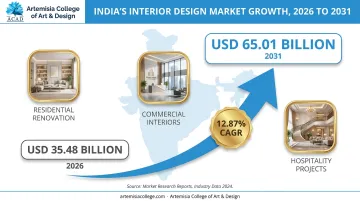
India's interior design market is valued at USD 35.48 billion in 2026 and is projected to reach USD 65.01 billion by 2031, growing at a 12.87% CAGR, according to Mordor Intelligence's India Interior Design Market report. That growth spans residential renovation, commercial interiors, and hospitality projects across every major Indian region.
More opportunity means more people want in, and online learning is the entry point for many of them.
Access Without Relocation
Students in tier-2 and tier-3 cities, think Nagpur or Coimbatore, no longer need to move to a metro hub for quality design education.
India now has over 1,100 ODL (Open and Distance Learning) programmes and 544 fully online programmes, reaching more than 19 lakh students nationally, per a 2025 Hindustan Times analysis of online education access. That same report notes learners in smaller towns often deal with unstable networks and shared devices, making downloadable material and recorded sessions more valuable than live-only formats.
Cost and Flexibility Advantages
Online and blended formats typically cost less than full-time on-campus design schools, and they let working professionals study around a job. Key advantages:
- Self-paced modules fit around existing work schedules
- Lower overhead (no hostel, no relocation) reduces total cost
- Live instructor-led sessions on AutoCAD, SketchUp, and 3ds Max replicate classroom learning remotely
- Cloud-based design critiques let mentors review work without a physical studio visit
The Hybrid Shift
Pure online learning has one gap: it struggles to replicate studio crit culture, the back-and-forth feedback that sharpens design judgment. That's pushing institutes toward hybrid models, where online theory pairs with in-person studio weeks or internships.
AI tools for moodboards and rapid layout drafts are also entering 2026 curricula, but as a productivity add-on. They speed up drafting; they don't replace design judgment.
Types of Online Interior Design Courses in India
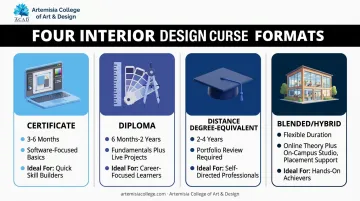
Course labels aren't standardised by any single rule, so it helps to think in terms of depth and outcome rather than duration alone.
Online Certificate Courses (3–6 Months)
These are beginner-friendly and software-focused. AND Academy's certificate, for example, runs six months with 110+ hours of part-time online instruction. They suit:
- Hobbyists exploring the field before committing
- Career switchers testing interest before a bigger investment
- Anyone wanting quick software exposure (AutoCAD, SketchUp basics)
Online Diploma Programs (6 Months–2 Years)
Diplomas go deeper: design fundamentals, materials, space planning, and layered software training. Is a one-year diploma worth it for job readiness? It depends entirely on what's inside it.
A diploma pays off if it includes live projects, portfolio output, and multiple software tools beyond the basics. Without those, you'll likely need additional upskilling before landing a design role.
Online/Distance Degree Programs (B.Des/BA Equivalent)
Several open universities offer distance diplomas. YCMOU's one-year ODL Diploma in Interior Design and Decoration is one current example. However, no verified UGC-DEB-approved distance bachelor's degree specifically in interior design currently exists in India. If a provider claims a distance B.Des equivalent, ask for the exact DEB approval document before enrolling.
Blended/Hybrid Learning Programs
This model pairs online lectures with on-campus studio time, practical labs, or placement weeks. It's increasingly the structure used by industry-integrated colleges, including Artemisia College, because it balances scheduling flexibility with the hands-on training and crit feedback that pure e-learning tends to miss.
Top Online Interior Design Courses & Institutes in India for 2026
| Provider | Format | Duration | Best For |
|---|---|---|---|
| YCMOU (Yashwantrao Chavan Maharashtra Open University) | ODL diploma with study-centre support | 1 year | 10th-pass students wanting a low-cost university-affiliated diploma |
| AND Academy | Private online certificate/diploma | 6 months–1 year | Beginners wanting quick software-focused training |
| AAFT Online | Live-online diploma | 1 year | Learners wanting scheduled live classes over self-paced content |
| Artemisia College of Art & Design | Blended (campus + industry-integrated placement support) | 1-year Certificate / 2-year Diploma | Students wanting structured, hands-on training with placement backup |
How to Vet a Course Before Enrolling
Run any shortlisted programme through this checklist:
- Accreditation status - confirm whether the awarding body has valid UGC-DEB recognition, and don't take marketing claims at face value
- Depth of software training - check which tools are taught (AutoCAD, SketchUp, 3ds Max, Photoshop) and whether training goes beyond basic tutorials
- Portfolio output - ask what you'll actually have to show employers by the end
- Placement support - find out if there's a dedicated placement cell, or just a generic "career services" page
Artemisia College's Industry-Integrated Approach
One programme from the table above that holds up well against this checklist is Artemisia College's blended track, which pairs campus training with structured placement support.
The programme runs as a Certificate (1 year) followed by a Diploma (2 years):
- Certificate year - builds foundational skills in AutoCAD, SketchUp, colour theory, and spatial understanding
- Diploma years - adds 3ds Max for 3D modelling and Photoshop for presentation rendering, applied to residential and commercial studio projects
Its Placement Cell works with design-facing brands including HomeLane, Livspace, Godrej Interiors, Urban Ladder Interiors, Bonito Designs, and Pepperfry Studio. Director Nishant Goel focuses on connecting students directly with these companies, guiding them from academic training into professional roles rather than leaving graduates to job-hunt alone.
Fees, Duration & Eligibility for Online Interior Design Courses
Fee structures vary sharply by format and provider. Here's what current pricing looks like:
| Format | Indicative Fee (2026) | Duration | Eligibility |
|---|---|---|---|
| YCMOU ODL Diploma | ₹15,018 total (university + study-centre fee) | 1 year | 10th pass |
| Private online certificate (e.g., AND Academy) | Starting around ₹73,500 + taxes | 6 months | 10+2 pass, basic digital literacy |
| Private online diploma (e.g., AAFT) | Varies by intake; check live pricing | 1 year | Interest in design, basic communication skills |
| Distance/degree-equivalent programmes | No verified national fee range exists | 2–4 years | Varies; portfolio or entrance review may apply |
City-specific note: Search queries like "interior design course fees in Delhi" often return figures that mix online and on-campus pricing. Quoted amounts can also shift between a provider's blog post and its live enrolment page. Always get a written quote for the current session rather than relying on older articles.
Eligibility snapshot:
- Certificate/diploma courses: usually open to 10+2 pass students
- Distance degree-equivalent programmes: may require a portfolio review or entrance assessment
- Blended or hybrid programmes: typically require the Certificate level first, or equivalent foundational skills
Career Scope, Placements & Salary After an Online Interior Design Course
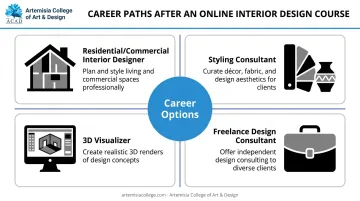
Trained interior designers in India move into several career paths:
- Residential/commercial interior designer - working directly on client spaces
- Styling consultant - focused on decor, furnishing, and finishing touches
- 3D visualizer - producing renders for design firms or real estate developers
- Freelance design consultant - taking on independent projects via referrals or platforms
Realistic Salary Expectations
Junior interior designers in India earn roughly ₹1.2 to ₹4.5 lakh annually, based on 716 recent salary submissions tracked by AmbitionBox's junior interior designer salary data. This is a self-reported market range, not a guaranteed placement outcome, and it varies by city, employer, and experience.
Why Portfolio and Placement Support Matter More Than the Certificate
A course label won't get you hired. What matters is what you can show and who helps you get in front of employers. This is where a well-supported programme earns its fees. A strong placement cell typically assists with:
- Interview preparation and mock sessions
- CV and portfolio finalisation
- Offer evaluation support
- Direct coordination with hiring companies
The Freelance Route
Beyond full-time roles, platforms and studios like Livspace, HomeLane, and Urban Ladder Interiors run designer-partner networks where freelancers take on projects with flexible hours and commission-based earnings. It's a growing option for graduates who want independence over a fixed employer, though it demands stronger self-marketing and client management skills than a salaried role.
About Artemisia College of Art & Design
Online study suits some students, but studio time is still where the craft is built. Artemisia College of Art & Design is run under Tryambakam Education Foundation and was started to build a job-oriented degree college offering high quality art and design education at low cost. Around 90% of the faculty come from the animation, game, interior design and fashion industries, with five to thirty-five years of experience behind them.
Interior design runs at three levels: the Certificate in Interior Design, the Diploma in Interior Design and the four-year B.Design in Interior Design. The college also awards B.Design degrees in Animation, Game Design and Fashion Design, BFA and MFA routes in Painting and Sculpture, and a Certificate in Photography.
Tuition is kept low compared with similar programmes elsewhere and scholarships are offered to bright and needy students. You can check the current fee structure or apply through early admission if you would rather submit a portfolio than sit an entrance test.
Frequently Asked Questions
Which course is best for interior design?
The "best" course depends on your goal. A diploma suits fast entry into junior roles, while a longer programme builds deeper portfolio strength. Evaluate curriculum depth and placement support before choosing, not just the credential name.
Is a 1-year diploma in interior design worth it?
Yes, if it includes software training, live projects, and portfolio output. Without those elements, you'll likely need extra upskilling before qualifying for senior design roles.
What are the fees for interior design courses in Delhi?
Fees vary widely by format, from short certificates to full degrees, and by institution. Always check the official fee page for current rates rather than relying on older blog figures.
Are online interior design courses recognized by employers in India?
Recognition depends more on the institute's accreditation and curriculum rigour than on the delivery format itself. A strong portfolio backed by a credible institute matters more than the "online" label.
Can I become an interior designer through an online course only?
A purely online course can build foundational and software skills, but hands-on studio practice, internships, or blended learning improve job readiness for most students.
What is the duration of a typical online interior design course?
Options range from 3-month certificate courses to multi-year diploma or degree-equivalent programmes, depending on your career goals and how quickly you want to enter the workforce.