This is a common turning point. Many civil engineering students discover they're more excited by how a space feels than by how much load a beam can bear. But then comes the family conversation: "Just finish your degree. Maybe do an M.Tech."
That pressure to "use the engineering degree" often clashes with a genuine pull toward design and aesthetics. This article breaks down the overlapping skills, real benefits and challenges, the exact transition path, and what you can realistically expect to earn, so you can decide with facts, not just gut feeling.
Key Takeaways
- Civil engineers already understand structure, materials, and measurements—a real head start in design.
- The switch does require new training in aesthetics, design software, and client communication.
- India's growing home décor market creates steady demand for trained interior designers.
- Diploma programs with strong placement support can fast-track your entry into a paid design role.
Why Civil Engineers Are Drawn to Interior Design
Civil engineering teaches you to think in structures. Somewhere along the way, many students realise they care just as much about how people experience those structures.
This shift shows up often: encouraged to pursue an M.Tech or a PSU job, many engineers find themselves pulled instead toward spatial planning, furniture, and finishes.
The Technical Overlap Nobody Talks About
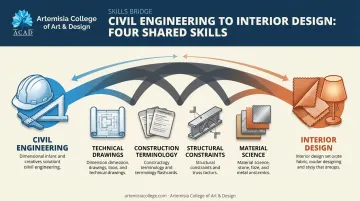
Interior designers still need to respect load-bearing walls, structural constraints, and material behaviour when planning a space. A civil engineer walks into this conversation already fluent in:
- Reading and creating technical drawings to scale
- Understanding construction terminology and site sequencing
- Knowing which walls can move and which can't
- Basic material science, from concrete to composite panels
A design student without a technical background has to learn all of this from scratch. You don't.
The Design-Build Advantage
Interdisciplinary "design-build" studios, where one team handles design, engineering, and execution under a single point of responsibility, are becoming more common in Indian commercial real estate. Firms increasingly value professionals who can bridge design sensibility with structural literacy rather than treating design and engineering as separate disciplines.
Social media portfolios, YouTube transition stories, and design-school open days have also normalised this pivot. What was once an unusual career choice is now a visible, well-documented one.
Is the Switch Actually Worth It? Weighing the Benefits
Civil engineering, for many, means compliance checklists, site inspections, and government tender documentation. Interior design offers something different: creative autonomy and direct client relationships. You're not just certifying that a structure meets code. You're shaping how someone lives in their own home.
There's also a market opportunity behind this. India's home décor sector was valued at ₹2,26,415 crore (roughly $25.50 billion) in 2024 and is projected to reach ₹3,62,263 crore by 2033, growing at a 5.40% CAGR, according to IBEF's 2025 industry analysis. Rising incomes, urbanisation, and e-commerce-driven furniture demand are the key drivers behind that growth.
Transferable Skills That Give Civil Engineers an Edge
Not every design graduate walks in with these strengths on day one:
- Spatial measurement accuracy – you already read floor plans without a second thought
- Structural safety awareness – you know instinctively what's feasible versus what looks good on paper but fails in reality
- Vendor and contractor coordination – site experience translates directly to managing execution teams
- Project timeline management – Gantt charts and schedules aren't new to you
This technical grounding often means civil-engineering-background designers move into project-management-heavy or senior design roles faster than design-only graduates, who typically need years of site exposure to build the same confidence.
Beyond that speed advantage, interior design offers more flexibility: freelancing, running your own studio, or joining a design-build firm are all viable paths. Civil engineering, by contrast, often channels people toward more rigid corporate or government career tracks.
Challenges and Realities to Consider Before Switching
Let's be honest about what you're walking into, because glossing over the hard parts does nobody any favours.
Soft skills are your biggest gap. Colour theory, mood-boarding, and understanding a client's emotional relationship with their space are areas most civil engineers have zero prior exposure to. This is core to the job, and it takes real practice to develop an eye for it.
Expect pushback. Family, peers, and even industry professionals may question the switch. "Just do an M.Tech instead" is a phrase many engineers-turned-designers have heard more than once. This resistance is common and rarely permanent once you show results.
There's also a financial trade-off:
- A formal diploma or design course requires tuition investment
- Entry-level design salaries can start on par with, or occasionally below, a settled civil engineering role
- Earnings grow meaningfully once you build a strong portfolio and specialise
The switch can still be worth it, provided you go in clear-eyed rather than starstruck.
How to Make the Transition: Courses and Career Path
The most direct route is a Diploma, B.Des, or PG Diploma in Interior Design. Many institutes accept graduates from any background, including civil engineering, without requiring you to restart your core education. Your degree becomes the foundation for this new specialisation.
How Long Does It Actually Take?
Course duration varies quite a bit:
- Certificate programs – a few months to a year, covering fundamentals like colour theory, materials, and basic software
- Diploma programs – typically one to two years, adding advanced studio work across residential, commercial, and hospitality spaces
- Degree programs (B.Des) – three to four years for a comprehensive, in-depth qualification
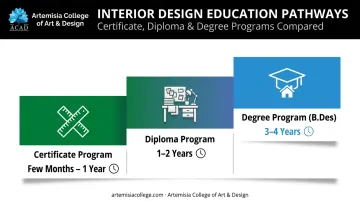
Given your technical foundation, some institutes offer accelerated or lateral-entry tracks for civil engineering graduates. Confirm the specifics directly with each college, since policies vary.
The Software Learning Curve
You already know AutoCAD, so that's one less thing to learn. What's new:
- SketchUp for 3D spatial visualisation
- 3DS MAX for advanced rendering across residential and commercial projects
- Photoshop for presentation graphics and finish detailing
- Mood-boarding and material selection, which are more about visual instinct than software mastery
At Artemisia College of Art & Design, the Interior Design curriculum builds this progressively. It starts with AutoCAD and SketchUp at the certificate level, then expands into 3DS MAX and Photoshop as students move into diploma-level studio work.
For someone coming from civil engineering, this structure means layering design skills onto what you already know instead of relearning the basics.
Classroom learning only gets you halfway. Portfolio-building, live client projects, and mentorship are what actually convert a civil engineer into a hireable interior designer.
This is where Artemisia's dedicated Placement Cell becomes relevant. It guides students through portfolio finalisation and mock interviews, then connects them with design studios and companies, easing the jump from student to working professional.
Career Prospects and Earning Potential After the Switch
Here's where numbers matter more than opinions.
According to AmbitionBox's 2025 salary data, entry-level interior designers with one year of experience earn roughly ₹1.0–4.8 lakh annually, compared to ₹1.2–4.9 lakh for civil engineers at the same experience level. The ranges overlap substantially, so a pay cut isn't guaranteed.
| Experience | Interior Designer | Civil Engineer |
|---|---|---|
| 1 year | ₹1.0–4.8L | ₹1.2–4.9L |
| 3 years | ₹1.8–6.3L | ₹1.9–6.0L |
| 5 years | ₹2.0–8.3L | ₹2.4–7.5L |
| 9 years | ₹2.0–18.0L | ₹3.3–12.0L |
Notice how the interior design range widens considerably at senior levels. That upper band typically belongs to designers running their own studios or leading commercial projects.
Where can you actually work?
- Design studios and boutique firms
- Real estate developers building residential and commercial projects
- Modular furniture and home renovation companies
- Design-build firms that value your engineering background specifically
Artemisia College's placement cell, for instance, connects graduates directly with firms like HomeLane, Livspace, Urban Ladder Interiors, and Godrej Interiors—covering every category above before graduation.

With experience, many civil-engineering-turned-designers move into project management, open their own studio, or specialise in commercial interior design, where structural literacy becomes a genuine differentiator rather than a side note on your résumé.
About Artemisia College of Art & Design
Switching across from engineering is mostly about picking up the visual and material side. Artemisia College of Art & Design is run under Tryambakam Education Foundation and was started to build a job-oriented degree college offering high quality art and design education at low cost. Around 90% of the faculty come from the animation, game, interior design and fashion industries, with five to thirty-five years of experience behind them.
Interior design runs at three levels: the Certificate in Interior Design, the Diploma in Interior Design and the four-year B.Design in Interior Design. The college also awards B.Design degrees in Animation, Game Design and Fashion Design, BFA and MFA routes in Painting and Sculpture, and a Certificate in Photography.
Tuition is kept low compared with similar programmes elsewhere and scholarships are offered to bright and needy students. You can check the current fee structure or apply through early admission if you would rather submit a portfolio than sit an entrance test.
Frequently Asked Questions
Can a civil engineer become an interior designer?
Yes. Civil engineers can transition with additional design training. Their technical background is often seen as an advantage rather than a barrier, particularly for site-heavy or structurally complex projects.
Do I need to start my education from scratch to switch to interior design?
No. A civil engineering degree isn't wasted. A diploma or PG program builds on your existing technical knowledge rather than replacing it entirely.
How long does it take to become job-ready as an interior designer after a civil engineering degree?
Timelines range from a few months for a certificate course to one to two years for a diploma or degree, depending on how deep you want to specialise.
Is a professional licence required to practice interior design in India?
No. Unlike architecture, which is regulated under the Architects Act, 1972, interior design in India has no mandatory government licensing requirement, making entry more accessible.
Which civil engineering skills are most valuable in interior design work?
Measurement accuracy and material knowledge transfer directly into design work, and site coordination experience adds another edge. These skills let you manage execution with far more confidence than a design-only graduate typically has early on.
Is interior design a financially rewarding career compared to civil engineering?
Starting salaries may be modest, but experienced designers with strong portfolios and specialisations can match or exceed civil engineering earnings over time, especially in senior or studio-ownership roles.