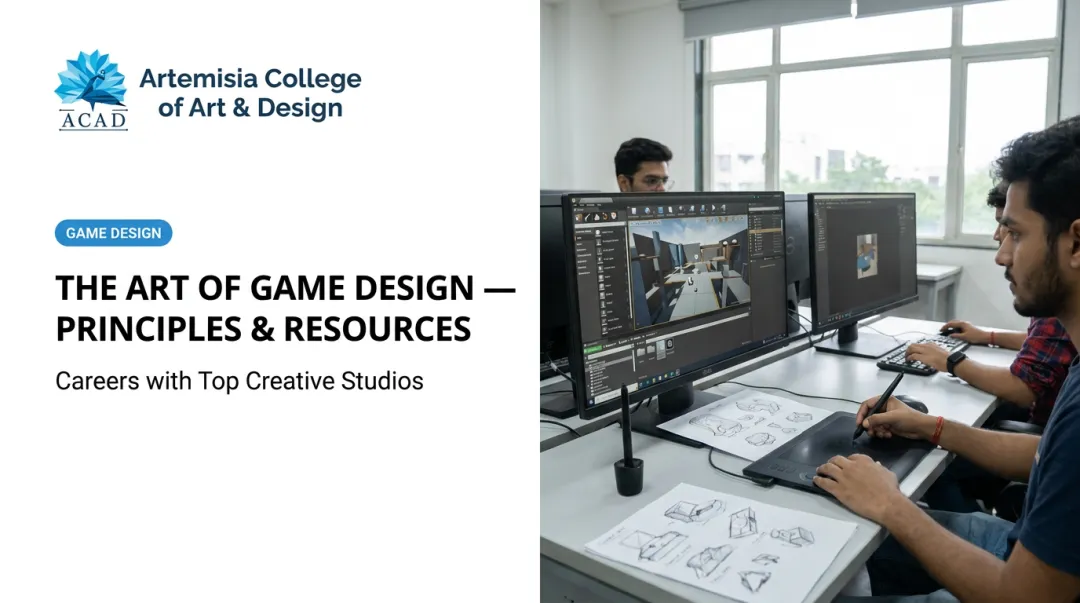

The competition is real. A GDC 2026 industry survey found that 74% of surveyed students are worried about game-industry job prospects, citing scarce entry-level roles and competition from laid-off veterans.
This guide walks through 35 real interview questions across creative, technical, narrative, and behavioural categories. Each one comes with guidance for building a strong example answer. We'll also cover how to prepare and answer common questions like "what are the 3 C's of game design?"
Key Takeaways
- Interviews test creativity, technical feasibility, narrative fit, and collaboration
- Strong answers pair a clear framework with one specific project example
- Portfolio readiness, mock interviews, and studio research matter more than raw talent alone
- A dedicated placement cell's structured mentoring sharpens interview performance for design graduates
How to Prepare for a Game Design Interview
Preparation separates candidates who freeze up from candidates who land offers. Focus your energy on these three areas before you walk into any studio interview:
- Research the studio's catalogue. Don't just say you admire their games, explain specifically why. If you're interviewing at a studio known for tight combat systems, be ready to discuss what makes their combat feel distinct from competitors.
- Build a portfolio that shows process, not just polish. Interviewers want to see sketches, failed prototypes, and iteration notes alongside finished work. A finished level shows what you built; process notes reveal how you think.
- Practise explaining your decisions out loud. Trade-offs, constraints, and dead ends all count. Reasoning matters as much as the final result.
Structured support helps here. At Artemisia College, the Placement Cell works with game design students on portfolio finalisation, mock interview sessions, and one-on-one mentoring before they sit in front of real studio panels. Students who complete this process have gone on to land roles at studios like Electronic Arts and Zynga.

Finally, prepare 2-3 sharp questions of your own:
- Ask a producer about current team priorities and roadmap pressures
- Question a fellow designer on how much creative ownership individual contributors get
- Find out how the team handles disagreement during production
Creative & Conceptual Design Questions
Walk us through your process of conceptualising a new game idea from scratch.
Start with brainstorming and a core theme, then move to early sketches, and finish with a stakeholder pitch. Example: "I began with a one-line concept, sketched three core mechanics on paper, tested the weakest one in a rough prototype, then pitched the refined version to my team with a single-page design doc."
How do you build a game's core loop to keep players engaged over time?
According to Game Developer, the core gameplay loop is the primary system defining a title, the foundation the rest of the game builds around. Reference a specific action-reward-progression loop you built, then explain how playtesting data confirmed players stayed engaged past the first few sessions.
What is your approach to prototyping a new game mechanic?
Favour rapid, low-fidelity prototypes over polish. Cardboard, paper, or grey-box builds test feasibility fast. Example: "I built a paper prototype in an afternoon to test a resource-trading mechanic before writing a single line of code, which saved weeks of wasted engineering time."
How do you decide which features to prioritise during a development cycle?
Reference a framework like MoSCoW, where features get sorted into Must Have, Should Have, Could Have, and Won't Have this time. Describe a real trade-off: "We moved a co-op mode from Should to Won't this time when playtesting showed the single-player loop needed more work first."
Describe your creative process from brainstorming to a finished pitch.
Show distinct stages: research, ideation, iteration, and buy-in. Example: "I researched five comparable titles, ran two ideation sessions with the team, cut half the ideas after early feedback, then presented a refined pitch that leadership approved without major changes."
How do you ensure your designs are fun and accessible for both new and experienced players?
Cover scalable difficulty, layered tutorials, and options like remappable controls. Example: "I built a difficulty curve that adapts based on player death rate, paired with an opt-in tutorial that experienced players can skip entirely."
What do you think makes a great game?
Balance intuitive mechanics, pacing, replayability, and emotional impact. Name a specific title: "Celeste works because every mechanic is taught through level design itself, and the difficulty curve respects both new and expert players simultaneously."
How do you balance innovation with current market trends in your designs?
Show genre awareness while introducing one distinctive hook. Example: "I studied five competing roguelikes, kept the familiar run-based structure players expect, but introduced a shared-world persistence mechanic that no competitor offered."
How do you approach designing games differently for mobile, console, and PC platforms?
Address control schemes, screen size, and performance limits for each. Mobile demands touch-first controls and shorter sessions, exactly the kind of platform thinking Apple's own design guidelines stress for touch-first titles. Console needs controller-friendly UI at a distance. PC needs scalable graphics settings and keyboard-and-mouse precision built for that input method.

Technical, Mechanics & Systems Questions
How do you approach balancing game mechanics for both fairness and engagement?
Describe iterative playtesting and data analysis. Example: "We tracked win rates across 200 matches, spotted one weapon sitting at a 65% pick rate, then adjusted its cooldown until pick rate normalised across the roster."
Describe your process for designing a compelling multiplayer or competitive experience.
Touch on matchmaking fairness, reward structures, and maintaining fun without sacrificing competitiveness. Good matchmaking has to juggle low ping, similar skill, and short wait times simultaneously, and you rarely get all three at once. Example: "We capped skill-based matchmaking to a tighter rating range during peak hours, accepting slightly longer queues so lower-skill players stopped getting steamrolled by mismatched lobbies."
How do you optimise a design when there are constraints on processing power or memory?
Show awareness of trade-offs between visual fidelity and mechanic complexity. Example: "On a mobile title, I simplified a particle-heavy ability system into a cheaper shader-based effect that preserved the visual feedback players relied on without tanking frame rate."
What metrics or KPIs do you use to measure a game design's success?
Reference retention rate, session length, or engagement funnels. Example: "Day 7 retention dropped sharply after the second level, so we mapped the drop-off funnel, found a difficulty spike, and smoothed the curve, which recovered retention by a noticeable margin."
Explain how you ensure your game designs remain scalable and maintainable as scope grows.
Talk about modular systems and documentation. Example: "I built our ability system on reusable components rather than hard-coded logic, so adding a new character ability took hours instead of days."
Tell us about a time you had to quickly learn a new tool or engine for a project.
Name the specific technology and its impact. Example: "I had two weeks to learn Unreal Engine's Blueprint system for a jam project, and the visual scripting let our team ship a working prototype we wouldn't have finished in raw code."
How do you approach designing an onboarding tutorial that teaches without overwhelming players?
Use a "show, don't tell" approach that introduces mechanics gradually through gameplay. Example: "Instead of a text-heavy tutorial screen, we placed a locked door early on that forced players to discover the dash mechanic naturally, no pop-up required."
Describe the most technically complex system or mechanic you have designed.
Explain the complexity honestly, then how you broke it into pieces. Example: "A crafting system with over 40 interdependent recipes got unmanageable fast, so I split it into tiered categories and built a spreadsheet tool that let the whole team edit recipes without touching code."

How do you handle a critical design flaw discovered late in development?
Show prioritisation under pressure and clear communication. Example: "Two weeks before alpha, we found an exploit that broke our economy. I flagged it immediately, proposed three fixes ranked by implementation time, and the team shipped the fastest one within 48 hours."
Narrative & Player Experience Questions
How do you integrate narrative elements into gameplay mechanics rather than relying only on cutscenes?
Reference environmental storytelling or choices tied directly to mechanics. Example: "Instead of a cutscene revealing a character's backstory, we let players find it through scattered notes tied to optional side objectives."
Can you explain the three-act structure and how you would apply it to a game's design?
A three-act framework guides the player's individually linear experience even in nonlinear games. Map setup to the opening missions, confrontation to the mid-game escalation, and resolution to the final act's pacing and stakes.
How do you balance storytelling with player freedom in an open-world design?
Discuss branching techniques that preserve agency without fragmenting the core story. Far Cry 2 handled this by breaking content into small reusable pieces triggered by world state rather than one giant branching tree, keeping player freedom intact without exploding production scope.
Describe your process for creating character backstories that resonate with players.
Tie backstory directly to gameplay motivation. Example: "A character's fear of heights wasn't just flavour text, it justified a specific movement limitation that shaped how players approached vertical level sections."
How do you incorporate accessibility considerations into your game designs?
Reference colourblind modes, subtitles, and remapping. Best practice favours remapping entire actions rather than individual buttons, and enabling in-game controls independent of platform settings. Speaker names and directional indicators in subtitles also matter more than people assume.
What techniques do you use to put yourself in the player's shoes during design?
Draw on user research, direct playtest observation, and community feedback loops. Example: "I sit silently behind playtesters and take notes on where they hesitate, rather than asking leading questions that bias their behaviour."
How do you use player personas to guide your design decisions?
Show how 2-3 defined personas shaped specific choices. Example: "Our 'Casual Explorer' persona pushed us to add a fast-travel option that our 'Completionist' persona never used, because each persona revealed a genuinely different play pattern."

Name a favourite example of mission or level design from any game and explain why it works.
Pick something specific. Example: "The 'All Ghillied Up' mission in Call of Duty 4 works because pacing shifts from tense stealth to sudden chaos, teaching patience through mechanics rather than instructions."
Behavioural, Collaboration & Career Questions
Tell me about a time you disagreed with a lead designer. How was it resolved?
Show respectful disagreement backed by data or a prototype. Example: "I pushed back on a combat pacing change, built a quick prototype to test my alternative, and when the data was inconclusive, I disagreed and committed to the lead's call."
How do you handle receiving critical feedback on your designs?
Emphasise not taking it personally. Example: "Early feedback on a level layout stung, but I separated the critique of the work from myself and used it to rebuild the pacing entirely."
Describe a time you received conflicting feedback from playtesters. How did you resolve it?
Explain how data patterns resolved the conflict. Example: "Half the testers wanted a faster pace, half wanted slower. I checked completion times against enjoyment scores and found the majority pattern pointed toward moderate pacing, so that's what shipped."
Tell us about a time you had to collaborate closely with another department, such as art, engineering, or QA.
Highlight translating design intent into technical requirements. Example: "I worked with engineering to translate a 'weighty' combat feel into specific numbers, frame windows, hit-stop duration, camera shake intensity, rather than vague adjectives."
Tell me about a time you failed in a design role and what you learned.
Own the mistake honestly. Example: "I shipped a difficulty spike without enough playtesting and lost early players. Now I never sign off on a difficulty curve without at least three rounds of outside testing."
Why do you want to work at this studio specifically?
Reference specific shipped titles and cultural alignment. Example: "Your studio's approach to systemic narrative in your last release matches exactly how I want to design, world state driving story rather than scripted branches."
What games are you currently playing, and what do you admire about their design?
Name something relevant to the studio's genre. Example: "I've been playing Hades and admire how its narrative unfolds through repeated failure, turning a roguelike's core loop into storytelling fuel."
Describe a situation where you had to work within a tight budget or limited resources.
Demonstrate resourcefulness. Example: "With no budget for custom animations on a student project, I redesigned an enemy encounter around existing assets and repurposed timing instead. That constraint taught me more about design than any unlimited-budget project could."
Where do you see your growth as a game designer over the next few years?
Connect personal goals to the studio's opportunities. Example: "I want to grow from systems design into a lead role, and your studio's flat design structure gives me the mentorship path to get there."
What the Questions Are Really Testing
Read the list above and the pattern is clear: nearly every question asks you to justify a design decision and explain what you would change. That is difficult to rehearse and easy to answer if you have actually shipped something.
Artemisia College of Art & Design builds that evidence deliberately. Students produce physical games, a playable 2D game in Unity, 3D projects in Unreal, and a final-year capstone, with portfolio development taught as its own subject alongside game production and management.
The degree also carries elective specialisation tracks in both third and fourth year, so students can go deep in 3D modelling and texturing, 2D art and animation, AR/VR development, level design, sculpting, engine work or game design itself.
Conclusion
Prepare projects rather than answers. The best interview material is a game you can talk about honestly because you made every decision in it.
Artemisia College runs game design at two levels: the one-year Certificate in Game Design, which ends with a complete playable 3D game, and the four-year B.Design in Game Design & Development. Certificate entry is direct with 10+2 in any stream; the degree is through the ACAD Entrance Test or portfolio-based early admission.
Frequently Asked Questions
How do I prepare for a game design interview?
Finalise a portfolio that shows process, not just polish. Research the studio's catalogue deeply, and practise explaining your design decisions out loud, including the trade-offs behind them.
What are the 3 C's in game design?
Character, Controls, and Camera are the three foundational pillars for any game built around a playable character. Character and controls define how players act, while camera defines how that action is framed.
What skills do interviewers look for in a game designer?
Creative thinking, systems and technical understanding, clear communication, and genuine player empathy. Most studios weigh reasoning and process just as heavily as the polish of your final output.
How many rounds are typically in a game design interview process?
Most processes follow a recruiter screen, a design test or portfolio review, and one or more panel or technical rounds. Exact round counts vary widely by studio and seniority.
Do I need a portfolio for a game design interview?
Yes, a portfolio showing your design process, prototypes, and finished work is essential, not optional. Studios want evidence of how you think, not just what you shipped.
What is the difference between a game designer interview and a game developer interview?
Designer interviews focus on mechanics, narrative, and player experience reasoning. Developer interviews lean toward programming logic, engine-specific technical questions, and implementation detail rather than creative decision-making.