Introduction
Before a character gets a face, a costume, or a single frame of colour, its silhouette has already told your audience something. Walt Disney and Ub Iwerks proved this in the 1920s with Mickey Mouse, a character built almost entirely from circles that remains one of the most recognised silhouettes on the planet.
Yet many students entering animation, game design, and VFX programs skip straight to rendering, texture, and polish. They miss the foundational shape work that made Mickey's silhouette so effective in the first place.
This blog breaks down the psychology behind circles, squares, and triangles, then walks through real studio case studies from Pixar and Disney. You'll walk away with a practical framework you can start using in your next sketchbook session.
Key Takeaways
- Shape communicates personality faster than colour, texture, or facial detail ever can
- Circles, squares, and triangles each carry distinct, well-documented psychological associations
- Pairing a dominant shape with secondary shapes builds nuance without losing readability
- Silhouette testing and mentor feedback turn shape theory into a usable portfolio skill
What Is Shape Language in Character Design?
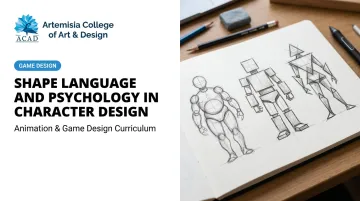
Shape language is the practice of using basic geometric forms to communicate a character's personality, emotional tone, and narrative role before any refinement gets added. It's the visual grammar that lets an audience "read" a character in a fraction of a second.
Psychologist Solomon Asch's landmark 1946 research on impression formation showed something relevant here: people build entire personality judgments off limited cues, and certain traits shape the whole impression far more than others.
Asch tested trait words rather than physical shapes, but his broader finding, that humans form fast, holistic judgments from minimal information, is exactly why character designers lean so heavily on visual shorthand.
Two terms matter most in this practice:
- Dominant shape – the primary geometric form that defines a character's overall build
- Silhouette – the character reduced to a flat black shape, used to test whether the design reads clearly without any internal detail
Professional designers run the silhouette test constantly. If a character's role, whether hero, villain, or comic sidekick, isn't obvious from the black shape alone, the design needs work.
Why Sharp Angles and Curves Read Differently
Research by Moshe Bar and Maital Neta, published in Psychological Science, found that people show a consistent preference for curved objects over sharply angled ones.
The researchers proposed that sharp contour transitions may trigger a subtle threat association in the brain, a bias rather than a fixed rule, but a compelling one for designers to exploit.
This isn't a niche animation trick. Disney, Pixar, and major AAA studios all treat shape as a foundational design layer, long before a character reaches full render.
The Psychology of Basic Shapes: Circle, Square, Triangle
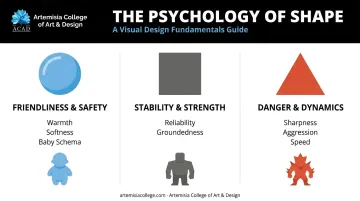
Most character designs anchor themselves to one of three foundational shapes. Each one triggers a distinct emotional read before a viewer processes anything else.
Circles: Friendliness, Softness, and Safety
Curved, angle-free forms signal warmth and approachability. That's why circles dominate children's media and mascot design.
- Mickey Mouse is built almost entirely from circles, from his head to his ears and body, according to Disney's own D23 archive.
- Baymax from Big Hero 6 pushed this further: Director Don Hall wanted an "appealing, huggable robot," inspiring an inflatable, non-threatening design.
Round shapes also borrow from what researchers call the baby schema, the large head and rounded proportions found in infant faces, which studies link to increased perceptions of cuteness and caretaking motivation. It's part of why round characters instinctively feel safe to hold, not just to look at.
Squares: Stability, Reliability, and Strength
Right angles and even proportions read as grounded and dependable. Squares show up constantly in protector, mentor, and warrior archetypes.
Pixar's Carl Fredricksen from Up is the textbook example. His head, torso, and even his hands were built on square geometry. Production designer Ricky Nierva described the actual challenge this created: giving "a square" human emotions that weren't themselves symbolically square. The shape gave Carl his stubborn, immovable presence before he ever spoke a line.
Square jaws and square torsos are a shortcut used across superhero and warrior design because they signal trustworthiness almost instantly.
Triangles: Dynamics, Danger, and Ambition
Pointed, unstable angles read as sharp, aggressive, or intensely dynamic. This makes triangles a natural fit for antagonists.
In Up, the hunting-dog pack led by Alpha, along with Charles Muntz himself, were built with angular, serious silhouettes to contrast Carl's boxy stability. Character supervisor Thomas Jordan noted the brief for Muntz specifically: a character who reads as a warm grandfather figure but can turn sinister in an instant, a shift the angular design helps sell visually.
Triangles aren't only for villains, though. Fast-moving heroes, tricksters, and sharp-witted characters use triangular accents to suggest intelligence or speed without tipping into menace.
Beyond the Basics: Shape Types and Iconic Studio Examples
The Types of Shapes Every Designer Should Know
Design education generally groups shapes into a few broad families:
- Geometric – precise, regular forms (circles, squares, triangles) that feel structured and intentional
- Organic – irregular, natural forms that soften a character's read and feel more lifelike
- Abstract – stylised or simplified forms that push a design toward surreal or symbolic territory
- Natural/free-form – shapes pulled directly from nature, often overlapping heavily with organic forms
Organic shapes soften a silhouette, which is why they're common in creature or fantasy design. Abstract shapes do the opposite: they strip a character down to something graphic and stylised, useful for logos, mascots, or highly stylised game art.
Case Studies: How Studios Apply Shape Psychology
These shape families move from theory to practice once a production team starts casting characters. Pixar's Up remains one of the clearest examples of deliberate shape casting in a single film:
- Carl – square, boxy, stubborn
- Russell – round, enthusiastic, almost egg-shaped
- Dug – round, happy, oversized nose
- Muntz and his hunting pack – angular, serious, threatening
This wasn't accidental. The production team built each character's shape to do narrative work before a single line of dialogue landed.
Mickey Mouse tells a similar story on a simpler scale. Disney's own design guides confirm his construction is built almost entirely from circles, a choice that helped his three-circle icon travel across cultures and generations without needing translation.
How to Apply Shape Language: A Practical Framework for Student Designers
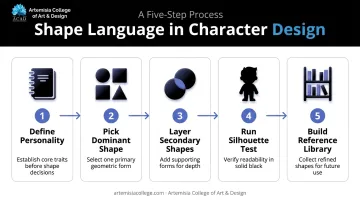
You don't need years of studio experience to start applying this. Follow these five steps in your next sketchbook session.
- Define personality before pencil. Write down the character's core traits and narrative role. Is this a protector, a trickster, a threat? Decide before you draw anything.
- Pick one dominant shape. Match it to the traits you listed, then build pure silhouettes using only that shape. No face, no costume detail, just the form.
- Layer in secondary shapes. A round-bodied character with a few sharp, triangular costume accents can read as "friendly but sharp-witted." This is where nuance lives.
- Run the silhouette test. Show peers or mentors the black silhouette only and ask them to guess the personality. If they get it wrong, the shape isn't doing its job yet.
- Build a reference library. Reverse-engineer the dominant shapes in films, games, and comics you admire. Pattern recognition here speeds up your own design instincts fast.
Professional designers repeat this same sequence on every new character brief, refining it with each project.
From Sketchbook to Studio: Building Your Character Design Career
Shape language fundamentals are often among the first things a studio art director checks when reviewing a portfolio. A beautifully rendered character with a weak silhouette gets noticed for the wrong reasons.
Structured, mentor-led training helps close that gap before students start job hunting. At Artemisia College, the Animation & VFX and Game Design programs pair guided assignments with critique sessions.
Students also get hands-on access to industry-standard tools like Unreal Engine, giving them room to practice fundamentals like shape and silhouette work before building a studio-ready portfolio.
Artemisia's placement cell carries that preparation forward:
- Portfolio finalisation and CV support
- Mock interviews and one-on-one mentoring
- Interview scheduling and professional communication guidance
This groundwork helps students present shape-driven character work with confidence to recruiters from studios such as Ubisoft, Krafton, and Electronic Arts. These studios are part of Artemisia's wider network of 100+ hiring partners across animation, gaming, and design.
Frequently Asked Questions
What is shape theory in character design?
Shape theory is the principle that geometric forms, such as circles, squares, and triangles, evoke specific emotional associations in viewers. Designers use it deliberately to communicate a character's personality before adding detail.
What is the shape language of Mickey Mouse?
Mickey Mouse is built almost entirely from circles: his head, ears, and body all trace back to the same rounded form. This construction helped his three-circle icon become instantly recognisable worldwide.
What are the four types of shapes?
Design education generally groups shapes into geometric, organic, abstract, and natural/free-form categories. Geometric forms feel structured, while organic and free-form shapes soften a character's read.
Do all animated characters have to follow a single dominant shape?
No. A dominant shape anchors a character's overall read, but designers regularly layer in secondary shapes for nuance. A round character with sharp accents can suggest complexity without losing clarity.
How does shape language affect character animation and movement?
Round characters tend to move smoothly and bouncily, square ones plant themselves with steady, deliberate weight, and triangular ones move sharply and quickly. Motion reinforces the personality the shape already suggests.
Can colour override the effect of shape language?
Colour adds emotional layering, but shape gets processed faster by the brain. In most designs, the silhouette creates the stronger first impression before colour has a chance to register.