Here's the problem: most aspirants enroll in an animation program without knowing what's actually taught semester by semester. They discover halfway through that their college barely touches 3D, or skips VFX compositing entirely, and expectations unravel fast.
This guide breaks down the complete Animation Syllabus 2026 - core subjects, semester structure, the 12 principles of animation, specializations, tools, and how the right curriculum connects directly to placements.
Key Takeaways
- India's animation-VFX sector is projected to hit 12.5% CAGR by 2027, fueling hiring demand
- Degree programs run 3-4 years; diplomas and PG diplomas run 1-2 years
- The 12 principles of animation (1981) remain foundational across every 2D and 3D syllabus
- Software fluency alone isn't enough: recruiters expect portfolio-ready showreels
- Studio partnerships and in-house production experience separate strong syllabi from generic ones
Animation Syllabus 2026: Structure & Key Facts
Eligibility Routes
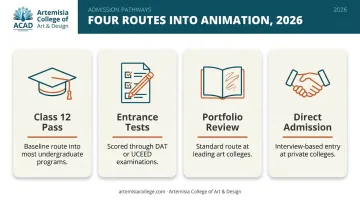
Admission into animation programs isn't governed by one national rule. Each institution sets its own path:
- Class 12 pass from any stream is the baseline requirement at most colleges, though some prefer a Science background for design-heavy tracks
- Entrance tests vary by institution: NID uses DAT Prelims and Mains, while UCEED applies to select B.Des programs at IITs
- Portfolio review is common at art and design colleges, where applicants submit sketches, digital work, or short animation samples
- Direct admission routes exist at many private colleges, including Artemisia College, based on interviews or aptitude checks rather than formal entrance exams
Course Durations You'll See in 2026
| Program Type | Typical Duration | Common Examples |
|---|---|---|
| BFA / B.Des | 3-4 years | BFA (Animation), B.Des (Animation & VFX) |
| B.Sc | 3 years | B.Sc Animation & VFX |
| Diploma / PG Diploma | 1-2 years | Diploma in Animation, PG Diploma |
| M.Sc / M.Des | 2 years | M.Des (Animation), M.Sc Animation & Multimedia |
These are benchmarks, not universal mandates. Duration shifts based on whether the college structures the course around design fundamentals first or jumps straight into production software.
Practical Work Dominates Evaluation
Animation syllabi lean heavily on studio-based assessment rather than written exams. Expect grading built around:
- Practical assignments (sketching, modelling, animation exercises)
- Portfolio and showreel reviews at the end of major units
- Written theory, usually limited to history, storytelling, and production process
No single percentage split applies across every college, but the pattern is consistent: your hands-on work carries more weight than your ability to memorize theory.
Core Subjects & Semester-Wise Curriculum Breakdown
Most 2026 animation syllabi share a common subject spine, even when the sequencing differs slightly:
- 3D Animation - modelling, rigging, texturing, and character movement in 3D space
- Multimedia - combining audio, video, text, and graphics into cohesive digital output
- Motion Graphics - animated graphic design used in titles, ads, and explainer content
- Visual Effects (VFX) - compositing CG elements into live-action or animated footage
- Communication/English - written and verbal skills needed for pitching, scripting, and client presentations
Documented curricula from Gurugram University and Graphic Era University show this pattern clearly: design foundations first, then production tools, then real-time engines and capstone work.
Semester 1-2: Foundation Subjects
Before touching advanced software, students build core visual literacy through:
- Design fundamentals and composition
- Drawing and sketching (often with lightbox exercises)
- Colour theory
- Graphic design basics using tools like Photoshop and Illustrator
- Introduction to multimedia and classical animation history
This sequencing matters. A student who can't sketch a believable pose struggles later when rigging a 3D character to hit that same pose convincingly.
Semester 3-4: Core Animation Skills
This is where 2D animation skills solidify. Curricula typically cover:
- Character design basics and expression sheets
- Frame-by-frame animation principles applied through tools like Adobe Animate
- Storyboarding and basic filmmaking concepts
- First hands-on projects combining drawing skills with digital tools
Students start producing short animated sequences, often their first real portfolio pieces.
Semester 5-6: Advanced Specialization
The shift toward production-grade skills happens here:
- 3D modelling, texturing, and lighting
- VFX compositing and matte painting basics
- Game development fundamentals (relevant even for animation-focused students)
- Post-production: sound editing, file compression, and editing workflows
By this stage, coursework starts resembling actual studio assignments rather than classroom exercises.
Final Year: Capstone & Industry Exposure
Most 2026 curriculums culminate in one of these formats:
- A portfolio project showcasing range across 2D, 3D, and VFX work
- An internship placement with a studio or production house
- An industry-collaborated capstone film built with faculty and, where possible, studio mentorship
Graduating without one of these three is increasingly rare: recruiters expect to see finished, presentable work, not just a transcript. At Artemisia College, this capstone stage feeds directly into our placement cell, where portfolio finalisation, mock interviews, and coordination with hiring studios like Ubisoft and Electronic Arts turn coursework into job offers.
12 Basic Principles of Animation Every Syllabus Teaches
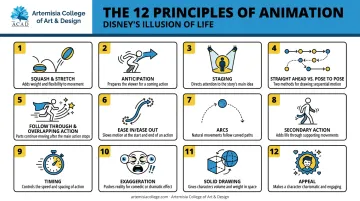
These principles trace back to Disney animators Ollie Johnston and Frank Thomas, published in their 1981 book The Illusion of Life: Disney Animation, according to Adobe's breakdown of animation fundamentals. Every animation syllabus worldwide still builds around them.
Here's the full list, briefly explained:
- Squash and Stretch - conveys weight and flexibility in a moving object
- Anticipation - prepares the viewer for an upcoming action
- Staging - directs the viewer's eye to what matters in a scene
- Straight Ahead vs. Pose to Pose - two different drawing workflows for building motion
- Follow Through and Overlapping Action - secondary parts of a body continue moving after the main action stops
- Ease In, Ease Out - motion accelerates and decelerates naturally rather than moving at constant speed
- Arcs - most natural movement follows a curved path, not a straight line
- Secondary Action - smaller movements that support the primary action without distracting from it
- Timing - the number of frames used determines speed and weight
- Exaggeration - pushing a pose or action beyond realism for clarity or comedic effect
- Solid Drawing - giving characters believable volume and dimension
- Appeal - making a character genuinely engaging to watch
From Bouncing Ball to Walk Cycle
Colleges teach these principles through a fixed set of classic exercises:
- The bouncing ball assignment, which teaches squash and stretch, timing, and arcs in one go
- The walk cycle, which layers in follow-through, secondary action, and weight distribution
- Tail or character motion assignments, often used to test overlapping action
2D vs. 3D Application
The principles don't change between mediums, but their execution does. Traditional 2D animation applies them through hand-drawn frames, while Autodesk's 3D animation resources show 3D software applying the same ideas through keyframes, motion paths, and curve editors.
A rigger achieves "squash and stretch" through deformation controls rather than redrawing a shape frame by frame. Artemisia's animation labs mirror this shift, training students directly in Unreal Engine, the same pipeline tools used by placement partners like Ubisoft and Electronic Arts.
This hands-on focus carries into how skills get evaluated. Most colleges assess mastery through practical portfolio submissions rather than written tests. If your bouncing ball doesn't feel like it has weight, no amount of theory memorization fixes that on a recruiter's screen.
Types of Animation & Specializations Covered in the Syllabus
Types of Animation & Specialisations Covered in the Syllabus
A well-rounded 2026 syllabus doesn't stop at one animation style. Here's what typically appears, and when:
- 2D animation - traditional frame-by-frame, vector-based, and cut-out techniques, introduced early (Semester 1-4)
- 3D animation and modelling - rigging, texturing, lighting, and CGI, layered in from Semester 5 onward
- Motion graphics and VFX - compositing, colour grading, and visual effects tools, usually paired with post-production units
- Niche formats - some colleges add stop motion, AR/VR-based animation, or even forensic animation to broaden career exposure
Specialisation Tracks Worth Knowing
| Track | Core Focus |
|---|---|
| BFA in Animation | Fine arts foundation, 2D/3D storytelling |
| 3D Animation & VFX | Modelling, rigging, compositing, post-production |
| Game Design | Interactive mechanics, level design, engine-based development |
| Modelling & Texturing | Asset creation, digital sculpting, surfacing |
Each track shares the foundational subjects but diverges hard by Semester 5. That's exactly why picking a college with clear specialisation paths matters more than picking one with a longer programme name.
Software, Tools & Practical Skills You'll Master
Syllabi build competency across a fairly standard toolkit:
- Autodesk Maya - professional 3D animation and VFX software
- Autodesk 3ds Max - 3D modelling, animation, and rendering
- Adobe Photoshop - concept art and image editing
- Adobe After Effects - motion graphics and visual effects compositing software
- Toon Boom Harmony - end-to-end 2D animation software for character rigging, inking, and compositing
- Blender - free, open-source 3D creation software
- Unreal Engine - industry-standard game engine for interactive and game design tracks
Learning the software is only half the syllabus's job. The real goal is a portfolio-ready output - a showreel that demonstrates range, not just button familiarity. ScreenSkills advises animation candidates to link a portfolio or showreel directly in every CV and cover letter sent to studios. Recruiters expect to see finished work, not just a list of tools on a resume.
From Syllabus to Studio: How Artemisia's Curriculum Prepares You for Industry Placements
A syllabus only matters if it connects to actual hiring outcomes. At Artemisia College of Art & Design, the Animation & VFX curriculum is shaped with real industry access in mind.
Artemisia's placement network includes studios such as:
- Rockstar Games
- Electronic Arts
- Ubisoft
- Krafton
- Lakshya Digital
- Green Gold Animation
The college also holds Gold Level Unreal Engine Academic Partner status from Epic Games, the only such accreditation held by a college in India, giving students access to workshops, advanced software builds, and priority internship pathways.
Placement Support Beyond the Classroom
Coursework alone doesn't land jobs. Artemisia's dedicated Placement Cell works with students at every stage of the hiring process:
- Finalizes portfolios tailored to specific studio expectations
- Builds CVs that highlight relevant coursework and projects
- Runs mock interviews paired with one-on-one mentoring
- Coordinates interview scheduling and offer evaluation
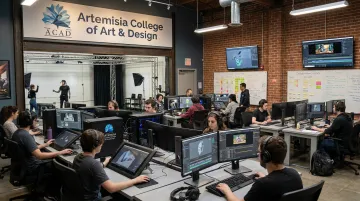
That support extends beyond hiring prep into hands-on production experience. Artemisia houses an in-campus Animation, VFX & Game production studio, giving students exposure to real production pipelines instead of simulated classroom projects. After the second year, students gain access to work on live industry projects, turning syllabus theory into actual studio practice before graduation.
About Artemisia College of Art & Design
A syllabus is only as good as the production work it leads to. Artemisia College of Art & Design was set up under Tryambakam Education Foundation to make high quality art and design education affordable without thinning it out. Roughly 90% of the teaching staff come from working industry, bringing between five and thirty-five years of practice into the studio. The college runs ACAD Studios, its own animation and game production house, and students join it as paid interns from their fourth semester onward.
Animation runs at three levels: the Certificate in 2D & 3D Animation, the Diploma in 3D Animation & VFX and the four-year B.Design in Animation. Alongside it the college awards B.Design degrees in Game Design, Interior Design and Fashion Design, BFA and MFA routes in Painting and Sculpture, and a Certificate in Photography.
Fees are deliberately low so cost is not what decides whether a creative student can study, and scholarships are available. Have a look at the fee structure, or go through early admission if a portfolio suits you better than an entrance test.
Frequently Asked Questions
What topics should be included in an animation syllabus?
A well-rounded syllabus covers the 12 principles of animation, 2D and 3D techniques, VFX and compositing, storytelling fundamentals, and hands-on software training across Maya, Photoshop, and After Effects.
What are the 12 basic principles of animation?
They are squash and stretch, anticipation, staging, straight ahead/pose to pose, follow through and overlapping action, ease in-ease out, arcs, secondary action, timing, exaggeration, solid drawing, and appeal.
What are the main types of animation?
The main categories are 2D (traditional and vector), 3D/CGI, motion graphics, stop motion, and VFX-based animation. Most syllabi introduce 2D early and layer in 3D and VFX in later semesters.
What is the eligibility for animation courses in 2026?
Most programs require a Class 12 pass from any stream, though some prefer a Science background. Admission routes include entrance exams like UCEED, portfolio reviews, or direct interview-based admission.
Which software is taught in an animation syllabus?
Common tools include Autodesk Maya, 3ds Max, Adobe Photoshop, After Effects, Toon Boom Harmony, Blender, and Unity for game design tracks.
How long does it take to complete an animation course?
Diplomas typically run 1-2 years, while degree programs like BFA or B.Des run 3-4 years. M.Sc and M.Des programs usually take 2 years post-graduation.