Introduction
Walk into any animation studio in India today and you'll find two very different worlds operating side by side.
One is built on drawing tablets and frame-by-frame illustration. The other runs on 3D modeling software, rigging tools, and render farms.
Many aspiring animators struggle to decide between 2D and 3D animation, and the choice is far more than a stylistic preference. It determines which software you'll spend years mastering, the studios that will hire you, and whether you end up on a kids' TV series or a AAA game production.
According to a FICCI-EY report on India's media and entertainment sector, India's animation and VFX segment generated ₹103 billion in 2024, with growth projected to reach ₹147 billion by 2027. That's a real, sizable industry, and both disciplines have a stake in it.
This guide breaks down exactly what separates the two, where each thrives, and how to figure out which path fits you.
Key Takeaways
- 2D animation uses flat, drawn frames; 3D animation uses modeled, rigged characters
- Artistic learners often prefer 2D; technical learners favor 3D pipelines
- Both fields offer genuine career tracks at Indian and global studios
- No style is objectively better; choose based on aptitude and target industry
2D vs 3D Animation: Quick Comparison
Here's a side-by-side snapshot of how these two disciplines differ across the factors that matter most to students.
| Factor | 2D Animation | 3D Animation |
|---|---|---|
| Core skillset | Drawing, illustration, frame-by-frame consistency, squash-and-stretch principles | 3D modeling, rigging, texturing, lighting, rendering |
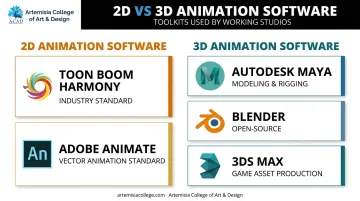
| Software | Toon Boom Harmony, Adobe Animate | Autodesk Maya, Blender, 3ds Max |
| Production approach | Faster iteration, suited to shorter-format content | Multi-stage pipeline: model, rig, animate, render |
| Career scope in India | Kids' TV, advertising, explainer content | AAA gaming, film VFX, international co-productions |
| Learning curve | Easier entry for students with drawing skills | Steeper, due to multiple technical stages |
Skillset and Software
If you're naturally drawn to sketching and storytelling through illustration, 2D rewards that instinct directly. 3D production follows a multi-stage pipeline: modeling, rigging, animation, lighting, and rendering. Autodesk documents this structure, and it's why most 3D artists specialize in one stage rather than mastering all of them at once.
Toon Boom describes its Harmony software as the industry's "gold standard" for 2D production, while Maya, Blender, and 3ds Max each serve professional 3D animation and VFX studios in different capacities.
Production Time and Career Scope
There's no universally sourced ratio proving 3D always costs more or takes longer than 2D; it depends entirely on project scope. What's clear is the career split:
- 2D roles concentrate in TV, advertising, and edtech content
- 3D roles cluster around gaming, VFX, and international film co-productions
- Hybrid roles in motion graphics and game cinematics increasingly draw on both skill sets
What is 2D Animation?
2D animation creates the illusion of movement using flat, two-dimensional drawings or digital illustrations arranged frame by frame. It's the format most of us grew up watching, and it remains deeply embedded in India's TV, advertising, and edtech content industries.
Its biggest advantage is speed of iteration. A 2D artist can sketch, revise, and finalize a character expression far faster than a 3D pipeline that requires re-modeling or re-rigging. This makes 2D a lower-barrier entry point for artistically inclined students, since strong drawing fundamentals translate directly into employable skills.
2D animation spans several subtypes:
- Traditional hand-drawn, frame-by-frame animation: the classic approach, still used for premium character work
- Digital cutout/rigged 2D: Toon Boom-style rigging that speeds up production for TV series
- Motion graphics: used heavily in advertising and explainer videos
Use Cases of 2D Animation
2D fits naturally into productions where turnaround time and expressive storytelling matter more than photorealism.
- TV series: Long-running kids' shows depend on efficient 2D pipelines to hit weekly episode deadlines
- Explainer and marketing videos: Brands use 2D motion graphics to simplify complex ideas quickly
- Mobile games: Many indie and casual titles rely on 2D art for lighter file sizes and faster development
- Educational content: Edtech platforms use 2D animation to illustrate concepts affordably at scale
Green Gold Animation, the studio behind Chhota Bheem, is a well-known Indian example of a production house built around animated storytelling. Some of its work has used both 2D and 3D CGI techniques, depending on the project.
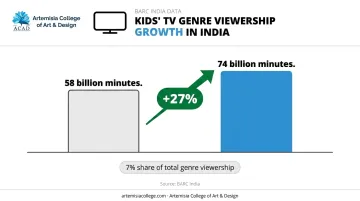
On the demand side, kids' TV content, where 2D animation dominates, has shown real staying power. BARC India data found the kids' genre grew from 58 billion to 74 billion viewing minutes, a 27% increase, holding a 7% share of total genre viewership. That's the whole kids' TV genre, not 2D exclusively, but it signals a stable audience base that 2D-heavy studios continue to serve.
What is 3D Animation?
3D animation builds characters and environments with actual height, width, and depth using modeled, rigged assets that exist in three-dimensional space. Where 2D is flat, 3D is spatial — cameras can move around characters, lighting can be adjusted dynamically, and assets can be reused across multiple scenes or even multiple projects.
This reusability is a major operational advantage. Once a character is rigged in 3D, animators can pose it in countless new scenes without redrawing it from scratch, which is invaluable for long-running game franchises or VFX-heavy film sequels.
3D work generally splits into a few specialized tracks:
- Character and creature animation: bringing rigged models to life with performance-driven movement
- VFX and simulation work: explosions, fluid dynamics, cloth, and particle effects for film and TV
- Real-time 3D for game engines: building assets optimized for engines like Unreal Engine or Unity
Use Cases of 3D Animation
3D dominates wherever realism, camera dynamism, or interactive rendering is required.
- AAA video games: Character models and environments rendered in real time through game engines
- Film VFX: Blockbuster visual effects, from creature work to full digital environments
- Architectural visualization: Rendering buildings and interiors before they're physically built
- Product design: 3D previsualization for manufacturing and marketing
India's VFX sector has become a genuine global hub. VFX Voice reports that major studios including ILM and Framestore have established hubs in Mumbai, joining Chennai, Bengaluru, and Hyderabad as the country's core VFX centers.
That expansion tracks with FICCI-EY's own projection that India's VFX revenue will grow from ₹30 billion in 2024 to ₹67 billion by 2027, the strongest available benchmark for where 3D-adjacent work is headed.
2D vs 3D Animation: Which One Should You Choose?
There's no universal right answer here. The decision comes down to three honest questions.
1. Are you artistic or technical by instinct? If you'd rather sketch a character expression than adjust a rig's joint weights, 2D likely suits you better. If you enjoy solving structural problems, such as how a mesh deforms or how light bounces off a surface, 3D will feel more natural.
2. What industry are you targeting? 2D offers quicker entry into TV, indie games, or advertising, while 3D positions you for AAA gaming, VFX, or film production.
3. What are your long-term career goals? Many studios hire specialists in just one discipline. But cross-training in both 2D and 3D noticeably widens your employability, since some productions blend both techniques within a single project.
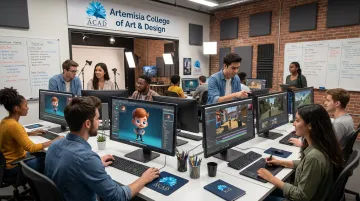
At Artemisia College, the Animation & VFX curriculum moves students through both pipelines rather than forcing an early specialization. Students cover foundational 2D principles alongside Autodesk Maya-based 3D modeling, rigging, and VFX tools.
Hands-on production exposure comes through ACAD Studios, the college's in-house animation and game production facility, where students have worked on projects for clients including Disney and Discovery Kids.
The college's dedicated Placement Cell then helps translate that dual skillset into job offers, supporting portfolio development, interview preparation, and studio matching. Its industry network spans both traditional animation houses and major gaming/VFX studios, including Rockstar Games, Ubisoft, Electronic Arts, DNEG, and Lakshya Digital.
The practical takeaway: specialize based on where your strengths lie, but structured exposure to both disciplines gives you a genuine edge when it's time to interview.
Ready to map out your own path? Explore Artemisia College's Animation & VFX program and speak with the placement team about whether 2D, 3D, or a blend of both fits your goals.
Conclusion
The 2D versus 3D debate isn't really a debate at all once you look at it honestly. Each discipline demands a different kind of thinking: 2D rewards drawing instinct and fast iteration, while 3D rewards technical patience across a longer, multi-stage pipeline. Neither is objectively superior; they simply serve different corners of India's animation, gaming, and VFX industry.
What matters more is matching your aptitude to the right track and target industry. Whether that means chasing a role in kids' TV production, joining an indie game studio, or working toward a VFX seat on an international film, both paths lead to real, well-established careers across India's creative industry.
Artemisia College's placement cell turns that potential into real placements, connecting students with employers such as Rockstar Games, Ubisoft, and HomeLane.
Frequently Asked Questions
Is it harder to animate in 2D or 3D?
Difficulty depends on your natural aptitude. 2D demands strong drawing skills and frame-by-frame consistency, while 3D demands mastery of modeling, rigging, and rendering software across multiple pipeline stages.
Which pays more, 2D or 3D animation jobs?
Salary ranges overlap: AmbitionBox data shows 2D animators earning roughly ₹1.4-6.9 lakh annually versus ₹1.5-7.5 lakh for 3D animators. Technical VFX/gaming roles can command more at senior levels, but skilled 2D artists in TV studios earn competitively too.
Can I learn both 2D and 3D animation?
Yes. Many institutes, including Artemisia College, sequence students through both 2D and 3D fundamentals within a single curriculum. Cross-skilling in both boosts job flexibility and placement chances.
What software is commonly used for 2D vs 3D animation?
2D animation typically relies on Toon Boom Harmony and Adobe Animate. 3D animation uses Autodesk Maya, Blender, and 3ds Max for modeling, rigging, and rendering.
Which has more career opportunities in India right now, 2D or 3D animation?
Both remain in demand. 3D, VFX, and gaming are growing faster as global studios expand their India operations, while 2D stays strong and stable in kids' TV and advertising.
Do I need technical or coding skills for 3D animation?
Coding isn't mandatory, but 3D animation requires stronger technical aptitude for understanding rigging, rendering settings, and multi-stage software pipelines compared to 2D work.