
It means something specific: job roles, skill requirements, salary ranges, hiring companies, and where the industry is headed over the next five years.
For a long time, India's game development story was mostly about back-office outsourcing: art assets, QA testing, and support work for studios based overseas. That's changing. Indian studios are now building original IPs, supporting AAA titles, and the government is finally building formal esports infrastructure around the sector.
This piece breaks down the market size, the actual career paths available, the skills you need, who's hiring, what you can expect to earn, and where the industry is realistically going next.
Key Takeaways
- India's gaming market is growing fast, fuelled by mobile-first adoption and clearer regulation
- Career options now span design, programming, art, animation, sound, QA, and production
- A strong portfolio and hands-on work often outweigh a degree when studios hire
- The 2025 Online Gaming Act has legitimised esports and skill-based games for investors
- Structured, industry-linked training with placement support offers the fastest route into major studios
Market Size and Growth of Game Development in India
India's gaming market has grown into one of the country's fastest-growing entertainment segments, though different research firms measure it differently.
| Source | Estimate | Scope |
|---|---|---|
| EY | ₹16,428 crore (FY23) to ₹33,243 crore (FY28), 15% CAGR | Online gaming revenue; real-money gaming made up 82.8% of FY23 revenue |
| Lumikai | $3.8B (FY24) to $9.2B (FY29), 20% CAGR | Broader gaming revenue including in-app purchases, advertising, and real-money gaming |
| Niko Partners | $1B+ currently to $1.5B by 2028 | Player spending only, not total market revenue |
According to EY's New Frontier online gaming report, that ₹16,428 crore to ₹33,243 crore projection covers online gaming broadly, so it's not a pure game-development number. Worth flagging so you don't over-index on the headline figure.
A Mobile-First Country
Nearly all of India's gamers play on mobile. EY puts the figure at 94%; Niko's more recent estimate sits close to 95%. That single fact shapes what kind of development work is in demand: lightweight builds, live-ops content updates, monetisation-friendly design, and fast iteration cycles rather than console-scale production pipelines.
Lumikai's FY24 research counted 591 million gamers in India, up from 568 million the year before, an increase of 23 million players in a single year. That's demand-side momentum most markets would envy.
Formal Recognition Through Regulation
Until recently, the gaming industry sat in a legal grey zone. That's shifted.
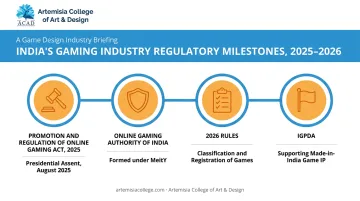
The Promotion and Regulation of Online Gaming Act, 2025 received presidential assent in August 2025. The accompanying 2026 Rules then created the Online Gaming Authority of India under the Ministry of Electronics and Information Technology, according to a PIB press release on the new governance framework. This authority now:
- Classifies and registers games operating in the country
- Decides what qualifies as a money game
- Handles player complaints and disputes
- Recognises esports and social/educational games as legitimate categories
Industry bodies are moving the same direction. The Indian Game Publishers & Developers Association (IGPDA) was formed with a mission centred on original Made-in-India IP, skills development, and attracting investment into home-grown AAA production. That's a clear signal India wants to stop being just a service vendor and start creating its own franchises.
Career Paths and Job Roles in Game Development
"Game developer" is a catch-all term that hides how many distinct careers sit inside the industry. Here's the core lineup:
- Game Designer: Defines mechanics, player experience, and creative vision; communicates the plan to every other department
- Game Programmer: Writes functional code, integrates art and audio assets, and debugs the build
- Game Artist: Produces 2D/3D characters, environments, textures, and models for the engine
- Animator: Brings characters and objects to life, building reusable movement systems for gameplay
- Sound Designer/Composer: Creates and integrates music, effects, and foley, then tests how it plays in-game
- QA Tester: Hunts for functional, graphical, and audio bugs and documents them for fixing
- Game Producer: Manages budget, schedule, staffing, and coordination between publishers and internal teams
Each role demands a different skill mix. Programmers think in logic and systems, while artists and animators lean on visual storytelling instinct. Producers, meanwhile, need to be equal parts organiser and diplomat.
Beyond Entertainment: Emerging and Adjacent Paths
Game development skills are increasingly valuable outside pure entertainment:
- AR/VR and immersive/XR experiences, with India's own skills framework now including VR application design as a recognised specialisation for game artists
- Gamification for education, healthcare, and corporate training, turning learning modules or simulations into interactive experiences
- Serious games for defence, industrial training, and workplace simulations
Studio Teams vs. Freelance and Indie Work
Large studios like Ubisoft and EA recruit graduates through Artemisia College's placement cell. Both organise work into "pods," small cross-functional teams led by a producer, each responsible for a feature or level. The workflow is structured and collaborative, though process-heavy.
Freelance and indie development looks different. You might be a one-person team wearing every hat, or part of a tiny crew building a game on a tight budget with far more creative freedom, and far less safety net.
How Careers Typically Progress
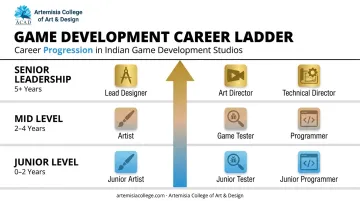
Most developers start in junior, execution-focused roles: junior artist, junior tester, junior programmer. With two to four years of experience, people move into mid-level roles with more ownership.
From there, career paths lead toward senior technical or creative leadership positions, such as lead designer, art director, or technical director, that shape a studio's direction rather than just executing someone else's brief.
Skills, Education, and Qualifications You Need
Every game developer needs some combination of technical fluency and creative instinct. The ratio just depends on the role.
Technical Tools Worth Learning
- Unity (C#): the most widely used engine for mobile and indie development
- Unreal Engine (C++/Blueprints): the standard for high-fidelity, console, and PC-scale projects
- Godot: a lightweight, open-source alternative gaining traction among indie developers
- Blender: free 3D modelling software used for asset creation
- Adobe Photoshop and Substance Painter: for concept art, 2D design, and texturing
Creative Skills Matter Just as Much
Storytelling, visual composition, character design, and animation principles aren't nice-to-haves. They're what separates a technically functional game from one people actually want to play. A programmer who understands pacing and a designer who understands code constraints both build better games than specialists who only know their own lane.
Degree vs. Portfolio: What Actually Gets You Hired
A formal degree helps, but it's rarely the deciding factor. Employers care more about what you can build and show. A Reliance Games internship posting for a 2D game artist role, for instance, lists a BFA or equivalent art credential as preferred, but explicitly accepts a strong portfolio and demo reel in its place.
This is exactly why structured, industry-linked programmes matter more than solo, self-taught learning. Artemisia College's Game Design curriculum, for example, combines technical training in Unity and Unreal Engine with storytelling and visual design coursework, backed by mentorship from working industry professionals.
Students also get access to an in-house game studio starting in the second year, where they work on live projects instead of simulated coursework. That kind of production exposure is what turns a portfolio into something recruiters take seriously.
Top Companies and Placement Opportunities in India
India's studio landscape now spans everything from AAA giants to homegrown mobile-first players:
| Company | India Presence |
|---|---|
| Rockstar Games | Dedicated India studio with open roles |
| Electronic Arts | Hyderabad hub for mobile, tech, and business functions |
| Ubisoft | Pune studio with active hiring |
| Krafton | India-specific careers page, growing local team |
| Zynga | Bengaluru studio expansion |
| SuperGaming | Pune-based, builds Indus and MaskGun |
| Reliance Games | Pune studio hiring across art, production, and QA |
What About Salary?
There's no single reliable, India-wide salary survey for game development roles, so treat any number you see online with some scepticism.
What's consistent across job postings is the pattern: entry-level roles like junior artist, junior tester, or intern start modest. Pay scales up meaningfully with experience, specialisation, and studio size.
A senior technical artist or lead designer at a AAA studio earns considerably more than a fresher, with that gap widening fastest once you've clocked three to five years of shipped-game experience.
The table below gives indicative salary ranges by role and experience level, based on data aggregated from Glassdoor, AmbitionBox, and LinkedIn for the Indian market:
| Role | Experience Level | Annual Salary Range (INR) |
|---|---|---|
| Junior Artist | 0-2 years | 3.6L - 9.6L |
| Junior Tester / QA | 0-2 years | 3.6L - 9.6L |
| Mid-level Programmer | 2-5 years | 12L - 15L |
| Lead Designer | 5+ years | 15L - 40L |
| Senior Programmer | 5+ years | 15L - 40L |
How Hiring Actually Happens
Most major studios don't rely purely on open applications. They run:
- Campus placement drives at partner colleges
- Direct industry partnerships with training institutions
- Internship pipelines that convert into full-time offers
This is where a dedicated placement cell earns its keep. Artemisia College's placement team, for instance, has built working relationships with studios including Rockstar Games, EA, Ubisoft, and Krafton, bringing recruiters onto campus rather than leaving students to cold-apply. Support covers portfolio finalisation, mock interviews, and direct introductions to hiring managers.

That process has already produced real outcomes. Prince Choudhary, a B.Des Game Design student, landed a Technical Artist Internship at Electronic Arts through the college's placement support.
"The placement cell provided consistent guidance, timely communication, and support throughout the placement process, which helped me secure an opportunity at Electronic Arts."
Challenges and Future Outlook for the Industry
The scope is real, but it isn't without friction.
Ongoing challenges:
- Many parents and students still see gaming as an unstable career choice compared to engineering or medicine
- Government funding for training infrastructure remains limited relative to the industry's ambitions
- Training institutions often lack the lab infrastructure and specialised faculty to keep pace with fast-moving engine updates
What's changing this:
The 2025 Online Gaming Act and the resulting Online Gaming Authority of India give the sector legal clarity for the first time, recognising esports and skill-based games as distinct from money gaming. That distinction matters for foreign investors who've historically stayed cautious about India's regulatory ambiguity.
Industry watchers expect this clarity to translate into more hiring over the coming years, though specific job-creation numbers should be treated as projections rather than guarantees.
Turning that potential into hires depends on fixing the structural gaps that still exist. Experts and government task forces keep flagging the same fixes:
- More national-level competitions and game jams to surface talent
- Better lab infrastructure at training institutes
- Stronger internship-to-employment pipelines that don't leave graduates to figure things out alone
Colleges that already run this playbook are positioning their students ahead of where the industry is heading, not just where it's been. That means hosting events like the Global Game Jam and building in-house studios for live project work, plus maintaining direct studio partnerships.
About Artemisia College of Art & Design
Turning that market growth into a job still comes down to a portfolio and the training behind it. Artemisia College of Art & Design runs under Tryambakam Education Foundation, built around one idea: strong fundamentals make a designer, software familiarity makes a computer operator. Around 90% of its faculty come from the animation, game, interior and fashion industries. Students join ACAD Studios, the college's own production house, as paid interns from the fourth semester, so they graduate with credits on work that actually shipped.
Game design runs at two levels: the Certificate in Game Design and the four-year B.Design in Game Design, taught in Unreal Engine under the college's Unreal Engine Academic Partner recognition. The college also awards B.Design degrees in Animation, Interior Design and Fashion Design, BFA and MFA routes in Painting and Sculpture, and a Certificate in Photography.
The college keeps tuition low and offers scholarships to bright and needy students. The current fee structure is published online, and early admission lets you apply on a portfolio and interview instead of an entrance test.
Frequently Asked Questions
Does game development have a future in India?
Yes. Market projections show strong growth, and mobile gaming adoption keeps climbing. The 2025 Online Gaming Act now gives the sector formal legal recognition, a strong signal for long-term career viability.
Are there game developers in India?
Yes, thousands of them, spread across studios in major tech hubs and growing indie scenes nationwide, working on everything from mobile hits to support work for global AAA titles.
What is the average salary for a game developer in India?
There's no single verified national figure. Entry-level pay tends to be modest, but it rises quickly with experience, especially once you've shipped a few titles and moved into a senior or lead role.
Do I need a computer science degree to work in game development?
Not necessarily. A degree helps, but most studios care more about a strong portfolio and demonstrated project experience, especially for art, design, and QA roles.
Which Indian cities offer the most game development job opportunities?
Bengaluru, Pune, and Hyderabad host the highest concentration of major studios like Ubisoft, EA, and Zynga, with Mumbai and other metros also home to a growing number of indie and mobile studios.
How long does it take to become job-ready in game development?
With focused training, consistent portfolio-building, and real project exposure, most students can become industry-ready within one to two years of structured study.