Introduction
Think of a character who stuck with you long after the credits rolled. Odds are, you can picture their silhouette, colours, and maybe even their walk—that's character design at work.
The commercial weight behind this is real. Nintendo's FY2024 annual report noted mobile and IP-related sales jumped 81.6% year-on-year, boosted largely by The Super Mario Bros. Movie, which also lifted sales of Mario-related games. One character, decades of recall.
But knowing character design matters doesn't make the blank page less intimidating. Many artists stall out, unsure where fresh ideas even come from.
This guide covers what character design actually involves, where to mine inspiration, genre-specific prompts, popular styles, memorability tactics, and how to turn this skill into a real career.
Key Takeaways
- Character design merges art and storytelling to reflect purpose and personality
- Strong inspiration mixes real-world references, existing art, and personal observation
- Ask a character's purpose and desired feeling to spark original design ideas
- Style should match your project's medium and audience, not just personal preference
- Building a career demands structured training, a strong portfolio, and real industry exposure
Where to Find Character Design Inspiration
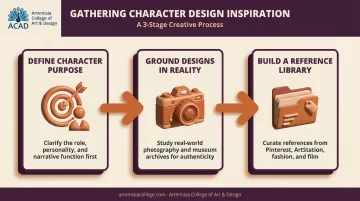
Define the Character's Purpose First
Before sketching a single line, pin down the role: hero, villain, mentor, comic relief. This decision guides every visual choice that follows — a battle-worn general dresses and moves differently than a nervous apprentice, even in the same world.
Skipping this step is why so many designs feel generic. Purpose first, pencil second.
Ground Your Designs in Reality
Real references stop your characters from looking flat or anatomically odd. Photography of people, animals, and movement gives you proportions and textures that pure imagination often misses.
- Unsplash and Google Images offer free searchable photography for poses, lighting, and body types
- Museum archives like Smithsonian Open Access and the National Gallery of Art provide costume, object, and historical references, often under open licences
- Production art books like Disney: The Art of Frozen (Chronicle Books) document character studies, sculpts, and colour scripts from concept to final film, offering a clear model for process
Build Your Reference Library
Once you have raw material, organise it. Pinterest works well for mood boards and quick visual discovery. ArtStation and Behance lean more toward finished portfolios, letting you study how professionals present character sheets and turnarounds.
Don't ignore sources outside "art" entirely:
- Fashion magazines for wardrobe logic and silhouette variety
- Film and music for mannerisms, posture, and attitude
- People-watching at a market or train station for quirks no reference site will give you
Then apply the recursive spark method: bounce between asking "what does this character need to do in the story?" and "what existing designs already solve part of that problem?" Keep cycling until the design feels grounded in this character's story rather than borrowed from someone else's.
Character Design Ideas to Spark Your Creativity
Use these as starting prompts, not finished briefs. Twist them further to fit your own story.
Fantasy & Adventure Characters
- A knight whose armour is welded from battlefield scraps and enemy weapons, wearing his history literally
- A princess who trains in secret each night, protecting the kingdom no one believes she can defend
- A forest healer who speaks fluent animal but has forgotten most human language
Sci-Fi & Futuristic Characters
- A technomancer who repairs broken AI by literally speaking to their code, treating machines like patients
- A pilot displaced fifty years in time, still flying a family heirloom mech nobody else knows how to maintain
- A colony administrator who's never left the ship, terrified of the planet she's meant to govern
Superheroes & Villains
- A once-feared vigilante trying to soften their public image after a PR disaster
- A supervillain who's run out of evil plans and started freelancing as a consultant for other villains
- A sidekick who quietly outgrew their hero years ago but stays out of loyalty
Everyday & Slice-of-Life Characters
- An office worker moonlighting as a competitive underground chess hustler
- A retired teacher who still corrects strangers' grammar out of habit
- A delivery rider who's memorised every shortcut in the city but can't find their own direction in life
Grounded characters like these matter for your portfolio. Studios want proof you can design believable humans, not just fantastical creatures — it shows the range recruiters actually look for.
Popular Character Design Styles to Explore
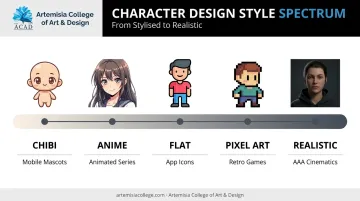
Character styles sit on a spectrum from photorealistic to heavily stylised, and each end serves different storytelling needs.
| Style | Visual Trait | Common Use |
|---|---|---|
| Anime | Bold colours, expressive features, action-driven design | Animated series, manga-adjacent games |
| Chibi | Oversized heads, compact bodies, simplified detail | Stickers, avatars, mobile game mascots |
| Flat | Minimal shading, clean shapes | App icons, branding illustration |
| Pixel art | Deliberate pixel-level construction | Retro and indie games |
| Realistic | High-fidelity proportions and rendering | AAA cinematics, real-time 3D humans |
None of these are locked to one medium by rule. A mobile game can use realistic art; an AAA title can lean stylised.
What matters is legibility, production speed, and audience fit. A webcomic drawn daily benefits from simplified, repeatable designs, while a children's book might favour warm, rounded shapes regardless of "style category."
Despite that flexibility, one rule holds across every style: if you're designing a full cast, keep a shared visual language. Consistent line weight, proportion logic, or recurring motifs across characters make an ensemble feel like it belongs in the same world.
Tips for Creating Memorable, Original Characters
Silhouette Is Your First Test
Before adding a single detail, black out your character and check if you can still identify them by outline alone. A recognisable silhouette reads instantly, even in a crowd scene or from a distance. If your character looks like a generic blob in shadow, the design needs work regardless of how good the linework is.
Colour Shapes Perception
Palette choices carry emotional weight before a viewer processes anything else. A 2025 systematic review of 132 studies, covering more than 42,000 participants across 64 countries, confirmed consistent, if complex, links between colour and emotion. Yellows and oranges tend toward high-energy positivity, while blues and greens skew calmer.
A practical example: a hero in warm red and gold reads as bold and driven, while the same character redesigned in cold blues and greys suddenly feels isolated or morally grey. Same silhouette, entirely different personality signal.
Use Juxtaposition to Dodge Clichés
Contradiction adds depth. Pair traits that don't obviously belong together:
- A hulking bodyguard obsessed with delicate embroidery
- A cheerful assassin who genuinely loves small talk
- A tyrant who's a devoted, gentle parent at home
These contrasts make characters feel like people, not tropes.
Turning Character Design Passion into a Career
Character design has become a genuine, ongoing hiring category across animation studios, VFX houses, and game developers, with roles like concept artist, character artist, and illustrator built around it.
In the US, the Bureau of Labor Statistics projects steady, if modest, demand for animators and effects artists through 2034, with thousands of openings yearly driven by industry turnover.
Getting hired, though, usually takes more than talent alone. It takes structure:
- Anatomy and fundamentals: proportion, gesture, and form studies that make your figures believable
- Software fluency: tools like Photoshop for concept work, Maya and ZBrush for 3D sculpting, and Substance Painter for texturing
- Consistent feedback: regular critique that pushes sketches toward professional polish
- Portfolio curation: knowing which pieces actually demonstrate hireable skill
This is where structured education earns its keep. Artemisia College's Animation & VFX and Game Design programmes build exactly this pipeline, pairing anatomy and concept art fundamentals with hands-on training in Maya, ZBrush, Substance Painter, and Unreal Engine, the same toolkit used at studios like EA, Ubisoft, and Rockstar Games.
Placement support matters just as much as classroom training. Artemisia's placement cell works through portfolio finalisation, CV preparation, and mock interviews before connecting students with its network of 150+ hiring partners, including EA, Ubisoft, Krafton, and Rockstar Games. Graduates placed in gaming roles in India typically start between ₹7 and ₹20 lakhs per year, with international offers ranging higher.
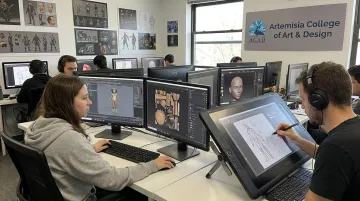
If you're past the hobby stage and serious about this as a profession, mentorship-driven training is worth exploring. The gap between a good sketch and an industry-ready portfolio is usually smaller than it feels, provided you have the right guidance closing it.
Frequently Asked Questions
What are good sources of inspiration for character design?
The strongest inspiration comes from real-world references (photography, anatomy studies), existing art or pop culture (studying illustrators and published concept books), and personal observation from daily life.
What is character design?
Character design is the process of visually developing a character's appearance, personality, and story role. Every visual choice, from posture to colour, should reflect who that character is.
What skills do I need to become a character designer?
You'll need solid drawing fundamentals, anatomy knowledge, colour theory, storytelling instinct, and proficiency in digital software like Photoshop or ZBrush. Most of these develop through consistent, guided practice.
How do I develop my own unique art style for characters?
Practise consistently, and study varied influences without copying any single one directly. Then deliberately repeat personal motifs, such as a shape language, colour habit, or proportion choice, across multiple projects until it becomes recognisably yours.
What software do most character designers use?
Common tools include Photoshop for 2D concept art, Procreate for sketching, and ZBrush or Maya for 3D sculpting and modelling. Substance Painter handles texturing, while Unreal Engine brings finished characters into real-time environments.
Can I build a career out of character design in animation or gaming?
Yes, it's a viable, in-demand career path, particularly with formal training. Programmes combining anatomy fundamentals, software training, and structured placement support, such as those offered at Artemisia College, help turn hobbyist sketches into industry-ready portfolios.