Yet many beginner animators confuse secondary motion with secondary action, treating them as the same principle. They aren't. Mixing them up leads to wasted effort, inconsistent timing, and scenes that never quite click.
This article breaks down what secondary motion actually is, how it differs from secondary action, and how to apply it so your animation reads as physically grounded rather than mechanically posed.
TL;DR
- Secondary motion is a physics-driven, passive reaction to a primary movement, not a deliberate choice.
- It falls under Follow Through and Overlapping Action, one of the 12 basic principles of animation.
- Common examples: swaying hair, rippling water, swinging accessories, flesh jiggle.
- Skip it and animation looks stiff; overdo it and it distracts from the action.
What Is Secondary Motion in Animation
Secondary motion is the natural follow-through of an object or body part reacting to a character's main movement. It's governed by physics, not choice. When a character turns their head, the hair doesn't decide to sway. It has no option but to react to inertia, weight, and attachment.
You'll typically see it applied in:
- Hair and cloth simulation
- Creature tails and appendages
- Jewellery, belts, and loose accessories
- Soft tissue and loose skin
- Water ripples and foliage reactions
Secondary motion supports realism and immersion, not narrative. It's a physics layer sitting underneath whatever the character is actually doing.
Secondary Motion vs. Secondary Action: Clearing Up the Confusion
This is where most confusion starts, and it matters because the two principles are animated in completely different ways.
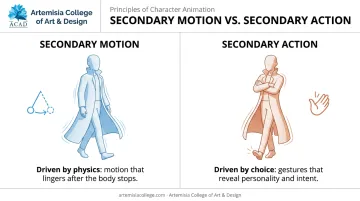
Secondary motion is passive and physics-based. A character turns their head sharply. The hair lags, overshoots slightly, then settles into an S-curve as it catches up. Nothing about that reaction is a "decision." It's inertia doing its job.
Secondary action, by contrast, is a deliberate behavioural choice that reveals personality. Animation Mentor draws this exact distinction clearly. Supportive extra business that a character actively performs, like fidgeting with glasses, is secondary action, subordinate to the primary movement. Hair, hats, and fleshy parts responding to force belong to Follow Through and Overlapping Action instead.
Side-by-side example: Picture a character storming into a room, annoyed. Secondary motion shows up as their coat swaying and settling a few frames after they stop walking. Secondary action shows up as them crossing their arms and tapping a foot while talking, a chosen gesture that tells you how they feel.
Professional animators layer both together in the same shot. But understanding which principle governs which movement stops you from animating a coat sway as if it were a character choice, or forcing "personality" into something that should just obey physics.
Key Advantages of Secondary Motion in Animation
These aren't abstract theory points. Each one has a direct, visible impact on how a shot reads to an audience or a reviewer.
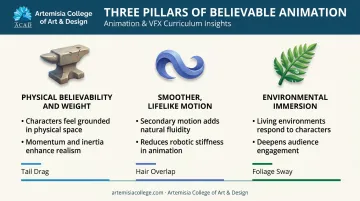
Advantage 1: Physical Believability and Weight
Secondary motion is how you communicate mass and material without ever explaining it. Stiff leather moves differently from flowing silk. A heavy tail drags differently than a light one.
Animators achieve this through timing offsets: secondary elements start moving slightly after the primary action and settle slightly later once it stops. A tail shouldn't appear to generate its own energy: its motion has to read as a reaction to the body driving it, matched to the force actually exerted.
Two factors decide how much offset to use:
- What the object is made from — stiff versus soft, light versus heavy
- How tightly it's attached — a loosely hanging chain drags more than a fitted strap
This advantage matters most in creature animation, characters wearing capes, hair, or accessories, and any cinematic shot where physical realism gets scrutinised frame by frame.
Advantage 2: Smoother, More Lifelike Motion
Animation without overlap has a "stop-start" quality — every part of the character freezes and moves in perfect sync, which reads as robotic rather than organic.
Veteran animation instructor Larry Lauria describes how overlapping hair, tails, and clothing over a body's core movement makes the result feel more fluid and life-like, because the timing curves ease in and settle rather than stopping abruptly.
There's a useful diagnostic here too: when experienced riggers strip overlapping action out of an otherwise solid body-mechanics test, the motion suddenly reads as stiff, even though the core poses haven't changed. If a shot feels mechanical, check whether anything in frame is still settling after the main action ends rather than focusing on the poses.
Advantage 3: Environmental Immersion and Production Value
Secondary motion isn't limited to characters. It extends into environments — dust displacement, foliage sway, water ripples — and this is what makes a set feel inhabited rather than painted on.
Production examples back this up:
| System | What it does |
|---|---|
| Epic Games' procedural foliage tools | Animate trees and grass to simulate wind, reacting continuously rather than sitting static |
| Real-time environment simulators used in game production | Model flowing water, erosion, and vegetation that respond to player interaction |
| Studio-grade water simulation in feature VFX | Generate splash and droplet behaviour with realistic refraction |
This advantage carries the most weight in game environments, large-scale VFX shots, and any scene where the setting needs to feel physically present rather than like a static backdrop.
What Happens When Secondary Motion Is Missing or Ignored
Skip this principle and the effect is immediate: movement looks stiff, mechanical, and disconnected from how objects actually behave in the real world. A character can hit every pose correctly and still feel wrong, because nothing in the frame is settling or reacting.
Scenes without it often get labelled "cheap" or unfinished — a common critique on student reels and portfolios. This isn't just aesthetic nitpicking, either.
Consider what it signals:
- A gap in observational skill: the animator hasn't studied how hair, cloth, or flesh actually move
- A gap in animation fundamentals: overlap and follow-through are core, testable basics, not advanced flourishes
- A gap in portfolio readiness: the reel reads as incomplete, even when the primary animation is technically sound
All three gaps get heavily assessed during industry placements and interviews, which is exactly why studios keep coming back to the same feedback: get the fundamentals solid before polishing anything else.
How to Apply Secondary Motion Effectively
Getting this right isn't about adding random wobble to everything. It follows a specific sequence.
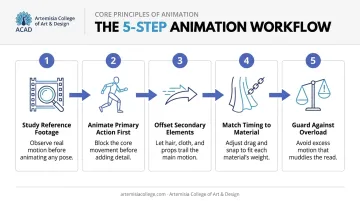
- Study real reference footage first. Watch how hair, cloth, and loose objects actually move — frame by frame if possible. Accurate secondary motion starts with accurate observation, not guesswork.
- Animate the primary action completely before touching secondary elements. Lock in the core body movement, its timing, and its arcs first.
- Offset deliberately. Let secondary elements move slightly after the primary action begins, and settle slightly later once it stops. This is the essence of overlapping action.
- Match timing to material. A stiff prop needs a small offset; a loose chain or long hair needs a larger one. There's no single universal delay that works for everything.
- Guard against overload. Too much secondary motion competes with the primary action and makes a shot look floaty rather than grounded. If it distracts from what the character is actually doing, dial it back.
This is exactly the kind of skill that improves fastest with structured, mentor-guided repetition rather than trial and error alone.
At Artemisia College, students in the Animation & VFX programme work through these foundational techniques under faculty guidance before their portfolios go in front of hiring partners. That step matters: the college's placement cell works directly with studios across animation, VFX, and game development.
Conclusion
Secondary motion is what separates animation that's technically correct from animation that feels physically alive. It's a small principle with an outsized effect — the settling cloak, the trailing hair, the ripple that doesn't quite stop when the character does.
Its real value shows up when animators combine it correctly with the other principles: secondary action for personality, timing to control rhythm, and follow-through that keeps the physics honest. None of them work in isolation.
Building this skill requires sustained, ongoing observation over time. That's part of why Artemisia College structures its Animation & VFX training around mentor-guided practice and placement preparation, helping students turn fundamentals like this into reels that are actually ready for studio review.
Frequently Asked Questions
What is secondary motion in animation?
Secondary motion is the passive, physics-driven reaction of an object or body part to a character's primary movement, such as hair or cloth trailing behind a turn. It falls under the principle of Follow Through and Overlapping Action.
What are some examples of secondary motion in animation?
Common examples include swaying hair, rippling cloth or capes, jiggling flesh, swinging jewellery or accessories, and water reacting to movement nearby.
What is the difference between secondary motion and secondary action?
Secondary motion is physical and passive, driven purely by inertia and material properties. Secondary action is a deliberate behavioural choice, like a character fidgeting, that reveals personality.
Is secondary motion one of the 12 principles of animation?
Not as a standalone principle. It falls under Follow Through and Overlapping Action, one of the original 12 core principles established by Disney animators.
How do you animate secondary motion realistically?
Study real physics through reference footage. Animate the primary action first, then offset secondary elements so they lag behind and settle after the main movement stops.
Can secondary motion be overdone in a scene?
Yes. Excessive secondary motion competes with and distracts from the primary action, making a shot feel floaty rather than grounded. It should always stay subordinate and purposeful.