Introduction
Watch any animated scene that feels "off," and the culprit is usually the same: everything stops moving at once. Real bodies don't work that way. Hair keeps swinging, sleeves keep drifting, and a jump doesn't end the instant feet touch the ground.
This is where follow through and overlapping action come in. They're the fifth of the 12 Principles of Animation, laid out by Frank Thomas and Ollie Johnston in their landmark 1981 book.
Skip these principles, and even technically clean animation reads as stiff or robotic, a complaint reviewers make constantly about student demo reels.
This guide breaks down what each principle actually means, how they differ, and how to practise them for 2D or 3D work.
Key Takeaways
- Follow through keeps body parts or objects moving briefly after the main action stops.
- Overlapping action staggers movement across different body parts throughout the action itself.
- Both principles come from Thomas and Johnston's 12 Principles of Animation, vital for realistic weight.
- Recruiters actively scan demo reels for these fundamentals before considering a candidate.
What is Follow Through in Animation?
Follow through is rooted in basic physics. When a moving body suddenly stops, parts attached to it don't stop simultaneously; they carry on briefly under their own momentum before settling. Animation Mentor describes it plainly: follow-through is the secondary motion that continues after the main action stops, with joints lagging and catching up in sequence.
Think of a character landing a jump. The feet plant, the pose locks, but the cape or hair keeps trailing for a few more frames before it settles. That trailing motion rarely travels in a straight line. It typically arcs through an S-curve, reversing direction as it slows.
The Moving Hold
A common mistake is freezing a character completely the moment the main pose is reached. That reads as dead. Instead, animators use a moving hold, a pose held for an extended period without looking static, achieved through small, controlled secondary movement rather than a total freeze. Picture a boxer who just landed a punch: the fist stays extended, but the shoulders drift slightly and the chest rises with a breath. That subtle drift keeps the pose alive without restarting the action, giving the audience time to read the moment before the story moves on.
Drag: The Heavier Cousin of Follow Through
Closely related to follow-through is drag, where looser or heavier elements lag noticeably further behind the main mass than lighter ones would. A few examples:
- A dog's jowls lagging behind a head shake
- A loose sleeve trailing an arm swing
- A ponytail whipping late on a sharp turn
Toon Boom's animation training notes that a trailing cloak often forms an S-curve shape, with the attached section and the tip curving in opposite directions as the fabric catches up.
What is Overlapping Action in Animation?
Where follow through happens after motion stops, overlapping action happens during it. Different parts of a body move at different speeds and start times rather than in perfect unison.
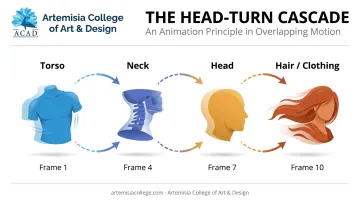
The classic teaching example is a head turn:
- The torso initiates the rotation first
- The neck follows a beat later
- The head trails the neck
- Hair or loose clothing lags furthest behind
This cascading sequence is what makes a turn look organic instead of mechanical, where every part rotates on the same frame like a single rigid block.
That same delay principle drives breaking the curve, a technique where a shape shifts from a C-curve into an S-curve and back again as it moves. This constant reshaping gives soft materials—hair, tails, capes—that flexible, alive quality rather than a stiff pendulum swing.
Most animation training programmes teach this same principle through the pendulum and tail exercise: a rigid block drives the primary motion, while a jointed tail attached to it drags behind and settles afterward, never leading the action. It's a deceptively simple drill that exposes timing problems fast.
Animator Larry Lauria puts the purpose well: overlapping action is a tool animators use to emphasise a character's action and mood. Overlapping the body, tail, hair, and clothing is what makes motion feel fluid rather than robotic.
A note before you cite examples: floppy-limbed characters in Pixar or Sony films are frequently pointed to as textbook overlapping action. Production sources confirm heavy use of hair, fur, and cloth simulation in films like these, but studios rarely label a specific shot as "overlapping action" in public materials. Verify the exact scene before citing it in a portfolio or presentation.
Follow Through vs Overlapping Action: What's the Real Difference?
This is the question that trips up most students, and the answer comes down to timing.
| Aspect | Overlapping Action | Follow Through |
|---|---|---|
| When it happens | During the primary motion | After the primary motion ends |
| What it looks like | Body parts moving at staggered speeds | Parts continuing to drift, then settle |
| Purpose | Creates natural, non-uniform movement | Prevents an abrupt, dead stop |
| Example | Torso leads a turn, hair trails behind | Cape keeps swaying after a character lands |
In short: overlapping action is about staggering the movement, follow through is about settling after the stop.
In practice, animators rarely separate the two into distinct steps. They blend into one continuous flow. The same trailing hair that overlaps during a head turn often keeps settling once the head stops.
Pro tip: Don't overthink the boundary between overlapping action and follow through. Focus on getting the physics right across the whole motion.
Why These Principles Matter in Animation
Thomas and Johnston identified follow through and overlapping action as the fifth of their 12 principles in The Illusion of Life (1981), the book that codified how Disney's animators built believable characters.
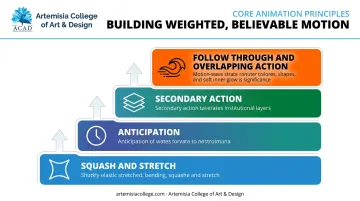
It doesn't work in isolation. Each principle builds on the next:
- Squash and stretch establishes flexibility
- Anticipation preps the audience for what's coming
- Secondary action adds nuance
Follow through and overlapping action tie the whole body together into one cohesive, weighted performance.
Without it, even a well-timed action feels hollow. Animation Mentor is blunt about this: without overlap, motion appears stiff, mechanical, and unnatural. Audiences may not consciously name the problem, but they feel it immediately. Characters read as puppets rather than living things.
This is exactly why the principle shows up so often in feedback on demo reels. A character can be modelled beautifully and rigged perfectly, but if the movement doesn't carry weight and momentum, it won't land with a hiring panel.
How to Practice and Apply Follow Through & Overlapping Action
Understanding the theory is one thing. Building it into muscle memory takes deliberate, structured repetition.
Step-by-Step Approach
- Block the primary action first - Get the core movement (a jump, an arm swing, a head turn) locked before touching secondary elements.
- Layer in follow through - Once the main pose is set, animate secondary elements like hair, clothing, or props settling afterward.
- Stagger the timing across body parts - Offset the start and peak of each joint's motion so nothing moves in perfect sync.
- Review frame-by-frame in slow motion - This is where stiffness hides. Scrub through your timeline slowly to catch areas where everything still moves as one rigid unit.
Tools and Exercises for Skill-Building
Classic training exercises include:
- The pendulum/tail test (a rigid shape dragging a jointed tail)
- A flag waving in wind exercise for cloth-like drag
- A basic walk cycle with arm and hair overlap
On the software side, Artemisia College's Animation & VFX curriculum builds these fundamentals primarily in Autodesk Maya, alongside Photoshop and Adobe Flash in earlier training stages. Students then move into Substance Painter, ZBrush, Houdini, and Nuke as they reach diploma-level coursework.
Industry-wide, Blender and Toon Boom Harmony are common tools for practising the same principles, particularly among 2D-focused animators.
As you run these drills, watch for two mistakes that undercut the effect:
- Over-exaggerating the effect - too much overlap looks floaty; too little looks stiff. Match the reaction to the force behind it.
- Ignoring weight and material - a heavy chain settles differently than a silk scarf, so the same offset on every element breaks believability.
Turning This Skill Into a Career-Ready Portfolio
Recruiters reviewing animation reels are trained to spot exactly the issues covered in this guide: stiff timing, uniform movement, and a lack of weight. Smooth, physically grounded motion is one of the fastest ways a reel stands out from the pile.
Artemisia College's Animation & VFX programme pairs hands-on faculty mentorship with a dedicated Placement Cell. The team helps students refine these exact fundamentals and build portfolios that hold up under industry scrutiny.
The Placement Cell then connects graduates with hiring partners across gaming and animation, including studios like Electronic Arts, Ubisoft, and Lakshya Digital.
That mentorship carries the principle past the classroom, helping it survive all the way into a hireable reel.

Frequently Asked Questions
What is the difference between overlapping action and follow-through in animation?
Overlapping action happens during the primary motion, with different body parts moving at different speeds. Follow through happens after the motion stops, as parts continue moving briefly before settling.
Can you give me an example of overlapping action animation?
The classic example is a head turn: the torso initiates, the neck follows, then the head, then hair or loose clothing trail last. This staggered sequence is also demonstrated in the pendulum/tail exercise used in animation training.
Which of the 12 principles is follow through and overlapping action?
It's the fifth principle in Frank Thomas and Ollie Johnston's 12 Principles of Animation, first outlined in their 1981 book The Illusion of Life.
Do follow through and overlapping action apply to 2D animation too?
Yes. Both principles apply across 2D, 3D, and stop-motion animation because the underlying physics-based logic, including inertia, weight, and staggered timing, doesn't change with the medium.
Why does my animation look stiff even after adding follow through?
Usually it comes down to ignoring an object's weight or material, or applying uniform timing to every body part instead of staggering it. Both mistakes flatten out the natural drag that makes motion feel real.
How can beginner animators effectively learn and practice these principles?
Start with focused drills like the pendulum test and a basic walk cycle, then get consistent feedback on your timing. Structured, mentorship-based training, like the guided coursework in Artemisia College's Animation & VFX programme, speeds this process up considerably.