
Here's the confusion many aspiring designers in India run into: they think game design means drawing characters or writing code. It's neither, exclusively. Game design is its own discipline, sitting at the intersection of psychology, systems thinking, and storytelling.
This guide breaks down what game design actually involves, the principles working designers rely on, the step-by-step process behind every shipped game, and the resources and career path that can take you from hobbyist to studio professional.
Key Takeaways
- Game design blends psychology, math, storytelling, and technology into one discipline
- Every shipped game follows a recognisable process, from concept sketch to launch
- Frameworks like Jesse Schell's "lenses" help designers diagnose weak spots quickly
- Structured, industry-connected education compresses years of trial-and-error into a faster path to a studio job
What Is Game Design? Understanding the Craft
Game designer and author Tracy Fullerton defines the role simply: a designer plans the structural elements of a system that produces an interactive experience, acting as an advocate for the player throughout.
Her playcentric method puts the intended player experience at the centre of every design decision, not the technology or the art style.
That's a meaningfully different job from painting concept art or writing gameplay code. Fullerton's own textbook, Game Design Workshop, is built to be nontechnical and exercise-driven, requiring neither programming nor art skills to complete.
Design lives at the level of rules, goals, and systems: art and code implement the vision.
A Genuinely Cross-Disciplinary Field
Northeastern University's game design curriculum bundles together narrative theory, level architecture, systems and mechanics, interface design, and both digital and physical prototyping under one discipline. That mix is deliberate.
A designer needs to reason like a psychologist, a mathematician, and a storyteller in the same afternoon.
Every designer, regardless of genre, works with four recurring building blocks:
- Mechanics – the actions a player can take and the rules governing them
- Objectives and goals – what the player is working toward, short and long term
- Player agency – how much meaningful choice a player actually has
- Progression and rewards – the pacing of new abilities, challenges, and payoffs
Underneath all four sits feedback and balance. A game needs to tell players clearly whether an action worked, and it needs difficulty tuned so challenge grows alongside skill. Get either wrong and players disengage, either from confusion or frustration.

India's gaming sector has been growing fast enough to force this specialisation into view. The FICCI-EY 2024 report noted India's online gaming segment grew 22% in 2023 to reach INR 220 billion, with more than 450 million online gamers in the country.
A market that size can't run on artists and engineers alone: it needs people whose actual job is shaping how the game plays.
The Core Principles Every Game Designer Should Master
Once you understand what design is, the next step is learning how experienced designers actually think through problems.
The Lens Concept and the Elemental Tetrad
Jesse Schell's The Art of Game Design: A Book of Lenses remains the field's most-cited reference on design thinking. Schell frames design decisions as questions viewed through different "lenses." The Lens of Essential Experience, for instance, asks designers to identify a real-world experience they want to evoke, then strip it down to its essence inside the game.
Schell also defines the Elemental Tetrad: Mechanics, Story, Aesthetics, and Technology. None of these four works in isolation. A beautiful art style that fights the core mechanics, or a story that the technology can't support, produces a game that feels disjointed no matter how polished any single piece looks.
Iteration and Balance
Prototyping isn't a phase you rush through. GDC's rapid-prototyping sessions consistently show that innovative games emerge from repeated trial, error, and testing, not a single flash of inspiration. The typical loop looks like this: think of an idea, build a rough version, test it, and change whatever isn't working, then repeat.
Balance work follows the same iterative spirit. Designers generally tune for:
- Fairness – no player or strategy has an unfair built-in advantage
- Challenge versus skill – difficulty scales with what the player has actually learned
- Risk versus reward – bigger risks should offer proportionally bigger payoffs
Designing for the Player, Not the Feature List
Psychologist Mihaly Csikszentmihalyi's concept of flow (that state of total absorption) depends heavily on clear goals and immediate feedback, alongside a workable challenge-skill balance. Designers lean on this constantly when pacing a level or a boss encounter.
Richard Bartle's well-known player taxonomy splits players into Achievers, Explorers, Socialisers, and Killers. It's a useful shorthand for predicting what will actually motivate someone, though Bartle himself framed these as stereotypes rather than rigid boxes. Pair that with fast, unambiguous interface feedback, and you get systems that keep players oriented instead of guessing.
The Game Design Process: From Concept to Post-Release
Design work follows a broadly consistent sequence in studios worldwide, even though exact terminology varies by team.
- Concept and ideation – brainstorm the core idea, research who you're making the game for, and lock in an initial vision before building anything.
- Planning and documentation – translate that vision into a game design document (GDD) covering mechanics, structure, and difficulty progression so the whole team works from one source of truth.
- Prototyping – build a rough, playable version with placeholder art. The goal here is testing whether the core mechanic is fun, not making it look good.
- Iteration and playtesting – put the prototype in front of real players repeatedly, adjusting based on what actually happens, not what you assumed would happen.
- Art, sound, and development – once mechanics hold up, layer in visuals and audio while engineers integrate everything into a stable build.
- Testing, release, and post-launch support – fix bugs, balance final numbers, ship the game, then keep tuning it based on community feedback and live data.

At Artemisia College, students walk through each of these stages firsthand: sketching paper prototypes before touching Unreal Engine, then rebuilding proven mechanics into full builds once playtesting confirms they work.
This sequence traces back to Fullerton's documented playcentric process, which starts with brainstorming and low-fidelity prototypes and only introduces full documentation once a concept has proven itself in testing.
Paper prototypes and index cards often precede any programmer or artist joining the project — the mechanic gets validated before a single asset is built.
Essential Skills and Resources to Learn Game Design
Breaking into design work means combining creative instinct with practical technical fluency.
Foundational skills worth developing:
- Game design theory (mechanics, systems, player psychology)
- Basic scripting or programming, particularly C++ or C#
- Visual and UX design fundamentals
- Written and verbal communication for pitching ideas to a team
Go-to resources:
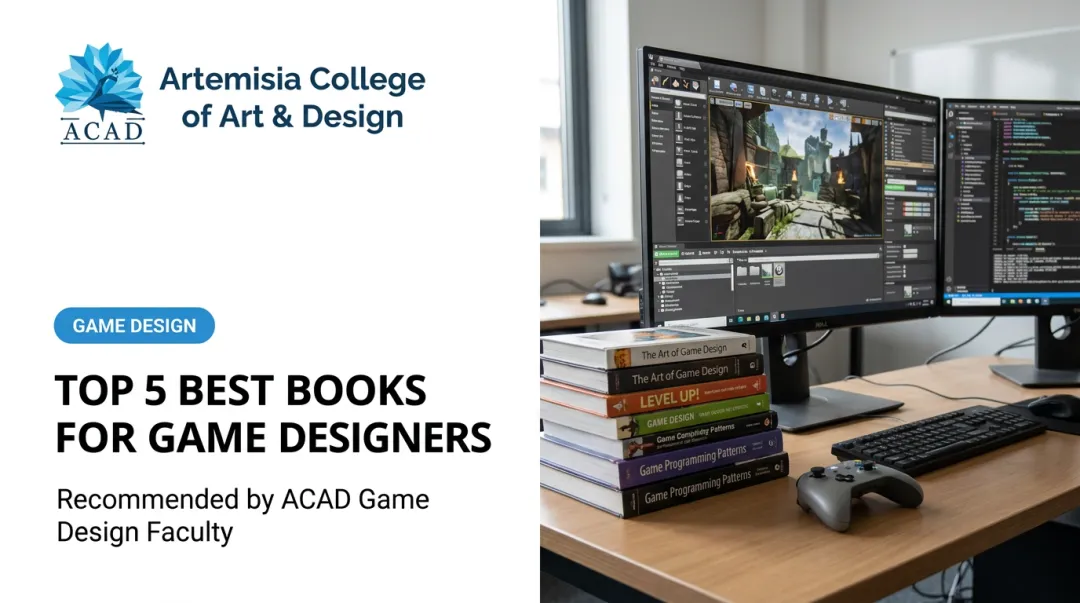
- The Art of Game Design: A Book of Lenses by Jesse Schell, still the field's standard reference
- Unity: C# scripting with rapid iteration across more than 25 platforms
- Unreal Engine: Blueprint visual scripting lets designers build gameplay without deep coding
- Godot: Free and open-source, with live in-game editing in version 4.4
Building real experience:
Nothing replaces shipping something, even something small. Global Game Jam events challenge participants to build a playable game under a shared theme within a tight time limit, ideal for practising rapid prototyping under pressure. Artemisia College has hosted this event as a venue partner, giving students direct exposure to that pressure-tested workflow.
That hands-on experience becomes the backbone of a strong portfolio. It typically includes design documents, a few playable prototypes, and evidence of iteration based on playtest feedback, not just polished screenshots.
Turning Design Skills into a Game Design Career
Theory and self-taught prototyping only take you so far. What actually shortens the distance between "student" and "hired designer" is structured, industry-connected education paired with mentorship that prepares you for portfolio reviews and interviews before you're facing them for real.
Artemisia College's Game Design program is built around that distance. Its curriculum runs through Adobe Photoshop and Autodesk Maya for asset and concept work, plus Substance Painter for texturing.
Students also work in both Unreal Engine and Unity for engine-level prototyping and production, gaining hands-on exposure to the tools studios use daily. The college holds Gold Level Unreal Academic Partner status from Epic Games — currently the only college in India with that recognition.

Curriculum access alone doesn't land a job, though; knowing how to present that training does. The Placement Cell extends beyond generic advice, supporting:
- Portfolio finalisation and CV development
- Mock interviews and one-on-one mentoring
- Guidance on which studios to target based on individual strengths
Campus access to recruiters from studios like Rockstar Games, Electronic Arts, Ubisoft, and Krafton gives students a direct entry point that's hard to replicate applying cold from outside a structured program.
Where Design Theory Becomes Design Practice
The theory above is well established. The gap is applying it: a designer who can discuss MDA is common, one who can balance an economy, pace a level and make a mechanic feel good is not.
Artemisia College of Art & Design sequences toward that. Fundamentals of game design and physical board game projects come first, then level and system design covering economies, reward systems and balancing, then game feel and interaction design, AI for games, and a final-year capstone. Game psychology and monetisation sit in fourth year.
The degree also carries elective specialisation tracks in both third and fourth year, so students can go deep in 3D modelling and texturing, 2D art and animation, AR/VR development, level design, sculpting, engine work or game design itself.
Conclusion
Theory is worth reading once and applying repeatedly. Build the smallest thing that tests the idea.
Artemisia College runs game design at two levels: the one-year Certificate in Game Design, which ends with a complete playable 3D game, and the four-year B.Design in Game Design & Development. Certificate entry is direct with 10+2 in any stream; the degree is through the ACAD Entrance Test or portfolio-based early admission.
Frequently Asked Questions
What are the 7 stages of game design?
A commonly cited version follows brainstorming, physical prototyping, an optional presentation stage, software prototyping, design documentation, production, and quality assurance. Different studios label these steps slightly differently, but the sequence stays consistent.
What kind of art is game design?
It's an interactive, multidisciplinary art form that combines visual design, narrative craft, and systems-based creativity. Unlike static art, it only fully exists once a player is actively making choices within it.
What is the 80/20 rule in game design?
This applies the Pareto principle: a small portion of mechanics or content typically drives most of a game's engagement. Designers use it to prioritize polish and testing rather than spreading effort evenly across every feature.
What are the 7 formal elements of game design?
Fullerton's game design framework actually lists eight formal elements, not seven: players, objectives, procedures, rules, resources, conflict, boundaries, and outcomes. Together, they define the formal structure any game rests on.
How do I start a career in game design in India?
Build a portfolio of design documents and playable prototypes, learn tools like Unreal Engine and Unity, and consider structured education with dedicated placement support, such as Artemisia College's game design programmes. That combination gets you noticed faster than self-teaching alone.
What skills do I need to become a game designer?
You'll need a mix of creative and technical ability: solid grasp of game mechanics and player psychology, basic scripting knowledge, visual storytelling skills, and the communication ability to pitch and defend design decisions to a team.