Aspiring designers usually ask the same three things: Can I actually earn a stable income doing this? What job titles exist beyond the generic "interior designer" label? And what does the salary progression realistically look like over 5-10 years?
This article answers all three. We'll cover career viability, specific job roles with real responsibilities, salary ranges by experience and specialisation, the skills employers actually screen for, and the education path that gets you hired.
Key Takeaways
- India's interior design market is projected to nearly double by 2031, driven by real estate demand
- Job titles include residential designers, CAD visualisers, and project directors, each with distinct pay scales
- Entry-level salaries start modest but can multiply with specialisation and reputation
- Software skills like AutoCAD and SketchUp are now baseline hiring requirements, not bonus skills
- Structured degree programs with placement support shorten the path from graduation to paid work
Is Interior Design a Good Career in India?
Short answer: yes, if you enjoy solving practical problems creatively. The demand is real and growing.
Mordor Intelligence pegs India's interior design market at USD 35.48 billion in 2026, expanding to USD 65.01 billion by 2031 at a 12.87% CAGR. That growth is fuelled by rising disposable incomes, rapid urbanisation, and a boom in both home renovation and commercial fit-out projects across tier-2 and tier-3 cities, not just metros.
The Creative-Technical Balance
Unlike purely artistic fields, interior design demands a specific mix of abilities. You need to be comfortable with:
- Creative concept development - translating a client's vague ideas into a cohesive design language
- Client management - listening to briefs, managing expectations, and handling revisions gracefully
- Technical drafting - producing accurate, construction-ready CAD drawings
- Project execution - coordinating vendors, contractors, and timelines on-site
If you enjoy both sketching mood boards and reading floor plans, this balance is a feature, not a burden. That same blend of creative and technical skill also explains why so many designers report genuine satisfaction with their day-to-day work.
Why Designers Report High Job Satisfaction
Most conventional desk jobs produce invisible output. Interior design doesn't. You watch a bare shell transform into a finished space, often within weeks.
That tangible payoff, combined with working across residential, commercial, hospitality, and retail settings, keeps the day-to-day genuinely varied. No two client briefs are identical, which is precisely why many designers describe the work as engaging rather than repetitive.
Interior Design Jobs & Career Descriptions: Where Can You Work?
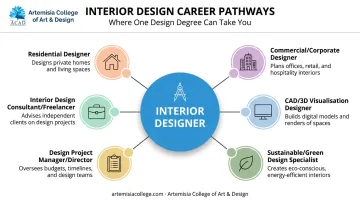
"Interior designer" is really an umbrella term. Beneath it sit several specialised roles, each with distinct responsibilities, work settings, and pay trajectories. Knowing which one fits your strengths matters more than the title itself.
Residential Interior Designer
Residential designers work directly with homeowners on space planning, furniture selection, and personalisation. Responsibilities typically include initial sketches, material sourcing, and cost estimation for the entire home. Most work within design studios, modular interior firms, or as independent practitioners once they build a client base.
Commercial & Corporate Interior Designer
Commercial designers focus on offices, retail stores, and hospitality spaces where brand identity matters as much as functionality. Designers here plan cabins, cubicles, boardrooms, and common areas while ensuring the space meets safety and ergonomic standards. Typical employers include design firms, corporate real estate teams, and hospitality groups.
Film Industry - Set Designer
Set designers bring spatial and aesthetic skills into film and television production, building the physical environments that directors and cinematographers need to tell visual stories. The role involves researching a script's period and tone, drafting detailed set layouts, sourcing props and materials, and supervising the build process on location or in studio. Interior designers are well-suited to this path because the core discipline - translating a brief into a three-dimensional, inhabited environment - is the same; the "client" is the director, and the "room" must read convincingly on camera.
Events - Stage & Exhibition Designer
Events designers work across corporate conferences, trade shows, music festivals, product launches, and cultural exhibitions, creating stage setups, exhibition booths, and experiential spaces that must engage audiences within a compressed timeframe. Unlike a permanent interior, these installations are designed to be assembled quickly, communicate a brand or theme at a glance, and then dismantled. The work requires a strong command of spatial planning, lighting, and material selection under tight production schedules, making it a natural fit for designers who enjoy fast-paced, project-based environments.
Interior Design Consultant / Freelancer
Freelancers run independent practices, managing client relationships, budgets, and vendor coordination without a company safety net. The appeal is entrepreneurial: freelancers set their own rates, choose their projects, and scale income with reputation rather than a fixed pay band. It's higher risk early on, but often higher reward once they're established.
CAD/3D Visualisation Designer
CAD and 3D visualisation specialists centre their work on technical drafting, photorealistic rendering, and BIM software to turn design concepts into construction-ready plans. Visualisers produce 3D models and walkthroughs, coordinate with lead designers and project managers, and are in high demand as clients increasingly expect to "see" a space before committing budget to it.
Design Project Manager / Design Director
A senior-level role overseeing project timelines, budgets, teams, and client presentations. Project managers typically handle BOQs (bills of quantities), billing, vendor oversight, and quality control from concept through final handover. This position generally requires several years of on-ground experience before firms hand over that level of responsibility.
Sustainable/Green Design Specialist
An emerging niche focused on eco-friendly materials, energy efficiency, and green building certification. India's own rating frameworks are formalising this space: IGBC Green Interiors Version 2, applicable to projects registered from April 2025, evaluates categories including energy efficiency, water conservation, and indoor environment quality. As sustainability becomes a client expectation rather than a nice-to-have, designers with this specialisation are in growing demand.
Interior Design Salaries in India: What to Expect
Salaries vary considerably based on experience, specialisation, city, and whether you're salaried or freelance. There's no single "average" figure that tells the full story, so here's the breakdown by career stage.
| Career Stage | Typical Annual Salary Range (INR) | Notes |
|---|---|---|
| Entry-level (0-2 years) | ₹1.4-5.4 lakh | Wide range depending on city and firm size |
| Mid-level (3-6 years) | ₹4.2 lakh average, up to ₹8.4 lakh | Growth accelerates with specialisation |
| Senior (3-13 years) | ₹3-11 lakh | Overlaps with mid-level bands based on skill depth |
| Principal | ₹9 lakh average | Based on a smaller sample of senior professionals |
| Freelance | ₹1.6 lakh to no limit | Project-fee based, varies with reputation |
Figures sourced from AmbitionBox's 2026 interior designer salary data
These figures reflect salaried positions. Freelance income follows a different pattern entirely.
Why Freelance Income Can Outpace Salaried Roles
Freelancers charge per project rather than drawing a fixed salary. Early on, this means inconsistent income while you build a client base. But once you have a strong portfolio and referral network, project fees can add up to far more than a comparable salaried position, especially in luxury residential or boutique commercial work.
What Pushes Salaries Higher
- Working in metro cities - Mumbai, Bengaluru, and Delhi command higher rates than tier-2 cities
- Specialising in commercial or luxury projects - these carry bigger budgets and bigger fees
- Building a personal portfolio and brand - visibility attracts higher-paying clients directly
- Gaining certifications - green design credentials and advanced software skills add negotiating leverage
Essential Skills for a Successful Interior Design Career
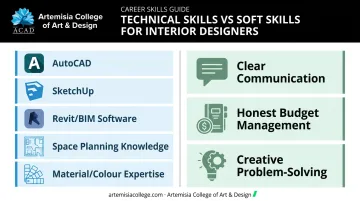
Hiring firms today screen for a specific mix of technical fluency and interpersonal ability, not just artistic talent.
Technical Skills
- AutoCAD - the baseline for drafting and technical documentation; nearly every current job listing requires it
- SketchUp - used for 3D spatial visualisation and client presentations
- Revit and BIM software - increasingly requested for larger commercial and fit-out projects
- Space planning knowledge - understanding flow, ergonomics, and code compliance
- Material and colour expertise - knowing what works structurally and aesthetically, not just visually
Soft Skills That Actually Matter
Client communication often decides whether a project succeeds, and designers who explain decisions clearly, manage honest budget conversations, and problem-solve when timelines slip tend to build repeat business. Three soft skills separate professionals from hobbyists:
- Clear communication - explaining design rationale so clients understand trade-offs
- Honest budget management - keeping a client's ₹8 lakh budget realistic against their Pinterest board
- Creative problem-solving - adapting when materials, timelines, or vendors fall through
A strong, diverse portfolio remains the single biggest differentiator in hiring and freelance client acquisition. Employers and clients alike want to see range, not one polished project. Artemisia College's placement cell helps students build that portfolio range through guided finalisation.
How to Become an Interior Designer in India: Education Roadmap
The typical path starts after Class 12 with a Bachelor's degree in Interior Design or Interior Architecture, generally spanning 3-4 years, followed by an optional Master's for those seeking deeper specialisation.
What matters more than the degree title is the program structure itself. Look for one that blends:
- Design theory - covering history, ergonomics, and material science
- Studio-based projects - hands-on work, not just lectures
- Software training - AutoCAD, SketchUp, and rendering tools taught to industry standard
- Live client briefs - real-world constraints, not hypothetical assignments
Artemisia College of Art & Design's Interior Design programme, offered as a Certificate, Diploma and B.Des track, is built around this practical structure. Certificate-level students start with AutoCAD and SketchUp alongside sketching, ergonomics, and material construction fundamentals.
The Diploma track then expands into 3DS Max and Photoshop, paired with lighting design, hospitality interiors, and commercial project work.
Internships and live projects built into the course strengthen job-readiness further. Graduates who've already handled a real client brief, however small, walk into interviews with proof of capability rather than just theoretical knowledge.
Launching Your Career: Why Placement Support Matters
The creative job market is competitive, and a strong portfolio alone doesn't guarantee interviews. Industry connections and structured placement guidance often make the difference between months of unanswered applications and a smooth transition into paid work.
Artemisia College's dedicated Placement Cell supports Interior Design students through:
- Finalise portfolios and craft professional CVs
- Conduct mock interviews and one-on-one mentoring sessions
- Evaluate offers and guide salary negotiations
- Coordinate with hiring firms throughout the process
The college's placement network includes established interior design and architecture firms such as HomeLane, Livspace, Godrej Interiors, Urban Ladder Interiors, Bonito Designs, Studio Lotus, and Morphogenesis. Access to firms of this calibre gives graduates a realistic shot at quality opportunities right out of college, rather than starting the job search from scratch.

About Artemisia College of Art & Design
Salary bands matter less than the portfolio you bring to the interview. Artemisia College of Art & Design is run under Tryambakam Education Foundation and was started to build a job-oriented degree college offering high quality art and design education at low cost. Around 90% of the faculty come from the animation, game, interior design and fashion industries, with five to thirty-five years of experience behind them.
Interior design runs at three levels: the Certificate in Interior Design, the Diploma in Interior Design and the four-year B.Design in Interior Design. The college also awards B.Design degrees in Animation, Game Design and Fashion Design, BFA and MFA routes in Painting and Sculpture, and a Certificate in Photography.
Tuition is kept low compared with similar programmes elsewhere and scholarships are offered to bright and needy students. You can check the current fee structure or apply through early admission if you would rather submit a portfolio than sit an entrance test.
Frequently Asked Questions
Is interior design a good career?
Yes. Demand is rising steadily on the back of real estate growth and renovation activity across Indian cities. It suits people who enjoy blending creative thinking with practical, technical problem-solving.
What jobs can you do in interior design?
Roles range from residential and commercial designer to freelance consultant, CAD/3D visualiser, and design project director. Each offers a different work setting, pace, and pay structure.
Do interior designers make lots of money?
Earnings start modest, typically ₹1.4-5.4 lakh annually, but grow significantly with experience, specialisation, and reputation. Freelance and consultancy work can eventually exceed salaried pay for established professionals.
What qualifications do you need to become an interior designer in India?
Most professionals complete a Bachelor's degree in Interior Design after Class 12, with an optional Master's for specialisation. A strong, varied portfolio matters just as much as the degree itself.
Is interior design a stressful job?
There's real deadline and client-management pressure, especially near project handover dates. Most designers offset this with the satisfaction of watching a concept become a finished, usable space.
Can I become an interior designer without a formal design degree?
It's possible through certificate courses and self-built portfolios. A structured degree program still offers stronger technical grounding in software and design principles, plus portfolio guidance and interview preparation that's harder to access on your own.