Anticipation is the second of Disney's 12 basic principles of animation, and it's the difference between a character who feels alive and one who looks like a puppet on strings. Skip it, and even technically perfect rigging or drawing reads as robotic.
This guide breaks down what anticipation actually is, why it matters so much, how it shows up across film, games, and everyday movement, and the common mistakes that trip up beginners. Whether you're sketching your first bouncing ball or polishing a demo reel for a studio application, understanding this principle changes how you see motion.
Key Takeaways
- Anticipation is the preparatory movement that makes motion feel motivated, not mechanical.
- Bigger, faster actions need bigger, more sustained anticipation to feel earned.
- Game studios treat anticipation mastery as a baseline hiring expectation.
- The deliberate "surprise gag" skips anticipation and remains a legitimate technique.
- Passive objects like blowing hair need no anticipation since they have no will of their own.
What Is Anticipation in Animation?
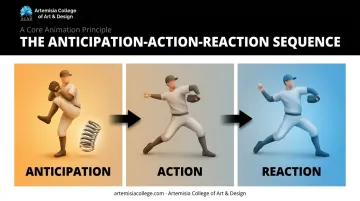
Anticipation is the preparatory action that tells an audience something is about to happen. It comes before the main action, and the reaction that follows reveals the outcome. Think of it as a three-beat structure: anticipation, action, reaction.
A character doesn't just throw a punch out of nowhere. Before the fist fires forward, three things happen:
- The shoulder pulls back
- The weight shifts
- The fist coils
That coiling isn't decoration. It's what makes the punch believable rather than jarring.
This preparatory buildup works because it mimics how energy stores and releases in the real world. Think of a compressed spring: it only moves powerfully once it's been loaded first.
Animation Mentor describes this as anticipation "selling" the buildup and storage of energy before the action happens. The timing, velocity, and size of that buildup need to match whatever comes next.
The textbook example is a baseball pitcher's wind-up. The pitcher doesn't step directly into the throw. There's a lean back, a leg lift, a coiled torso, all before the arm whips forward. Without that wind-up, the pitch would look like the ball simply appeared in flight. With it, viewers understand exactly what's coming and why it carries force.
The Origin: Disney's 12 Principles of Animation
Anticipation was formally documented by Disney veterans Ollie Johnston and Frank Thomas in their 1981 book, The Illusion of Life: Disney Animation. It's listed second among the 12 principles, right after Squash and Stretch.
That placement isn't accidental. Squash and Stretch gives a character weight and flexibility. Anticipation gives that same character intent. Together, they form the backbone of everything else that follows, from staging to follow-through.
Decades later, animation schools and VFX training programs still teach it as one of the first concepts students learn, regardless of whether they're working in hand-drawn 2D, rigged 3D, or stop-motion.
Why Anticipation Matters in Believable Animation
Without anticipation, movement looks like it's being dragged by an outside force rather than driven by the character's own decision. A character who suddenly teleports into a jump, with no crouch beforehand, feels wrong even to viewers who can't articulate why.
Anticipation also solves a practical visibility problem. Some actions, like a fast ball throw, might only take two or three frames on screen, too fast for the eye to register clearly. The preparatory pose gives the audience time to understand what's about to occur, so the action itself doesn't need to slow down to be readable.
There's a comedic dimension too. In classic cartoon timing, an exaggerated squash-before-surprise reaction (a character coiling up before an explosive jump-scare take) makes the eventual payoff land harder. The buildup raises tension, and the release resolves it, which is precisely the mechanism that makes physical comedy work.
Here's the twist: sometimes the best move is skipping anticipation on purpose. This is called a surprise gag. By withholding the expected preparatory pose, animators create shock or comedic anticlimax, because the audience's brain was primed for a wind-up that never arrived. Mastering anticipation means knowing the rule well enough to break it deliberately.
Richard Williams covers this exact tension in The Animator's Survival Kit, one of animation's most-cited technical references. If you're serious about the fundamentals, it's worth having on your shelf alongside Johnston and Thomas's original text.
Types and Real-World Examples of Anticipation
Anticipation shows up at every scale, from subtle facial shifts to full-body wind-ups. Common examples include:
- A heel pressing down before a step forward
- Lips compressing slightly before a character speaks
- A quick blink before a head turn
- Full-body squash preceding a jump
- Leaning opposite the run direction before a sprint start
The core rule: anticipation size should scale with action size. A small hop only needs a brief knee bend, while a superhero leap across a building needs a longer, more dramatic crouch. Get the proportions wrong, and even a well-drawn action feels unconvincing, either too abrupt or unnecessarily sluggish.
Broad vs. Subtle Anticipation
Classic animated shorts lean into broad, exaggerated wind-ups because the comedic style calls for it. A character about to sprint might crouch dramatically for several frames, telegraphing the burst of speed with theatrical flair.
Realistic character animation and feature films typically dial that back. The anticipation is still there, it just hides inside smaller gestures: a shift in weight, a held breath, a slight narrowing of the eyes. The principle doesn't change. Only the volume knob does.
Anticipation in Video Game Animation
Games add a functional layer to anticipation that film doesn't need to worry about: fairness. When an enemy raises a sword above its head before swinging, that pose isn't just artistic polish. It's a gameplay cue, giving the player a window to block, dodge, or counter.
This concept is often called telegraphing in game design circles, and it typically combines animation with sound cues or visual effects to make the warning unmistakable. Get the timing too short, and players feel cheated. Too long, and the game feels sluggish.
Because this skill directly affects playability, studios pay close attention to it during hiring. Job listings for animator roles commonly ask for a strong grasp of animation principles and anatomy alongside hands-on keyframing ability. Anticipation is one of the fundamentals bundled into that expectation.
Artemisia College's Animation & VFX program builds this exact skill set through direct placement coordination with studios including Ubisoft, Krafton, and Electronic Arts, giving students exposure to how gameplay-driven animation actually gets evaluated.
How to Master Anticipation: Practical Tips
Getting anticipation right means training your eye to notice when the "energy math" doesn't add up, rather than memorising a formula.
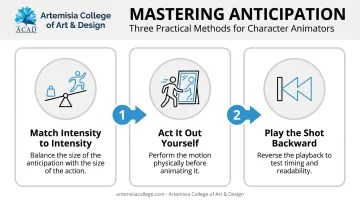
- Match intensity to intensity. The timing, velocity, and size of your anticipation pose should scale with the power of the action that follows. A gentle wave needs almost nothing beforehand. A haymaker punch needs a visible coil.
- Act it out yourself. Stand in front of a mirror, or film yourself performing the movement before animating it. Your body naturally finds anticipatory motions, like a shoulder drop or weight shift, that are easy to miss when working from imagination alone.
- Play the shot backward. This is a trick many professional animators swear by. In reverse, anticipation becomes follow-through. If the reversed motion looks stiff or abrupt at the start, that's usually where your anticipation is missing or too weak.
None of these steps require expensive tools. They just require a willingness to slow down and study motion before committing it to the timeline.
Common Mistakes and When to Skip Anticipation
Even animators who understand the theory can stumble on execution. Watch out for these:
- Underpowered anticipation in fast action. High-speed "superhero" moves need proportionally large anticipation, or a tiny crouch before a massive leap makes the speed look unconvincing instead of powerful.
- Unintended anticipation. This happens when a body part moves before it logically should, like a head flinching before a punch lands, usually because the reaction and impact get keyed on overlapping frames. The fix: add breakdown frames so the head stays still until contact.
There's also a key exception worth remembering: purely reactive, will-less objects don't need anticipation. A glass tipping off a table or hair blowing in the wind isn't driven by internal decision-making, so there's no intent to signal. Anticipation belongs to characters and objects that appear to choose their movements, not to things simply reacting to outside forces.
Building a Career Around Strong Animation Fundamentals
Studios reviewing animator, storyboard artist, and game animation portfolios treat principles like anticipation as a non-negotiable baseline. A reel that shows a character genuinely winding up before an action, with timing that matches the energy of the payoff, signals to recruiters that the fundamentals are solid. That signal carries more weight than rendering quality or software polish at this stage.
Getting there takes more than watching tutorials. It helps to have:
- Structured feedback on your posing and timing choices
- Guidance on which pieces belong in a demo reel versus a portfolio
- Practice presenting your work the way a studio interview actually unfolds
This is where industry-integrated education makes a measurable difference. Artemisia College of Art & Design's Animation & VFX program pairs classroom fundamentals with a dedicated Placement Cell that supports students through portfolio finalisation, CV creation, mock interviews, and coordination with hiring studios.
Ritik Sadiwal, a B.Des Animation graduate, credits that placement support with helping him land a role as a 3D Animator at Studio 56. Prince Choudhary, from the Game Design program, secured a Technical Artist Internship at Electronic Arts with similar guidance from the placement team.
Portfolio reviewers can spot memorized theory instantly. What convinces them is anticipation demonstrated confidently under interview pressure, with guidance that gets you interview-ready beforehand.

Frequently Asked Questions
What is an example of anticipation in animation?
Common examples include a knee bend before a jump, a shoulder wind-up before a punch, or a squash pose before a ball bounces. Each one prepares the viewer for the motion that follows.
Why is anticipation important in animation?
It prepares the audience for upcoming action, adds a sense of weight and realism, and prevents movement from looking mechanical or externally forced. Without it, even well-drawn motion can feel disconnected from the character's intent.
What are the 12 basic principles of animation?
They are Squash and Stretch, Anticipation, Staging, Straight Ahead Action and Pose to Pose, Follow Through and Overlapping Action, Ease In and Ease Out, Arcs, Secondary Action, Timing, Exaggeration, Solid Drawing, and Appeal, with Anticipation ranking second.
Can too much or too little anticipation hurt an animation?
Yes. Too little makes fast action look unconvincing, since the buildup doesn't match the payoff. Too much can slow pacing and dull the impact of surprise, especially in comedic or action-heavy scenes.
Is anticipation used differently in 2D animation versus 3D animation?
The underlying principle stays the same across both mediums. Execution differs though: 2D animators draw the anticipation pose and its in-betweens by hand, while 3D animators pose a rig and key its controls to achieve the same buildup.
How can beginners practice using anticipation in their animation?
Start with a simple bouncing ball exercise, film yourself acting out the motion for reference, and use the reverse-playback trick to spot where anticipation is missing or too weak. Repetition on small exercises builds the instinct faster than theory alone.