This is one of the most common frustrations for beginner animators, and it rarely has anything to do with drawing skill. The real culprit is almost always timing and spacing.
As TED-Ed puts it, "expert timing and spacing is what separates a slide show from a truly amazing animation." Timing is one of animation's original 12 core principles, and spacing is the technique behind another, Slow In and Slow Out. Together, they're what makes movement believable.
This guide breaks down what each term actually means, how they work together, and how you can start practising both today.
Key Takeaways
- Timing sets how long an action takes in frames; spacing sets how far it moves
- Four spacing types (linear, ease in, ease out, easy ease) each create a distinct feel
- Weight, scale, and emotion should shape every timing decision you make
- Uniform spacing and mismatched timing for mass instantly signal amateur animation
- Mentor-guided critique helps internalise these nuances faster than tutorials alone
What Is Timing and Spacing in Animation?
Timing is the number of frames an action takes to happen: how long it lasts. Spacing is the distance an object travels between each of those frames: how far it jumps from one frame to the next. Timing governs "when." Spacing governs "how."
Animation pioneer Norman McLaren captured this idea decades ago. As the British Film Institute explains, McLaren described animation as "not the art of drawings-that-move but the art of movements-that-are-drawn." The gaps between your frames matter just as much as the frames themselves.
Frames, FPS, and Keyframes
Every animation runs at a set frame rate, typically 24 frames per second (fps) in professional film and TV work. Within that rate:
- Keyframes mark the start and end poses of an action
- In-betweens (or "breakdowns") are the drawings or positions that fill the gap
- Exposure refers to how many frames a single drawing stays on screen
Understanding this vocabulary matters because timing and spacing decisions are made frame by frame, not in vague "fast" or "slow" terms.
Why the Bouncing Ball Shows Everything
Picture a ball dropping from a shelf:
- Fewer frames between the top and the ground = a fast, light drop
- More frames = a slower, heavier-feeling fall
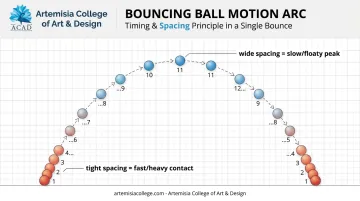
- Tight spacing near the contact point and wider spacing in the air shows gravity pulling the ball down
Here's the catch: you could keep the exact same duration and completely change how the drop feels just by rearranging where those frames sit in space. That's why timing and spacing are inseparable but not identical: you need to control both on purpose.
This framework isn't new. Disney animators Frank Thomas and Ollie Johnston first codified it in their 1981 book, The Illusion of Life, which remains the reference point most animation schools still teach from today.
Timing in Animation: How It Shapes Weight and Emotion
Timing functions as a storytelling tool: the number of frames you assign to an action tells your audience what something weighs, what it's made of, and how a character feels in that moment.
Three Factors That Should Drive Every Timing Decision
- Weight - Heavier objects need more frames to start moving and more frames to stop. A boulder doesn't snap into motion; it lumbers into it.
- Scale - Larger objects appear to move slower than small ones covering the same relative distance, even at identical speeds.
- Emotion - Fast, sharp movement reads as excitement or anxiety. Slow, lingering movement reads as calm, exhaustion, or sadness.
Try this comparison: animate someone throwing a bowling ball, then animate the same person throwing a balloon. The pose might be nearly identical, but the balloon throw needs far more frames on the follow-through and hang time, while the bowling ball snaps through its arc. Frame count alone tells your brain which object is heavier.
Planning Timing With a Timing Chart
Professional animators rarely guess at timing on the fly, especially when a scene involves several overlapping actions. They plan it using a timing chart or exposure sheet (X-sheet) - a grid that maps exactly how many frames each pose, hold, or transition should occupy before a single frame gets drawn or keyed. Studios producing feature films and game cinematics rely on these charts to keep entire animation teams synced on pacing before expensive production work begins. This planning step separates deliberate, weighty motion from animation that just "happens" to look okay.
A Practical Exercise to Start Today
Grab a stopwatch or your phone camera:
- Record yourself (or a friend) performing a simple action - sitting down, catching a ball, picking up a bag
- Count the frames the action takes at your target frame rate
- Key that exact timing into your animation before adjusting anything else
This habit builds an internal clock for realistic timing faster than guessing ever will.
Spacing in Animation: The Four Types Every Animator Should Know
Spacing determines whether a movement feels smooth, jarring, accelerating, or decelerating, without changing how long the action takes. It's the placement of an object's position between consecutive frames.
There are four classic spacing patterns every animator learns:
| Spacing Type | How It Looks | Feels Like |
|---|---|---|
| Linear | Frames spaced evenly throughout | Constant, mechanical motion (a conveyor belt, a robot arm) |
| Ease Out | Frames bunched at the start, widening later | Gradual acceleration (a car pulling away, a rocket lifting off) |
| Ease In | Frames widening early, bunching toward the end | Gentle deceleration (a car braking, a door easing shut) |
| Easy Ease | Frames bunched at both ends, spread through the middle | Natural, organic movement (a bouncing ball, a character gesture) |
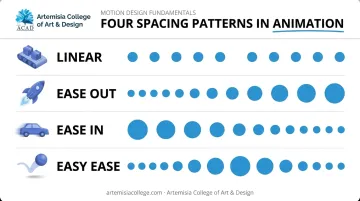
Linear spacing is useful, but only for things that genuinely move at a constant rate. Use it on a living character, and the motion instantly reads as stiff or robotic.
Fine-Tuning Spacing With Software Curves
Once you understand spacing on paper, software makes it precise:
- Maya uses the Graph Editor to display and reshape animation curves and tangents
- After Effects offers a Graph Editor with built-in Easy Ease, Easy Ease In, and Easy Ease Out controls
- Toon Boom Harmony calls its version the Function Editor, used to adjust velocity and ease along a motion path
These tools let you see spacing as a curve rather than guessing frame by frame. A steep curve segment signals fast movement, while a flattened section marks a slowdown, letting you diagnose timing problems at a glance. Animation & VFX students at Artemisia College practice with these curve editors to refine spacing before portfolio reviews.
The Uniform Spacing Trap
If you take one thing from this section, take this: overly uniform spacing is the single biggest giveaway of unrefined animation. Real movement rarely holds a constant speed for long. Pair your spacing choices with motion arcs (curved paths of movement) to keep everything feeling organic rather than mechanically straight.
Common Mistakes Beginners Make With Timing and Spacing
Even with the theory fresh in your mind, these mistakes show up constantly in early animation work:
- Uniform spacing throughout an action - removes any sense of acceleration or weight, leaving movement flat and lifeless
- Identical timing for objects of different mass - an elephant and a mouse animated in the same number of frames breaks physical believability instantly
- Skipping anticipation, overshoot, and settle - impacts and stops feel abrupt without these small preparatory and follow-through beats
Fixing the Anticipation Gap
A published breakdown of timing and spacing techniques recommends a simple fix for an action that jumps straight from preparation to impact. Add roughly 2-3 frames of anticipation, 1 frame of overshoot, and 4-6 frames of settle around the key action. Those extra frames alone can turn a stiff, robotic motion into something that reads as physical and alive.
The fix requires smarter placement of the drawings you already have, not more of them.
Building Strong Animation Fundamentals for a Creative Career
Self-study tutorials are a solid starting point for learning timing and spacing. But nuanced skills are harder to pick up alone.
Judging exactly how many frames a heavy object needs, or spotting mismatched spacing in your own work, tends to click faster under a mentor. They can watch your reel and tell you precisely what's off.
That's the gap structured, studio-style training is built to close.
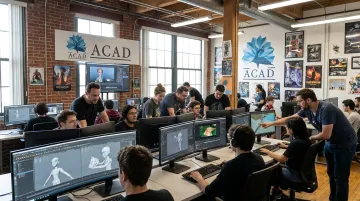
Artemisia College's Animation & VFX programme gives students exactly this kind of environment: hands-on projects, an in-house animation production studio, and training under industry-experienced faculty, rather than relying purely on tutorials watched alone.
The college is also an official Unreal Engine Academic Partner, which matters as more studios blend real-time engines into their animation pipelines.
Strong fundamentals open real doors in the industry. Artemisia's dedicated Placement Cell has connected animation graduates with globally recognised studios, including:
- Rockstar Games
- Electronic Arts
- Ubisoft
- Krafton
- Naughty Dog
If you're serious about turning timing, spacing, and the rest of the fundamentals into a real career, it's worth exploring the Animation & VFX programme to see how the coursework and placement support fit together.
Frequently Asked Questions
What is timing and spacing in animation?
Timing is the duration of an action measured in frames, while spacing is the distance an object travels between those frames. Together, they determine how believable and expressive a movement feels.
What is the difference between timing and spacing in animation?
Timing decides how long an action takes. Spacing decides how that time is distributed: whether movement accelerates, decelerates, or stays constant within that duration.
What are the different types of spacing in animation?
The four core types are linear (constant speed), ease in (gradual slowing), ease out (gradual acceleration), and easy ease (slow at both ends, faster in the middle).
Why is timing considered one of the most important animation principles?
Timing communicates weight, physics, and emotion in a way no single drawing can. Poor timing is one of the fastest ways an animation reads as unnatural, even with strong artwork.
How can beginners practice timing and spacing without expensive software?
Analyse reference footage frame by frame, time real actions with a stopwatch, and animate simple bouncing-ball exercises on paper or in a free flipbook tool.
Is timing and spacing different in 2D versus 3D animation?
The underlying principle is identical in both. 2D animators typically plan with hand-drawn timing charts, while 3D animators adjust curves directly in a Graph Editor.