
The college you choose shapes more than your resume. It builds your technical foundation, sharpens your creative instincts, and determines whether you walk out with a portfolio that actually gets you hired. Thousands of students enter fashion design programmes every year hoping to turn sketches into careers. This guide breaks down the institutes worth your attention, in India and beyond.
Key Takeaways
- Global fashion capitals (New York, London, Milan, Paris) remain iconic benchmarks.
- India's own ecosystem, from NIFT to emerging private colleges, offers strong, accessible alternatives.
- Program options span Diploma to B.Des/M.Des, with fees ranging dramatically between government and private institutes.
- Curriculum depth, placement support, and faculty experience matter more than brand recognition alone.
- Career paths extend well beyond "fashion designer," covering styling, merchandising, textile design, and entrepreneurship.
Overview of Fashion Design Education in India & Globally
A typical fashion design programme covers illustration, pattern making, draping, textile science, and portfolio development. Employers expect graduates to speak this technical vocabulary fluently from day one.
Beyond curriculum, institute choice matters because skill-building isn't uniform. A college with strong studio infrastructure and mentorship produces graduates who can walk into an interview with a coherent body of work, not scattered class assignments.
India's design education ecosystem has scaled quickly. The National Institute of Fashion Technology (NIFT) alone operates close to 20 campuses nationwide, a network few countries can match. Add private institutes, state universities, and specialised design colleges, and the options multiply fast.
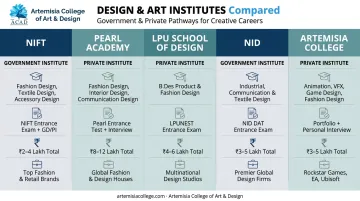
This scale isn't limited to India, though. New York, London, Milan, and Paris still anchor global fashion education with their industry proximity and legacy houses. But India has built something distinct: a mix of government rigor (NIFT, NID) and private flexibility (Pearl Academy, LPU, Artemisia College of Art & Design, and newer regional players) that doesn't require relocating abroad.
Below, we cover the institutes students across India, including those outside the metro bubble, should seriously evaluate.
Top Fashion Design Colleges & Universities to Consider
We shortlisted these institutes based on accreditation, curriculum depth, placement consistency, faculty experience, and industry exposure, not just name recognition.
Artemisia College of Art & Design
Artemisia teaches Fashion Design alongside Animation, Interior Design, Game Design and Fine Arts on one campus, with around 90% of its faculty drawn from those industries.
What makes it worth a look is the hands-on support structure rather than scale. Its Placement Cell guides students through portfolio finalisation, CV building and interview prep, backed by connections across fashion and design brands, and fashion students take on real client projects that they are paid for during the course.
| Category | Details |
|---|---|
| Programmes Offered | Certificate, Diploma and four-year B.Design in Fashion Design |
| Admission Route | Direct admission for Certificate and Diploma; ACAD Entrance Test or portfolio-based early admission for B.Design |
| Best Suited For | Students wanting industry-integrated, mentorship-driven fashion education with paid project work |
National Institute of Fashion Technology (NIFT)
NIFT is India's premier government fashion institute, operating under the Ministry of Textiles. It's a statutory body established under the NIFT Act, 2006, with campuses spread across the country.
What sets it apart: a decades-old alumni network, entrance-exam-driven admissions that filter for genuine aptitude, and unmatched industry recognition among Indian recruiters.
| Category | Details |
|---|---|
| Programmes Offered | B.Des, M.Des, B.F.Tech, and M.F.Tech across Fashion Design, Knitwear Design, Textile Design, Fashion Communication, and Leather & Accessory Design |
| Admission Route | NIFT Entrance Exam — General Ability Test (30%) + Creative Ability Test (50%), followed by a Situation Test/interview (20%) for B.Des |
| Placement Strength | Runs a centralised placement process across campuses each year; check NIFT's official placement brochure for current package figures before applying |
Pearl Academy
Pearl Academy has built a solid reputation in fashion, design, and business-of-fashion education across multiple Indian cities. It leans heavily into industry-facing curriculum rather than purely academic theory.
Its differentiators include tie-ups with global apparel brands and degree programmes delivered through its CAES partnership structure.
| Category | Details |
|---|---|
| Programmes Offered | B.Des/M.Des Fashion Design plus professional certificate courses |
| Fee Range | B.Des Fashion Design: ₹85,000 one-time fee + roughly ₹3,93,900 per semester (verify current figures on Pearl's official fee page, as amounts can change annually) |
| Industry Connect | Recruiter partnerships include H&M, Mango, UNIQLO, alongside Indian names like Biba, Masaba, and Satya Paul |
Lovely Professional University (LPU) School of Design
LPU runs one of India's largest private university setups, with dedicated fashion studios and a curriculum that leans into emerging tools like 3D garment modelling and sustainability electives.
It stands out for sheer scale, broad scholarship access, and a curriculum that keeps pace with industry shifts like technical textiles and digital design software.
| Category | Details |
|---|---|
| Programmes Offered | B.Des Fashion Design, with electives in sustainability, technical textiles, retail buying, and entrepreneurship development |
| Fee Range | Varies by scholarship slab; confirm the exact current amount directly on LPU's official admissions page |
| Placement Highlights | 2024 outcomes included offers from Trident (₹18 LPA), Shantanu & Nikhil, Skill in a Box, and Suvasa |
National Institute of Design (NID)
NID focuses on design thinking and interdisciplinary learning as one of India's premier government design institutes. Its programmes touch textile and apparel design rather than a single dedicated "fashion design" degree title.
Admission runs through NID's own Design Aptitude Test (DAT), not CEED, a common point of confusion among applicants. NID gained statutory recognition as India's 41st Institute of National Importance, as reported by Business Standard, cementing its research-driven design culture.
| Category | Details |
|---|---|
| Programmes Offered | B.Des Textile Design (Ahmedabad); M.Des Apparel Design and Lifestyle Accessory Design (Gandhinagar) |
| Admission Route | DAT Prelims (shortlisting) followed by DAT Mains: Studio Sensitivity Test (60%) + In-Person Sensitivity Test (40%) |
| Recognition | Institute of National Importance; strong design research reputation within India |
Fashion Design Career Paths & Salary Expectations
A fashion design degree opens more doors than most people assume. Common outcomes include:
- Fashion designer: designing collections for labels or launching your own
- Stylist: working with brands, editorials, or private clients
- Merchandiser: bridging design and retail buying decisions
- Textile designer: developing fabric prints, weaves, and finishes
- Pattern maker: translating sketches into wearable garment structures
- Entrepreneur: building an independent label from scratch
At Artemisia College, the placement cell has guided fashion design graduates toward roles with brands like Anita Dongre, Tarun Tahiliani, and Raymond, putting these career paths into practice.
According to Pearl Academy's own career guidance data, salary ranges shift significantly with experience:
- Entry-level: ₹1.8 to ₹3.6 lakh per annum
- Experienced professionals: ₹12 to ₹30+ lakh per annum
- Freelance assignments: ₹25,000 to over ₹1 lakh per project
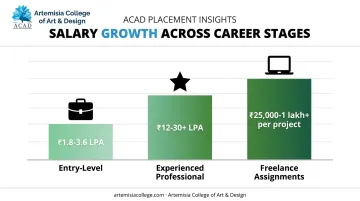
Treat these as institutional benchmarks rather than verified national averages.
Beyond traditional roles, fashion-tech is opening new ground. Skills in 3D garment design, sustainable textiles, and smart fabrics are increasingly valuable. Indian technical-textile exports touched roughly ₹21,407 crore in 2023-24, per Invest India's industry analysis, signalling real investment in this space. Freelancing and independent label launches are also becoming more viable as digital tools lower the barrier to entry.
How We Chose the Best Fashion Design Schools
Too many students pick a college based on brand name or the lowest fee, without checking whether placement support or portfolio guidance actually exists, and that's a costly mistake.
We weighed each institute against:
- Accreditation and institutional recognition (NAAC/UGC status, government affiliation)
- Faculty expertise and industry background
- Placement consistency, not just headline packages
- Infrastructure quality, including studios and software access
Reputation alone doesn't guarantee career outcomes, so we prioritised factors that actually predict whether a graduate lands relevant work.
Conclusion
The right fashion design school depends on your goals, your budget, and how much hands-on mentorship you need to get industry-ready. Reputation matters, but it shouldn't be the only factor.
Before finalising a decision, dig into curriculum depth, placement support structure, and whether the college genuinely helps build a hireable portfolio.
If you're based in Central India and want a college that pairs design education with dedicated placement mentorship, Artemisia College's Fashion Design programme is worth exploring. It offers a structured, well-guided start into the creative industry.
About Artemisia College of Art & Design
Choosing a fashion school comes down to how much studio time and real client work you actually get. Artemisia College of Art & Design is run under Tryambakam Education Foundation and was started to build a job-oriented degree college offering high quality art and design education at low cost. Around 90% of the faculty come from the animation, game, interior design and fashion industries, with five to thirty-five years of experience behind them.
Fashion design runs at three levels: the Certificate in Fashion Design, the Diploma in Fashion Design and the four-year B.Design in Fashion Design. The college also awards B.Design degrees in Animation, Game Design and Interior Design, BFA and MFA routes in Painting and Sculpture, and a Certificate in Photography.
Tuition is kept low compared with similar programmes elsewhere and scholarships are offered to bright and needy students. You can check the current fee structure or apply through early admission if you would rather submit a portfolio than sit an entrance test.
Frequently Asked Questions
Which university is good for fashion design?
NIFT, NID, and Pearl Academy remain strong, established choices with long placement histories. Institutes like Artemisia College offer personalised mentorship and placement support for students seeking accessible, industry-integrated learning outside major metros.
What jobs can I do if I love fashion?
Common roles include fashion designer, stylist, merchandiser, textile designer, fashion buyer, and entrepreneur running an independent label. Fashion-tech roles in 3D design and sustainable textiles are also emerging fast.
What is the eligibility for fashion design courses in India?
Undergraduate courses typically require Class 12 completion from any stream. Postgraduate programmes generally require a bachelor's degree in any discipline, though specific institutes may add portfolio or entrance test requirements.
Which entrance exams are needed for fashion design admission?
Common exams include the NIFT Entrance Exam, NID's Design Aptitude Test (DAT), and institute-specific tests like Pearl Academy's entrance evaluation. LPU accepts LPUNEST or alternatives like UCEED and CUET merit.
How much does a fashion design course cost in India?
Government institutes like NIFT and NID typically cost less than private colleges such as Pearl Academy or LPU, where annual fees can run into several lakh rupees. Always verify current fees on the official college website before applying.
Is fashion design a good career choice?
Yes, with strong entrepreneurship potential and growing demand across styling, merchandising, and textile-tech roles. Success depends heavily on choosing a college with genuine placement support, not just a recognisable name.