Introduction
Pinterest boards, Instagram reels, and AI mood-board generators have changed how designers gather inspiration. But when it comes to getting a specification right or understanding why a room feels balanced, a well-chosen book still does the job better than a scroll session.
The trouble is choosing wisely. With hundreds of titles ranging from dense technical manuals to glossy coffee-table inspiration, many aspiring designers waste money on books that look impressive but teach nothing new.
This guide sorts the noise. We've grouped the most-recommended interior design books by purpose (technical reference, theory, or styling) and by reader stage (student or working professional). Build a library that actually earns its shelf space.
TL;DR
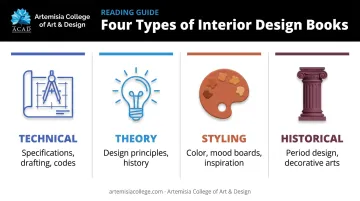
- Interior design books fall into four types: technical, theory, styling, and historical
- Students need foundational, course-style books covering drafting, specifications, and design principles
- Professionals lean on quick-reference manuals and client-presentation resources
- Books supplement studio training and mentorship; they don't replace it
Why Interior Design Books Still Matter for Students and Professionals
Scattered blog posts and Pinterest pins rarely give you verified measurements, code references, or historical context in one place. Books do, and design schools know it.
Required-text lists still exist for a reason. The New York School of Interior Design's official "Required Textbooks for Reserves" document, updated as recently as September 2023, lists mandatory and suggested titles by course, edition, and ISBN across its entire curriculum. This proves that structured programmes still anchor coursework in printed references rather than scattered web content.
Professional certification bodies lean on books too. The CIDQ's NCIDQ Exam Reference Materials list, revised in November 2025, names specific texts, including Construction Drawings and Details for Interiors, as representative study resources for exam candidates preparing to practise professionally.
Here's what this means practically:
- Design schools keep a small physical reference shelf alongside digital tools for accuracy in drafting, codes, and specifications
- Working designers return to the same handful of books repeatedly for precedent and inspiration, even while running their day-to-day projects on software
- Both groups rely on books as a dependable layer underneath faster digital research, not merely as optional extras
The list below curates titles that consistently show up across design school syllabi and professional exam prep, organised by what stage of your design journey they serve best.
Top Interior Design Books for Students & Professionals
We selected these titles based on author authority and practical applicability, weighing how consistently each is recommended across design curricula and professional resources, with attention to relevance for both Indian and global design practice.
The Interior Design Reference & Specification Book

Chris Grimley and Mimi Love's guide packs charts and diagrams on space, materials, life safety, lighting, and sustainability into a portable format. It's built for fast answers, not long reads.
This is the book you grab mid-client-meeting when someone asks about standard counter heights or code-compliant clearances. No flipping through chapters, just the number you need.
| Attribute | Details |
|---|---|
| Best For | Working professionals needing a fast, reliable desk/site reference |
| Key Topics Covered | Standard measurements, specifications, materials, and finishes |
| Skill Level | Intermediate to Professional |
Construction Drawings and Details for Interiors

Rosemary and W. Otie Kilmer's text (now in its 4th edition) teaches you to read and produce construction documentation, from drafting conventions to CAD and BIM workflows.
The real value here is bridging the gap most students struggle with: turning a beautiful concept sketch into a buildable drawing set contractors can actually follow.
| Attribute | Details |
|---|---|
| Best For | Students learning technical documentation and working drawings |
| Key Topics Covered | Construction drawings, detailing standards, documentation practices |
| Skill Level | Beginner to Intermediate |
Residential Interior Design: A Guide to Planning Spaces

Maureen Mitton and Courtney Nystuen cover room-by-room residential planning, ergonomics, accessibility, and building systems in one comprehensive volume.
What makes it useful is how it connects textbook theory to real client scenarios: kitchens that actually work for a family of five, bathrooms that meet universal design needs.
| Attribute | Details |
|---|---|
| Best For | Students and early-career designers focusing on residential work |
| Key Topics Covered | Space planning, ergonomics, room-by-room design principles |
| Skill Level | Beginner to Intermediate |
Architectural Graphics

Francis D. K. Ching's classic (now 7th edition) teaches visual communication: drafting conventions, presentation drawings, and how to represent space on paper or screen.
Even designers who work entirely in digital tools benefit here. Understanding why a drawing convention exists makes you faster and more accurate when you switch to software.
| Attribute | Details |
|---|---|
| Best For | Students building sketching, drafting, and visual communication skills |
| Key Topics Covered | Drafting conventions, presentation drawings, visual storytelling |
| Skill Level | Beginner |
Interior Design and Decoration

Sherrill Whiton's foundational text has anchored design education for decades, tracing historical interiors, furniture, and decorative arts alongside core design principles.
It stands out for context. Knowing where a design movement came from helps you use its principles intentionally rather than by accident.
| Attribute | Details |
|---|---|
| Best For | Students wanting historical and theoretical grounding |
| Key Topics Covered | Design history, decoration principles, period styles |
| Skill Level | Beginner to Intermediate |
A Pattern Language

Christopher Alexander and his co-authors mapped over 250 recurring design problems, and their solutions, across rooms, buildings, and neighbourhoods.
This one deepens your understanding of why spaces feel right beyond just how they look. It's less a design manual, more a way of thinking about human behaviour in built environments.
| Attribute | Details |
|---|---|
| Best For | Professionals and advanced students exploring design psychology |
| Key Topics Covered | Spatial patterns, human behaviour, architectural theory |
| Skill Level | Intermediate to Professional |
The Colour Scheme Bible

Anna Starmer breaks color theory into practical, usable chunks: 200 schemes and 50 palettes explained through material and mood combinations.
For designers who freeze up when a client says "make it feel warmer," this book gives you a systematic way to build confident palettes instead of guessing.
| Attribute | Details |
|---|---|
| Best For | Students and professionals refining colour and mood-board skills |
| Key Topics Covered | Colour theory, palette building, mood and perception |
| Skill Level | Beginner to Intermediate |
The Interior Design Course: Principles, Practices, and Techniques

Tomris Tangaz structured this as a course in book form, covering everything from site research and sketching to CAD, materials, lighting, and portfolio-building.
It's ideal for someone exploring the field before committing to formal study, essentially a one-volume preview of what design school covers.
| Attribute | Details |
|---|---|
| Best For | Aspiring students exploring interior design before or during formal study |
| Key Topics Covered | Design elements, principles, career practices |
| Skill Level | Beginner |
How to Choose the Right Books for Your Career Stage
Not every book on this list belongs in every reader's bag. Match your picks to where you actually stand.
If you're a student, prioritise:
- Foundational, course-style books that build core competency (The Interior Design Course, Architectural Graphics)
- Drafting and documentation texts before you specialise (Construction Drawings and Details for Interiors)
- Theory books that give you context for design decisions (Interior Design and Decoration)
- Material and finish guides that build practical vocabulary before internships or studio critiques
If you're a working professional, prioritise:
- Quick-reference technical manuals for day-to-day project challenges (The Interior Design Reference & Specification Book)
- Client-presentation-focused resources that sharpen how you sell an idea
- Books that solve immediate problems, not ones that require weeks to work through
Whichever stage you're at, balance is essential. Pair classic theoretical texts with at least one or two contemporary titles, so your knowledge of timeless principles doesn't drift out of step with current client expectations and material availability.
Books Alone Aren't Enough: Turning Knowledge into Industry-Ready Skill
Reading builds vocabulary. It doesn't build a portfolio. The gap between knowing a construction detail and drafting one correctly under deadline pressure only closes through actual studio practice.
Real competency comes from three things books can't fully deliver:
- Studio practice: applying space-planning theory to an actual client brief with real constraints
- Software proficiency: translating hand-drawn concepts into CAD or 3D deliverables clients expect
- Mentor feedback: someone experienced pointing out what a textbook diagram misses in your specific project
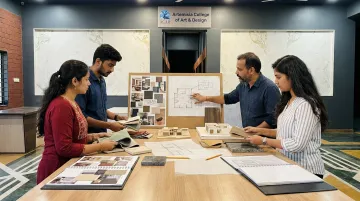
Structured design education is built to close that gap. Artemisia College of Art & Design's Interior Design programme pairs foundational reading like the titles above with hands-on studio work, portfolio development, and direct mentorship from faculty with industry backgrounds.
Artemisia's dedicated Placement Cell then takes that combination further. It works with students on portfolio finalisation, mock interviews, and company-specific application guidance, helping turn book-and-studio knowledge into a presentation that actually lands a job.
Past Interior Design graduates from the programme have secured roles at firms including Livspace and VIMA – The Dimension. That track record shows the theory-to-studio-to-placement pipeline works in practice, not just on paper.
Conclusion
There's no single "best" interior design book. The right pick depends entirely on whether you need foundational learning, a fast technical answer, or creative inspiration for your next mood board.
Build a small, purposeful library instead of collecting titles randomly. Start with books that match where you are right now, not where you hope to be in five years.
If you're ready to move beyond reading and into hands-on, mentor-led training, Artemisia College of Art & Design's Interior Design programme offers exactly that. Structured studio practice can complement everything you've learned from the page.
About Artemisia College of Art & Design
Reading widely is a good habit, but drawing and specifying are learned in a studio. Artemisia College of Art & Design runs under Tryambakam Education Foundation, built around one idea: strong fundamentals make a designer, software familiarity makes a computer operator. Around 90% of its faculty come from the animation, game, interior and fashion industries.
Interior design runs at three levels: the Certificate in Interior Design, the Diploma in Interior Design and the four-year B.Design in Interior Design. The college also awards B.Design degrees in Animation, Game Design and Fashion Design, BFA and MFA routes in Painting and Sculpture, and a Certificate in Photography.
The college keeps tuition low and offers scholarships to bright and needy students. The current fee structure is published online, and early admission lets you apply on a portfolio and interview instead of an entrance test.
Frequently Asked Questions
What is the best interior design book?
There isn't one universal answer. It depends on your need. For technical reference, The Interior Design Reference & Specification Book is a strong pick; for theory and history, Interior Design and Decoration remains a go-to.
Which interior design books are best for beginners and students?
Course-style and foundational texts work best, particularly The Interior Design Course: Principles, Practices, and Techniques and Residential Interior Design: A Guide to Planning Spaces. Both build core skills without assuming prior knowledge.
Do professional interior designers still rely on books, or mostly on design software?
Most professionals use software like AutoCAD, SketchUp, or Revit for execution but still keep books nearby for specifications, theory, and inspiration. Architectural Digest's 2025 roundup found several top designers return repeatedly to specific titles for precedent and creative reference.
Are books by international (US/UK) authors still relevant for Indian interior design students?
Yes, core principles of space, colour, and construction detailing translate across regions. That said, students should adapt material choices and building codes to Indian standards like the National Building Code, since international titles often reference their own local codes.
How many interior design books should a student own to start with?
Start with three to five core titles covering theory, drafting, and space planning rather than buying many books at once. Add specialised titles later as your interests and project needs become clearer.
How can I apply what I learn from these books in a real design career?
Structured programmes with studio practice and mentorship, such as Artemisia College's Interior Design course, help convert book knowledge into practical, portfolio-ready skills. Reading builds the foundation; guided studio work and placement support turn it into an actual career.