Introduction
Turning a script or brief into a character audiences remember and animators can actually use is the real job of 2D character design. It's the process of translating personality, backstory, and narrative role into flat, illustrated visuals ready for production.
If you're an aspiring animator, illustration student, or career-switcher eyeing the animation industry, this process matters more than any single drawing skill. Many people assume character design is "just drawing cool characters." It isn't.
This guide breaks down every stage of that process, the tools and skills involved, and how to build a career around it.
Key Takeaways
- 2D design flows through research, concept art, sketching, refinement, and model sheets.
- Studios apply it across film, games, advertising, and edtech for audience recall.
- Anatomy, software skills, and studio feedback define production-ready character designs.
- Mentorship-led training, like Artemisia College's Animation & VFX program, builds hireable skill.
What Is 2D Character Design?
2D character design is the process of visually conceptualising and rendering a character in two-dimensional space, using line, colour, silhouette, and form to communicate personality, backstory, and story function. The goal goes beyond a pretty drawing: a character that reads instantly, resonates emotionally, and hands off cleanly to the animators or riggers who'll bring it to life.
This is different from 3D character modelling, which sculpts geometry with actual depth for rigging and rendering. 2D design produces flat, illustrated assets; 3D produces dimensional models. Both start with concept art, but the deliverables diverge sharply from there.
Why It Matters in Animation
Strong character design drives recognition long after the story ends. Mickey Mouse's three-circle silhouette, developed and refined between 1929 and 1939, remains one of the most recognised shapes on the planet, according to D23's history of Mickey's design evolution.
That recognisability compounds into business value. A 2024 IPA analysis of creative consistency across 4,000+ ads and 56 brands found that the most visually consistent brands generated 27% more very large brand effects and 28% more very large business effects. Recurring characters were one contributing factor among several, but the pattern is clear: consistent, well-designed visual assets pay off.
Where It's Applied
Character design shows up wherever a story needs a face:
- Animated films and series — lead designers build an entire cast's visual language before a single frame animates
- Mobile and PC games — hand-drawn 2D characters get built directly into game engines for playable assets
- Advertising and explainer content — brands commission original characters for short-form campaigns and mascots
- Edtech and corporate animation — recurring characters guide users through educational or instructional content
The 2D Character Design Process: Step-by-Step Breakdown
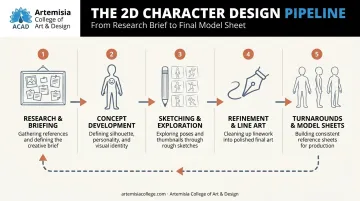
This process isn't a straight line. Designers loop back between stages constantly, responding to director notes, team feedback, and production constraints. Here's how it typically unfolds.
Step 1: Research & Briefing
Every design starts with a brief: the script, genre references, target audience, and a personality description from the writer or director. Designers then build a mood board, pulling colours, textures, and tonal references that match the story's world.
Step 2: Concept Development
Next, personality traits and narrative role start shaping visual decisions. Is this character young or old? Tall or squat? What does their silhouette say before they even speak? Body type, age, and attire all get roughed out here based on who the character is, not just what looks cool.
Step 3: Sketching & Exploration
This is where volume matters more than polish. Artists produce dozens of rough thumbnails, testing silhouette, proportion, pose, and expression. Skipping this stage is one of the fastest ways to end up with a generic, forgettable design.
Step 4: Refinement & Line Art
Once a direction gets approved, the chosen sketch gets cleaned into confident line art. Shading and texture get layered in next, matching the production's established art style. Expect several revision rounds here based on director feedback. This is normal, not a red flag.
Step 5: Turnarounds & Model Sheets
The final deliverables are what actually keep a production running smoothly:
- Front, three-quarter, side, and back turnarounds
- Expression sheets showing the character's emotional range
- Pose sheets and costume/prop details
These documents, as ScreenSkills notes in its character designer profile, function as the reference point animators and riggers use to keep a character consistent from scene to scene. Skip them, and consistency errors creep in fast.
Skills, Tools & Software Every Character Designer Needs
Great character design rests on a handful of core fundamentals:
- Anatomy — even stylised characters need believable structure underneath
- Perspective — so poses read correctly from any camera angle
- Silhouette design — the shape test that determines instant recognisability
- Expression drawing — conveying emotion with minimal linework
Software That Gets Used in Production
| Tool | Best for |
|---|---|
| Photoshop | Painting, sketching, concept art |
| Clip Studio Paint | Character drawing plus frame-by-frame animation |
| Toon Boom Harmony | End-to-end 2D production and rigging |
| TVPaint | Bitmap-based frame-by-frame animation |
| Illustrator / Inkscape | Vector-based, flat art styles |
No single tool is objectively "best." Studios choose based on their art style; raster tools like Photoshop suit painterly work, while vector tools like Illustrator suit cleaner, flat-shaded styles.
Soft Skills That Actually Get You Hired
- Taking art-director feedback without getting defensive
- Iterating fast under real deadlines
- Communicating design intent clearly to modellers and animators
A hiring-ready portfolio typically shows range: multiple character types, varied expressions, and poses that prove you can adapt, not repeat one style. Studio-style critique builds that range faster than working alone, because you have to defend and revise your choices under real feedback pressure.
At Artemisia College, students develop exactly this range through mentor-led crit sessions before the placement cell connects them with studios like Ubisoft, Rockstar Games, and Lakshya Digital.
Common Mistakes and Misconceptions Beginners Make
Beginners tend to trip on the same handful of issues:
- Treating design as pure drawing. Ignoring personality, backstory, and narrative role produces technically nice art that doesn't serve the story.
- Skipping the sketching stage. Jumping straight to a "final" polished design usually locks in generic choices before better ideas get explored.
- Confusing design with animation. Character design happens in pre-production and defines how a character looks; animation happens later and defines how they move. Different skill sets, different jobs.
- Making model sheets optional. Skip them, and costly inconsistencies creep in: wrong proportions, mismatched colours, missing details that shift from frame to frame once animation starts.
Building a Career in 2D Character Design
Most careers start through one of a few doors:
- Junior character designer roles at animation or game studios
- Illustrator-to-animation transitions, where existing drawing skill gets redirected toward production pipelines
- Internships at established studios, which double as portfolio-building opportunities
Studios generally look for one combination: strong fundamentals paired with a portfolio that's already been tested against real feedback, not just polished in isolation.
This is where structured training earns its keep. Artemisia College's Animation & VFX program is built around real studio pipelines and mentorship-driven portfolio development, so students practise real industry expectations from day one instead of guessing at them.
The college's Placement Cell adds another layer of support:
- Finalises portfolios and creates CVs
- Runs mock interviews and one-on-one mentoring
- Coordinates directly with hiring studios, including Rockstar Games, Electronic Arts, and Green Gold Animation
Structured mentorship and direct industry coordination turn that technical mastery into an industry-ready career, converting hobbyist sketches into professional portfolio pieces.
Frequently Asked Questions
What software do animators use for 2D character design?
Most designers use Photoshop or Clip Studio Paint for the illustration and concept stages. Production teams then move approved designs into Toon Boom Harmony or TVPaint to build animation-ready assets.
What's the difference between 2D character design and 3D character modelling?
2D design produces flat, illustrated artwork used for turnarounds and model sheets. 3D modelling sculpts actual geometry with depth, built specifically for rigging and rendering.
What skills are essential to become a 2D character designer?
You need solid anatomy, silhouette and expression drawing, and comfort with industry software. Just as important is the ability to take feedback and revise quickly without losing the character's core identity.
How long does it take to design a professional 2D animation character?
It varies widely by complexity and revision rounds. A full cycle, from initial research through to a finished model sheet, can take anywhere from a few days to several weeks.
Do you need a degree to work as a 2D character designer?
A strong portfolio matters most to hiring studios. That said, structured programs like Artemisia College's placement cell add real value, offering portfolio reviews, mock interviews, and direct connections to studios such as Ubisoft and Electronic Arts.
What is a model sheet in character design?
A model sheet is a production reference document showing a character's turnarounds, expressions, and costume details. Animators and riggers use it to keep the character consistent across every scene.