
That's where books still earn their place. The right ones expose you to decades of trial-and-error compressed into a few hundred pages, saving you from repeating mistakes veteran designers already solved.
This blog rounds up 10 of the most recommended books for game designers, chosen for their relevance, depth, and real-world applicability across different career stages.
TL;DR
- Books build design fundamentals that hands-on practice alone can't teach
- Our list spans theory (Rules of Play) and psychology (A Theory of Fun)
- It also covers holistic design (The Art of Game Design) and systems thinking (Game Mechanics)
- Selection criteria: industry recognition, depth of insight, and usefulness across career stages
- Formal, industry-linked education turns this theory into a job-ready portfolio
Why Books Still Matter for Aspiring Game Designers
Game design sits at the crossroads of psychology, systems thinking, and storytelling. That's a wide skill set, and no single YouTube tutorial covers all three at once.
Tutorials and game engines teach you how to build something. Books teach you why a design decision works in the first place — the reasoning that eventually becomes design intuition.
Take player psychology and systems thinking as examples. Understanding human drives and flow states explains why players stick with a game or abandon it, which shapes how you pace challenges and rewards.
Systems thinking works the same way: designers who grasp how interconnected mechanics react to player behaviour build more varied, less rigid experiences.
This is also why serious academic programs treat design theory as core curriculum, not an afterthought. Carnegie Mellon's game design program, for instance, has students study the histories, theory, and practice of game creation rather than tools alone.
Formal, industry-linked education takes this a step further. Programs like Artemisia College's Game Design curriculum help students apply theoretical concepts through mentorship and studio-style, portfolio-focused projects, turning book knowledge into something a hiring manager can actually evaluate.
Top 10 Best Books for Game Designers
These ten titles were selected for their relevance across beginner to advanced designers, their coverage of psychology, systems, narrative, and craft, and their continued citation across game design curriculums and studios worldwide.
The Art of Game Design: A Book of Lenses – Jesse Schell

Jesse Schell has taught at Carnegie Mellon's Entertainment Technology Center since 2002, worked as a Disney Imagineer, created Toontown Online, and now runs Schell Games as CEO. That real-world résumé shows in the book's structure.
Rather than one linear framework, Schell organises the book around "lenses," mental checklists for examining a game from a specific angle. The current edition contains over 100 of these lenses, covering everything from player motivation to game balance.
That's what makes it one of the most widely recommended entry points into design theory: it doesn't just cover mechanics. It looks at the designer, the process, the game, the player, and the experience as one connected system.
| Category | Details |
|---|---|
| Best For | Beginners and experienced designers seeking a comprehensive foundation |
| Key Focus | Psychology-driven, multi-lens approach to design thinking |
| Format/Extras | Companion card deck and app for brainstorming sessions |
Rules of Play: Game Design Fundamentals – Katie Salen & Eric Zimmerman

Published by MIT Press in 2003, this book has become one of the most cited texts in game studies. MIT Press describes it as establishing a theoretical framework and critical vocabulary for games and game design, treating games as systems of information and feedback.
Both authors bring serious academic weight. Zimmerman teaches at NYU's Game Center and has previously taught at MIT, Parsons, and RISD. Salen teaches across computer game science and human-computer interaction programs. It's no surprise MIT's own OpenCourseWare game design syllabus lists this book as required reading.
What sets it apart:
- Dives into the theoretical "why" behind design choices, not just the "how"
- Frames games as cybernetic systems, useful for anyone building complex mechanics
- Analyses board games, sports, and digital games under one shared framework
| Category | Details |
|---|---|
| Best For | Design students and professionals interested in game theory and academia |
| Key Focus | Systems thinking and formal frameworks of play |
| Note | Denser read; best suited for those ready to engage with academic material |
A Theory of Fun for Game Design – Raph Koster

Raph Koster served as creative lead on Ultima Online and later as creative director on Star Wars Galaxies — two titles that shaped how MMOs approach player engagement. That experience informs this book's central question: why do humans find games fun in the first place?
The revised second edition (2013) is fully illustrated and presented in colour, a deliberate departure from dense design textbooks. Koster connects fun to the brain's pattern-recognition and problem-solving instincts, framing games as tools for learning rather than pure entertainment.
The standout strength: it breaks down the neuroscience of engagement in a format that's genuinely approachable, useful whether you're a first-year student or a decade into your career.
| Category | Details |
|---|---|
| Best For | Designers wanting an engaging, easy introduction to player psychology |
| Key Focus | Psychology of fun, reward, and engagement |
| Format | Illustrated and conversational, unlike typical design textbooks |
The Gamer's Brain – Celia Hodent

Celia Hodent holds a PhD in psychology and has worked across some of the industry's biggest UX teams, including Ubisoft's Strategic Innovation Lab and LucasArts. She later served as Director of User Experience at Epic Games, where her work touched Fortnite, Unreal Engine 4, and Paragon.
The book applies cognitive science and UX methods directly to game design decisions, covering perception, memory, attention, motivation, and emotion. It's less about theory for theory's sake and more about building usable, engaging player experiences.
Where it delivers value:
- Connects academic UX principles to actual game design decisions
- Covers usability testing, analytics, and UX strategy alongside cognitive psychology
- Bridges the gap between "this feels fun" and "this is measurably usable"
| Category | Details |
|---|---|
| Best For | Designers focused on player experience and UX-driven design |
| Key Focus | Cognitive psychology and usability applied to games |
| Pairs Well With | General UX texts for a broader design perspective |
Game Mechanics: Advanced Game Design – Ernest Adams & Joris Dormans

This one's not for beginners, and it doesn't pretend to be. Ernest Adams founded the International Game Developers Association and worked as a lead designer at Bullfrog, while Joris Dormans built the Machinations visual framework for simulating and balancing game economies.
Published in 2012, the book teaches the Machinations tool alongside chapters on internal economies, progression mechanisms, feedback structures, and simulation balancing. It's platform-agnostic, meaning the principles apply whether you're designing a mobile game or a sprawling RPG economy.
What makes it different: it moves past basic mechanics into the numerical, systemic reasons why gameplay feels balanced (or doesn't), covering territory most beginner books never touch.
| Category | Details |
|---|---|
| Best For | Intermediate to advanced designers ready to go beyond fundamentals |
| Key Focus | Systems design, economies, and progression mechanics |
| Prerequisite | Basic understanding of core game design principles recommended |
Fundamentals of Game Design – Ernest Adams

Ernest Adams returns here with a broader foundation text that walks through the full design pipeline: concepting, mechanics, worldbuilding, interface design, and production realities. Where Game Mechanics goes deep on systems, this volume is the structured overview many programs assign first.
It is widely used in university syllabi because it maps cleanly onto coursework. Each chapter pairs principles with exercises, so readers can practice rather than only absorb theory.
What sets it apart:
- Covers the full design lifecycle in one reference volume
- Strong on genres, player roles, and design documentation habits
- Practical exercises that translate well into classroom or self-study work
| Category | Details |
|---|---|
| Best For | Students and early-career designers building a complete foundation |
| Key Focus | End-to-end fundamentals across mechanics, narrative, and production |
| Note | Excellent companion to Adams & Dormans for systems depth later |
Level Up! The Guide to Great Video Game Design – Scott Rogers

Scott Rogers draws on years as a designer and creative director across console titles, then packages that experience into a highly visual, example-driven guide. The book is known for its humor and diagram-heavy explanations of level flow, camera work, and player guidance.
It sits between beginner accessibility and intermediate craft. You get concrete patterns for teaching players through space, pacing encounters, and avoiding common layout mistakes that kill fun on first play.
Where it delivers value:
- Visual explanations that stick better than pure prose
- Strong coverage of level design, tutorials, and player onboarding
- Industry war stories that connect principles to shipped games
| Category | Details |
|---|---|
| Best For | Designers focused on levels, flow, and player guidance |
| Key Focus | Level design craft, camera, and teaching through space |
| Format | Illustrated, conversational, and example-heavy |
The Game Design Workshop: A Playcentric Approach to Creating Innovative Games – Tracy Fullerton

Tracy Fullerton's classic workshop text is built around iterative prototyping and playtesting. It treats design as a cycle of making, observing players, and refining - not a one-pass document exercise.
The playcentric method is especially useful for students and indie teams who need a repeatable process. Paper prototypes, formal playtest protocols, and structured reflection exercises appear throughout.
The standout strength: it turns "just make something and see" into a disciplined practice with clear steps, roles, and evaluation criteria.
| Category | Details |
|---|---|
| Best For | Students, educators, and teams building a prototyping culture |
| Key Focus | Playtesting, iteration, and playcentric design process |
| Pairs Well With | Schell's lenses for idea generation before each prototype cycle |
Challenges for Game Designers – Brenda Brathwaite & Ian Schreiber

This book is less a theory monograph and more a workout plan. Brathwaite and Schreiber pack dozens of design challenges that force you to invent mechanics, constraints, and systems under tight creative briefs.
It is ideal when you already know the vocabulary but need reps. Many exercises deliberately remove digital tools so you focus on rules, incentives, and player goals instead of engine features.
What makes it different: deliberate practice over passive reading - you close the book having designed, not only annotated.
| Category | Details |
|---|---|
| Best For | Designers who learn by doing and want structured creative drills |
| Key Focus | Hands-on challenges across genres, constraints, and systems |
| Prerequisite | Basic familiarity with core design terms helps, but not required |
The Game Narrative Toolbox – Tobias Heussner, Toiya Kristen Finley, Jeremy Soule & Ann Lemay

Narrative designers need more than plot tips - they need pipelines, documentation, and collaboration patterns that survive production. This toolbox-style volume covers character work, worldbuilding, branching structures, and writing for interactive media.
It bridges story craft and team process, which is why it shows up alongside systems texts on many reading lists. If your gap is writing for players who choose paths, this is the practical counterpart to pure theory books.
Where it delivers value:
- Concrete narrative tools usable in pre-production and production
- Coverage of branching, characters, and world consistency
- Team-oriented advice for working with designers and producers
| Category | Details |
|---|---|
| Best For | Narrative designers and hybrid designer-writers |
| Key Focus | Interactive storytelling craft and production workflow |
| Pairs Well With | Schell and Fullerton for systems-plus-story balance |
How We Selected These Books
Each title on this list was evaluated against three criteria: industry recognition, citation frequency across design courses and studios, and coverage of both theory and practical application. Books that only appeared in a single curriculum or lacked real-world backing didn't make the cut.
A common mistake aspiring designers make is sticking to one lens: reading only beginner-friendly books, or skipping psychology-focused texts because they seem "less technical."
That approach leaves gaps. A designer who understands systems but not player psychology will build mechanically sound games that don't feel satisfying. One who understands fun but not systems will struggle to scale a design into something balanced and repeatable.
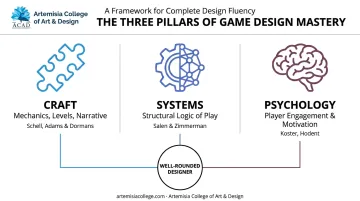
The strongest design thinking comes from mixing perspectives:
- Craft: how mechanics, levels, and narrative fit together (Schell, Rogers, Adams & Dormans, Heussner et al.)
- Systems: the formal, structural logic behind play (Salen & Zimmerman, Adams, Brathwaite & Schreiber)
- Psychology: why players engage, learn, and stay motivated (Koster, Hodent)
- Process: how iteration and playtesting turn ideas into shippable designs (Fullerton)
Conclusion
Books build the theoretical foundation, but they're not the finish line. Real growth as a game designer comes from applying these concepts through actual projects, honest feedback, and mentorship from people who've shipped games before.
Pair your reading list with hands-on practice. Build a portfolio. Get comfortable with the tools and workflows studios expect from new hires.
That's exactly the gap Artemisia College's Game Design program is built to close. The curriculum combines theoretical grounding with industry-integrated training and mentorship, backed by dedicated placement support that helps students transition smoothly into studio roles.
About Artemisia College of Art & Design
Reading the canon helps; building and testing your own game helps more. Artemisia College of Art & Design was set up under Tryambakam Education Foundation to make high quality art and design education affordable without thinning it out. Roughly 90% of the teaching staff come from working industry, bringing between five and thirty-five years of practice into the studio. The college runs ACAD Studios, its own animation and game production house, and students join it as paid interns from their fourth semester onward.
Game design runs at two levels: the Certificate in Game Design and the four-year B.Design in Game Design, taught in Unreal Engine under the college's Unreal Engine Academic Partner recognition. The college also awards B.Design degrees in Animation, Interior Design and Fashion Design, BFA and MFA routes in Painting and Sculpture, and a Certificate in Photography.
Fees are deliberately low so cost is not what decides whether a creative student can study, and scholarships are available. Have a look at the fee structure, or go through early admission if a portfolio suits you better than an entrance test.
Frequently Asked Questions
What are the top 10 books for game design?
This blog covers 10 highly recommended picks spanning theory, psychology, systems, level craft, narrative, and playcentric process. Start with The Art of Game Design or A Theory of Fun, then branch into systems (Rules of Play, Game Mechanics), craft (Level Up!, Fundamentals of Game Design), and practice (The Game Design Workshop, Challenges for Game Designers).
How can I read game design books for free?
Try library apps like Libby for free ebook borrowing, or check publisher preview chapters and free resources such as The Nature of Code. Students enrolled in design programs, including Artemisia College's, typically get campus library access to these titles too.
What is the best book to start with as a beginner game designer?
The Art of Game Design or A Theory of Fun for Game Design are the best starting points. Both use accessible language and cover foundational concepts without assuming prior design experience.
Do I need to read design books if I'm already studying game design formally?
Yes. Books deepen theoretical understanding that structured coursework, like the project-based studio learning at Artemisia College, builds on through hands-on practice. The two approaches reinforce each other rather than duplicate.
Are these books relevant for both video game and board game designers?
Mostly, yes. Principles around psychology, systems, and fun apply across both formats, though board game-specific texts add mechanism-level depth that's harder to find in video-game-focused books.
How often should I revisit game design books throughout my career?
Revisit them whenever you hit a new design challenge or shift specializations, such as moving into UX or systems design. Concepts that felt abstract early in your career often click differently once you've shipped a few projects.