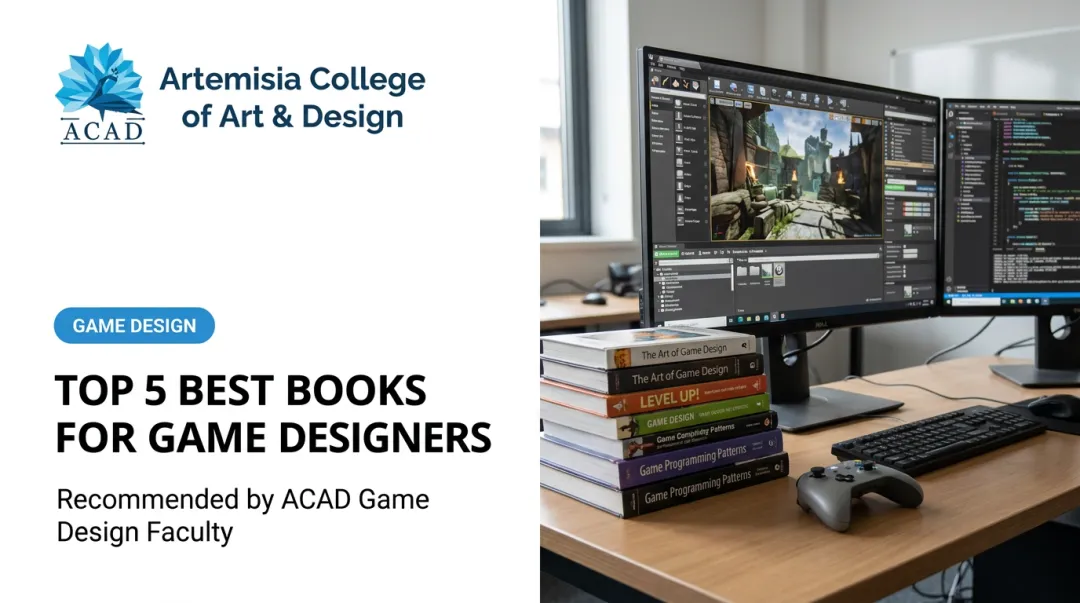

YouTube tutorials and Udemy courses can teach you which button does what in Unity or Unreal. They rarely explain why a mechanic feels satisfying, how player psychology shapes retention, or how studios structure a shippable economy. That depth usually lives in books.
This list rounds up 18 titles across design theory, player psychology, programming, narrative, and career strategy — the disciplines that separate hobbyists from hire-ready developers.
Key Takeaways
- Books still teach the deep, structural knowledge that short tutorials skip entirely
- 18 titles span 5 categories, from design theory to career growth
- Picks are filtered by author credibility, practical value, and tool relevance
- Reading builds theory; mentorship and portfolio work turn it into hireable skills.
Why Game Development Books Still Matter
A genuinely useful game development book does one of three things: it teaches design theory, builds technical craft, or maps out career strategy. Software walkthroughs don't count — those go stale the moment an engine updates.
Books, on the other hand, hold up. Jesse Schell's lens framework from 2008 is as relevant to a mobile puzzle game today as it was to console titles then. That durability matters more as the talent pool grows.
Demand backs this up. Niko Partners forecasts Indian player spending will cross $1 billion in 2025 alone. More players means more studios hiring, and more competition among candidates who all claim they "know game design."
The 18 books below are the ones that actually separate informed candidates from the rest. They're organised by discipline, so you can jump to whichever stage of your learning journey applies right now.
The 18 Best Game Development Books
This list runs from beginner-friendly primers to dense technical references. Each category builds on the last, moving from theory toward practical, hireable skill.
Game Design & Theory Fundamentals
1. The Art of Game Design: A Book of Lenses — Jesse Schell

Schell's book is built around 100+ "lenses" — question sets you apply to any design problem, from mechanics to marketing. It's the closest thing the industry has to a shared design vocabulary, which is why it's still assigned in most college-level design courses.
2. Game Design Workshop — Tracy Fullerton

3. Rules of Play — Katie Salen and Eric Zimmerman

This one treats board games, sports, and video games as variations on the same theoretical model. Dense, academic, and genuinely useful if you want to understand why games work across formats, not just how to build one.
4. A Theory of Fun for Game Design — Raph Koster

Koster argues fun is pattern recognition — your brain rewarding you for mastering a new system. Once a pattern is fully learned, the fun drains out. It's a short read that reframes how you think about mechanics and player fatigue.
5. Fundamentals of Game Design — Ernest Adams

A structured, comprehensive walk through mechanics, balancing, and level design, minus any programming instruction. Best for readers who want a syllabus-style approach rather than Schell's more exploratory format.
Player Experience & Psychology
6. The Gamer's Brain — Celia Hodent

Hodent holds a PhD in psychology and led UX at Epic Games during Fortnite's early growth, plus earlier UX work at Ubisoft. Her book applies cognitive science directly to onboarding, tutorials, and difficulty curves — practical, not theoretical.
7. Game Feel — Steve Swink

"Game feel" is the invisible layer that makes a jump satisfying or a shot connect. Swink breaks this hidden design language into measurable components: input, response, context, polish. Essential for anyone designing controls or combat systems.
8. Designing Virtual Worlds — Richard Bartle

Bartle created the famous player-type taxonomy — achievers, explorers, socialisers, and killers — that still shapes how multiplayer games are designed today. This book applies that framework to building persistent, social virtual spaces.
Programming, AI & Engine Development
9. Programming Game AI by Example — Mat Buckland

Covers state machines, pathfinding, and fuzzy logic using C++. It's older but the fundamentals haven't changed — most AI in shipped games still leans on these core techniques rather than exotic machine learning.
10. Foundations of Game Engine Development (Vols. 1 & 2) — Eric Lengyel

Volume 1 covers the math (linear algebra, transforms, geometry); Volume 2 tackles real-time rendering, lighting, and shading. This is engine-programmer territory, not a casual read, but there's no better resource if you want to build an engine from scratch.
11. Game Mechanics: Advanced Game Design — Ernest Adams and Joris Dormans

Focuses on systems thinking: how mechanics combine into emergent gameplay, how in-game economies balance themselves, and how to model all of it before writing a line of code.
12. No-Code Video Game Development — Michael Kelley

Uses Unity and PlayMaker to build full games through visual flowcharts instead of scripts. A solid entry point for designers who think in systems but aren't ready to code yet.
Narrative, Level & Systems Design
13. The Game Narrative Toolbox — Tobias Heussner et al.

Four working narrative designers cover everything from MMO quest writing to mobile and indie storytelling. The multi-author format means you get contrasting approaches rather than one person's opinion.
14. Level Up! The Guide to Great Video Game Design — Scott Rogers

Rogers designed on Pac-Man World and God of War, and it shows. Heavily illustrated with sketches and diagrams throughout, it's the most hands-on, least textbook-like entry on this list.
15. Introduction to Game Design, Prototyping, and Development — Jeremy Gibson Bond

Combines design theory, rapid prototyping, and actual Unity/C# programming in one book. If you want theory and code side by side, this is the closest match.
Career, Business & Industry Insight
16. The GameDev Business Handbook — Michael Futter

Covers the unglamorous side: incorporation, contracts, crowdfunding, IP protection. Useful once you're past "how do I design a game" and into "how do I keep the studio open."
17. Start Your Video Game Career — Jason W. Bay

Practical guidance on resumes, portfolios, and career paths across art, design, programming, and production. Written specifically for job seekers, not hobbyists.
18. The Making of Prince of Persia: Journals 1985–1993 — Jordan Mechner

Mechner's raw, present-tense journals from building an indie classic solo. Not a technical manual — it's the closest thing to sitting next to a developer during years of creative struggle, self-doubt, and eventual success.
How We Chose These Books
The easiest mistake is picking books by fame or age alone, grabbing whatever ranks highest on a "best of" list without checking if it actually matches your discipline or skill level.
We filtered instead by three factors:
- Author credibility: real shipped-game experience, not just theory (Hodent at Epic, Rogers at Sony)
- Practical applicability: exercises, prototypes, or case studies you can apply
- Continued relevance: still useful with current engines and tools, not just historically significant
Books vs. Formal Education: Why Structured Training Still Matters
Books build theory. They rarely build a portfolio, and they definitely don't run mock interviews.
That gap is where structured programs earn their place. At Artemisia College of Art & Design, the Game Design programme pairs the same theoretical grounding you'd get from Schell or Fullerton with hands-on training in Unreal Engine, Unity, Maya, and Substance Painter. That training happens inside a physical game studio, not just lecture slides.
Artemisia is also India's only Gold Level Unreal Academic Partner, recognised directly by Epic Games. The college's placement cell maintains relationships with studios including Ubisoft, Electronic Arts, Krafton, and Rockstar Games, among 100+ hiring partners across gaming and creative fields.

What books can't replicate:
- Portfolio review and CV development tailored to studio expectations
- Mock interviews and one-on-one mentoring before real hiring rounds
- Direct introductions to recruiters at partner studios
- Guidance on offer evaluation and salary negotiation once you land an interview
Reading A Theory of Fun teaches you why mechanics work. It won't get your portfolio in front of a Krafton recruiter.
Reading Into Practice
The reading list above covers design, code and production. The constraint is rarely knowledge; it is converting it into shipped work under real constraints.
Artemisia College of Art & Design sequences that conversion. Physical board and arcade games in first year, a playable Unity game with C# scripting, engine architecture and rendering pipelines in second, Unreal with Blueprint scripting and AI for games in third, and a production-managed capstone in fourth.
The degree also carries elective specialisation tracks in both third and fourth year, so students can go deep in 3D modelling and texturing, 2D art and animation, AR/VR development, level design, sculpting, engine work or game design itself.
Conclusion
Read widely, build narrowly. One finished project teaches more than three books you did not apply.
Artemisia College runs game design at two levels: the one-year Certificate in Game Design, which ends with a complete playable 3D game, and the four-year B.Design in Game Design & Development. Certificate entry is direct with 10+2 in any stream; the degree is through the ACAD Entrance Test or portfolio-based early admission.
Frequently Asked Questions
What is the 80/20 rule in game development?
It's the idea that roughly 20% of the work creates 80% of a game's core experience, according to Game Developer's industry culture breakdown. The remaining 80% of effort goes into polishing and balancing that core.
Is it too late to start game development?
No. Many developers enter the field from unrelated careers in their late twenties or beyond. Structured learning and a focused portfolio matter more than your starting age.
Which book should a complete beginner read first?
Start with The Art of Game Design or Fundamentals of Game Design. Both build foundational vocabulary without assuming prior technical knowledge.
Do I need to know programming to become a game developer?
Not for every role. Design, narrative, and art positions don't require it, though it helps. No-code tools like PlayMaker offer a practical entry point if coding isn't your strength.
Can reading books alone make you a professional game developer?
Books build theory, not a hireable skill set on their own. Studios want a portfolio, applied project experience, and industry exposure — the gap that placement-focused programs like Artemisia College's are designed to close.
How long does it take to learn game development from books?
It varies by discipline and starting point — anywhere from several months to a few years of consistent study paired with actual project work, not just reading.