Many hobbyists struggle to find structured guidance beyond scattered video tutorials, while aspiring fashion professionals need software skills that campus programmes rarely cover in enough depth. Online embroidery courses have filled that gap, teaching hand stitching, machine digitizing, and embellishment design to anyone with a laptop and a few free hours a week.
This guide ranks the top online embroidery design courses of 2026, breaks down what each platform actually teaches, and explains how to match a course to your goal — whether that's a weekend hobby, a small embroidery business, or a full-blown fashion design career.
TL;DR
- Online embroidery courses now cover hand stitching, digitizing, and fashion embellishment for every skill level.
- Domestika, Craftsy, Udemy, Skillshare, and Wilcom Academy lead the online space, each suited to different skill levels.
- Certification value and real software access separate strong courses from weak ones.
- Technical skills grow well online, but mentorship and job placement typically need a structured, campus-based programme.
- This ranking weighs curriculum depth, instructor credibility, format flexibility, and value for money.
Overview of Online Embroidery Design Education in 2026
Embroidery design in 2026 covers far more than needle and thread. It spans hand stitching, 3D and bead embellishment, and machine digitising (the process of converting artwork into stitch files a computerised embroidery machine can read).
Fashion houses, home décor brands, and personalisation businesses all rely on these skills, often blending traditional handwork with software-driven production.
The shift online isn't surprising. E-commerce embroidery businesses need digitising skills fast, and remote fashion freelancers can't always relocate for a week-long workshop.
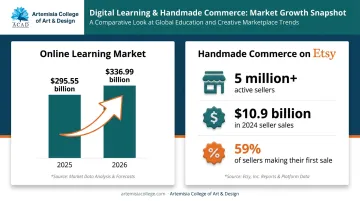
The broader e-learning market reflects this pull toward flexible, self-paced formats. It was valued at $295.55 billion in 2025 and is forecast to reach $336.99 billion in 2026, according to Straits Research. That figure covers all e-learning, not embroidery specifically, but it signals how comfortable learners have become with screen-based skill-building.
Handmade commerce adds another layer of demand. Etsy alone reported more than 5 million active sellers and $10.9 billion in 2024 seller sales, with 59% of surveyed sellers making their first sale that year. That's proof embroidery hobbyists increasingly see a real path to turning stitching into income.
That growing appetite has produced a crowded field of platforms, each with a different teaching philosophy. Below is a ranked look at the ones actually worth your time and money in 2026.
Top Online Embroidery Design Courses to Consider in 2026
Course quality here is judged on four things: curriculum depth, instructor expertise, certification value, and whether the format suits hobbyists or career-focused learners. Some platforms nail one of these. Only a handful nail all four.
Start here if you want this as a career, not a hobby: the online courses below are good for technique, but embroidery sits inside surface design, and employers hire on garment work rather than samplers. Artemisia College of Art & Design teaches surface design, pattern making and hand-and-machine construction inside its Certificate in Fashion Design and Diploma in Fashion Design, with paid client projects during the course. If you want the full route, there is also the four-year B.Design in Fashion Design.
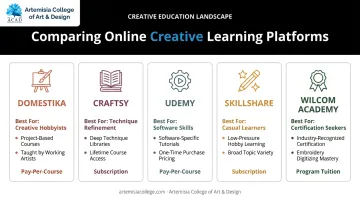
Domestika – Embroidery & Textile Art Courses
Domestika runs on project-based, video-led classes taught by working embroidery artists and textile designers rather than generic instructors. Courses like "Embroidery Techniques" pack 46 lessons across 9 modules into roughly seven hours, structured around a final project you can post to your portfolio.
What makes it stand out:
- Strong community feedback built into every course page
- Lifetime access once purchased
- Visually rich project galleries that double as portfolio material
| Category | Details |
|---|---|
| Format & Duration | Self-paced video lessons, typically 2-6 hours per course |
| Best For | Hobbyists and creatives wanting stylistic, contemporary embroidery projects |
| Pricing | One-time course fee or subscription-based Plus access |
Craftsy – Hand & Machine Embroidery Classes
Craftsy's library runs deep: 70 hand and machine embroidery classes, from beginner running-stitch basics to a dedicated machine embroidery digitizing class. Each class breaks technique into step-by-step segments, with downloadable patterns you keep after the class ends.
Why it stands out:
- Structured, stitch-by-stitch technique breakdowns
- Downloadable pattern resources included with every class
- Class Q&A for troubleshooting specific projects
| Category | Details |
|---|---|
| Format & Duration | Pre-recorded modules, lifetime access per class purchased |
| Best For | Beginners wanting a structured, stitch-by-stitch learning path |
| Pricing | Per-class fee or annual membership (promotional pricing changes often) |
Udemy – Embroidery Digitizing for Machine Embroidery
Udemy's embroidery catalogue leans technical. Its bestselling digitizing course, built around Wilcom EmbroideryStudio, runs 56 lectures over roughly 10 hours and requires the software already installed on your machine. It's practical, software-first training aimed at people who want to digitize commercially, not just admire stitches.
Why it stands out:
- Low one-time cost with frequent discounts
- Practical software walkthroughs, not just theory
- A visible track record, rated 4.5/5 by active students
| Category | Details |
|---|---|
| Format & Duration | Self-paced video course, usually 5-15 hours total |
| Best For | Learners aiming to start a machine embroidery or personalisation business |
| Pricing | Low one-time cost, frequently discounted |
Skillshare – Modern & Contemporary Embroidery Design
Skillshare treats embroidery as a creative community exercise. Short classes on hoop art, floral embroidery, and mixed-media stitching sit inside one subscription, and most run under an hour — built for browsing rather than deep technical study.
Why it stands out:
- Peer project sharing on every class page
- One subscription ($167.88/year, billed annually) covering a broad content library
- Certificates require completing lessons plus submitting a class project
| Category | Details |
|---|---|
| Format & Duration | Short-form classes, 30 minutes to 2 hours each |
| Best For | Casual learners exploring embroidery as a creative hobby |
| Pricing | Monthly or annual subscription covering unlimited classes |
Wilcom Embroidery Studio Academy – Professional Digitizing Training
Wilcom Academy trains people on the exact software running commercial embroidery machines across the manufacturing industry. It's the closest thing to an industry standard here, with progress tracking, instructor Q&A, webinars, and masterclasses tied directly to EmbroideryStudio versions.
One caveat: neither the Academy nor Wilcom America's training pages promise a formal professional certification credential. Treat this as deep software mastery, not an accredited qualification.
Why it stands out:
- Structured modules tied to real production software
- Recognised within embroidery manufacturing circles
- Built for learners targeting digitizing or production roles, not casual hobbyists
| Category | Details |
|---|---|
| Format & Duration | Structured modules over several weeks, tied to an EmbroideryStudio license |
| Best For | Learners targeting embroidery digitizing or production roles |
| Pricing | Premium pricing reflecting professional software licensing |
How to Choose the Right Online Embroidery Course
The most common mistake? Picking a course because it's cheap or has a flashy thumbnail, rather than matching it to what you actually want. A ₹999 digitizing course is a poor use of money if you just want a relaxing weekend hobby. A subscription hoop-art class won't make you production-ready for a commercial embroidery shop either.
Before paying for anything, check these factors:
- Instructor credibility – Has the instructor worked professionally, or are they demonstrating a technique for the first time on camera? Professional guilds typically list tutors trained through formal apprenticeships, a useful credibility benchmark.
- Software/digitizing coverage – If your goal involves machine embroidery, confirm the course actually teaches digitizing software (Wilcom, Hatch, Tajima DG) rather than only hand technique.
- Certification value – A "certificate of completion" from a marketplace course isn't the same as an accredited qualification. Know which one you're getting.
- Community or feedback access – Courses with active Q&A, peer discussion, or teacher monitoring catch mistakes faster than solo video-watching ever will.
If you're aiming for a full-time embroidery or fashion design career rather than a side hobby, dig deeper. Ask whether the course offers any portfolio review, critique, or exposure to working professionals. Most self-paced platforms don't, and that gap matters more the further your ambitions go.
Beyond Online Learning: Turning Embroidery Skills into a Fashion Design Career
Online courses are excellent at building technical foundations. What they rarely offer is mentorship, live critique from working designers, or a pipeline into an actual job — the pieces that turn a stitched sampler into a career.
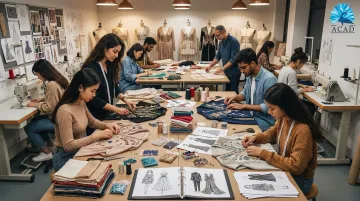
That's where a structured programme fills the gap. Artemisia College of Art & Design runs Fashion Design certificate and diploma programmes where surface design, pattern-making, and hand-and-machine construction techniques are taught alongside fashion illustration, textile basics, and garment construction.
The diploma track adds visual merchandising, entrepreneurship, and Adobe Illustrator training, aimed at students who want studio-ready skills rather than hobby proficiency alone.
What a self-paced course can't replicate:
- Real industry projects – Fashion Design students complete paid, real-world projects during their studies, not just practice exercises.
- Runway exposure – Students have showcased work at platforms including Delhi Times Fashion Week.
- Structured internships – Summer internships across India follow the 2nd and 3rd years, with paid part-time work at ACAD Studios for strong performers after year one.
Fashion design careers reward this kind of preparation. US data shows fashion designers held roughly 25,700 jobs in 2024, with 20% self-employed, according to the Bureau of Labor Statistics. Entrepreneurial paths matter just as much as traditional employment in this field, a pattern likely to hold true as India's own design industry expands.
Artemisia's Placement Cell, which supports every design discipline on campus, works through portfolio finalisation, mock interviews, and one-on-one mentoring to help graduates transition into paid roles.
The college's broader industry network includes hiring partners across fashion and retail, including names like Fabindia, Anita Dongre, Tarun Tahiliani, Raymond, Arvind Fashions, and Pratibha Syntex. This gives students visibility into the kind of companies that hire embellishment and textile talent.
For serious career changers, the smartest route isn't choosing one path over the other. Use an online course to test your interest and pick up baseline stitch or software skills cheaply, then bring that head-start into a structured programme where mentorship, critique, and placement support actually exist.
Conclusion
There's no single "best" online embroidery course. It depends entirely on whether you're chasing a creative hobby, a small embroidery business, or a full-time design career. Domestika and Skillshare serve the first group well. Udemy and Wilcom Academy serve the second and third.
Before paying for any course, check three things:
- What certification actually means on that platform
- Whether software or digitizing training is included
- Whether real community or feedback support sits behind the videos
If you're past the hobby stage and thinking seriously about a fashion design career, an online course alone won't get you there. Reach out to Artemisia College of Art & Design to talk through how a structured programme, real industry projects, and dedicated placement support could take your embroidery skills the rest of the way.
About Artemisia College of Art & Design
Embroidery is one technique inside surface design, and it pays best when it sits on full garment training. Artemisia College of Art & Design was set up under Tryambakam Education Foundation to make high quality art and design education affordable without thinning it out. Roughly 90% of the teaching staff come from working industry, bringing between five and thirty-five years of practice into the studio.
Fashion design runs at three levels: the Certificate in Fashion Design, the Diploma in Fashion Design and the four-year B.Design in Fashion Design. The college also awards B.Design degrees in Animation, Game Design and Interior Design, BFA and MFA routes in Painting and Sculpture, and a Certificate in Photography.
Fees are deliberately low so cost is not what decides whether a creative student can study, and scholarships are available. Have a look at the fee structure, or go through early admission if a portfolio suits you better than an entrance test.
Frequently Asked Questions
How to become an embroidery designer?
Start with stitch fundamentals through hand embroidery, then learn digitizing software such as Wilcom or Hatch for machine work. Build a portfolio of original projects, and choose between freelance client work or a structured fashion design programme based on your goals.
Can I learn embroidery at home?
Yes, online video courses and practice kits cover hand stitching and basic techniques well. Machine digitizing and running an embroidery business, though, benefit from more structured guidance and feedback.
Is an online embroidery course worth it for beginners?
Absolutely, and it's low-risk. A low-cost course lets you test genuine interest before investing in advanced software, machines, or in-person training.
What software is commonly used for embroidery digitizing?
Wilcom EmbroideryStudio and Hatch Embroidery dominate professional and hobbyist digitizing respectively. Many designers also use Tajima DG, Embrilliance StitchArtist, Brother PE-Design, and the free Ink/Stitch platform.
How long does it take to learn embroidery design?
Beginners can pick up basic hand stitches in a few weeks of regular practice. Machine digitizing and genuine design proficiency, by contrast, typically take several months of consistent, hands-on work.
What career opportunities exist for trained embroidery designers?
Freelance embroidery commissions, fashion house embellishment roles, home décor design, textile manufacturing positions, and independent embroidery businesses are all common paths, often combined rather than chosen exclusively.