
That shift has left a lot of 12th-pass students confused. Which course actually leads to a job? Does your stream matter? And what do photographers realistically earn?
This guide walks through eligibility, course types, specializations, career paths, salary expectations, and how to choose a program that won't leave you stuck at the "theory only" stage.
Key Takeaways
- Photography courses after 12th accept students from Science, Commerce, and Arts alike
- Options range from short certificates to full Bachelor's and Master's degrees
- Career paths include photojournalism, fashion, wildlife, product, and content creation work
- Placement support and institute reputation matter as much as the curriculum you choose
Eligibility Criteria for Photography Courses After 12th
Here's the good news: photography courses don't gatekeep by subject. Whether you studied Physics, Accountancy, or History in Class 12, you're eligible to apply.
Basic requirement: A 10+2 pass from a recognised board. That's it for most certificate and diploma programs. Some institutes state only "pass class" with no percentage attached, while others set a minimum, commonly somewhere between 45% and 60% depending on the program level.
Selection beyond marks: For degree programs at more competitive institutes, marks are just the entry ticket. Many also require:
- An entrance exam or aptitude test (some universities run their own CET-style tests)
- A photography portfolio submission, reviewed alongside a personal interview
- A statement of purpose or recommendation letters, at select colleges
English Proficiency and Other Requirements
Beyond marks and portfolios, a few programs add one more layer to the process: language readiness. If your Class 12 instruction wasn't in English, some English-medium degree programs may ask for proof of proficiency, though this isn't a blanket rule across the board. It tends to apply mainly to international or NRI applicants rather than domestic students.
Practical tip: Eligibility criteria shift from year to year and institute to institute. Always check the specific program page or prospectus before applying rather than relying on a general rule you found online.
Types of Photography Courses After 12th
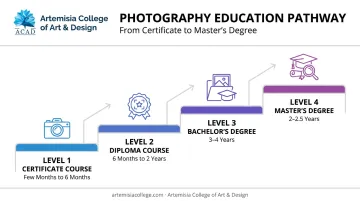
Photography education breaks into four levels, each suited to a different timeline and depth of expertise.
Certificate Courses in Photography
These run short, typically a few months to half a year, and cover camera fundamentals, composition, and lighting basics. They're ideal if you want to:
- Test your interest before committing to a longer program
- Add a quick skill to an existing creative background
- Decide between photography and another visual field
Certificate courses are widely available both online and offline, making them the lowest-commitment entry point.
Diploma Courses in Photography
Diplomas run longer, from roughly six months up to two years, and go deeper into genre-specific skills like fashion, wildlife, or product photography. They strike a middle ground: faster industry entry than a degree, but more depth than a certificate. This route suits students who've already narrowed their focus and want hands-on specialization before entering the field.
Bachelor's Degree Programs
A BA, BFA, or BSc in Photography typically spans 3 to 4 years. This is the most comprehensive route, combining:
- Technical camera work and lighting
- Editing software proficiency
- Filmmaking and video basics
- Portfolio development through real shoots and internships
This path suits students aiming for long-term specialization, leadership roles, or postgraduate study later.
Master's Degree Programs
An MA, MFA, or M.Des in Photography, pursued after a bachelor's degree, focuses on personal style, conceptual thinking, and research-driven visual storytelling. Duration varies by institute, some run 2 years, others extend closer to 2.5 years. These programs often attract students eyeing teaching, curatorial work, or creative-director positions down the line.
Photography Specializations You Can Choose From
Once you've picked a course level, the next decision is a niche. Indian photography curricula commonly cover:
Commercial:
- Fashion photography
- Product and e-commerce photography
- Food photography
Documentary and people-focused:
- Wedding and event photography
- Photojournalism
- Portrait photography
- Sports photography
Nature and built environments:
- Wildlife photography
- Travel and landscape photography
- Interior and architecture photography
Picking a niche early helps you build a focused portfolio, and recruiters and clients consistently value depth in one area over scattered, generic work.
Some specializations naturally cross over into other creative fields. Fashion photography, for instance, sits close to fashion styling and design, while interior photography overlaps with interior design work.
If you're drawn to either, it's worth exploring allied creative programs alongside your photography training. Institutions like Artemisia College of Art & Design offer Fashion Design and Interior Design programmes that add versatility on set and in client conversations.
Career Opportunities, Job Roles & Salary in Photography After 12th
Photography opens into far more roles than "wedding photographer" or "studio owner." Common career paths include:
- Photojournalist
- Wedding and event photographer
- Fashion photographer
- Product or e-commerce photographer
- Wildlife photographer
- Documentary filmmaker
- Photo editor
- Content creator or social media visual specialist
With experience, many photographers move into creative director positions, open their own studios, or take up full-time roles at media houses, ad agencies, or e-commerce brands.
What Photographers Actually Earn
Salary data from AmbitionBox's photographer salary report gives a realistic starting point:
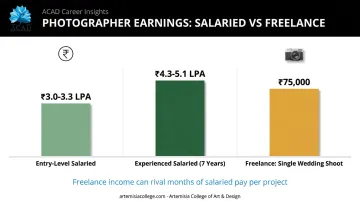
- Entry-level (around 1 year): ₹3.0–3.3 lakh per annum, based on 360 submitted salaries
- Experienced (around 7 years): ₹4.3–5.1 lakh per annum, based on 139 submitted salaries
These are salaried figures, though. Freelance and per-project income tells a different story. A studio manager quoted in a Hindustan Times report on wedding photography mentioned charging ₹75,000 for a single wedding day shoot, illustrating how one strong client booking can outpace a month's fixed salary.
Highest-paying niches tend to cluster around fashion, commercial/advertising, and wedding photography, though there's no single dataset ranking them precisely against each other. What actually drives income more than the course you took:
- Specialization depth
- Client network and referrals
- Portfolio quality
Many photographers also diversify beyond client assignments, running workshops, selling prints, or building content creation income on top of shoot fees.
How to Choose the Right Creative Program for a Photography Career
Not every institute delivers the same outcome, even with an identical course title on paper. A few things worth checking before you enrol:
- Hands-on shoot experience - Look for programs where students shoot regularly with professional equipment, not just theory-heavy classrooms
- Mentorship from working professionals - Faculty who are still active in the industry bring current, practical insight
- A dedicated placement cell - One that supports portfolio finalization, mock interviews, and introductions to relevant studios or brands
- Industry connections and alumni outcomes - Strong studio and brand partnerships usually translate into better internship and job access
Institutes with this kind of structured, industry-integrated placement system - like Artemisia College of Art & Design, which runs one across its creative programmes - show what strong placement support looks like in practice.
Look for similar systems in photography-focused programs: it's this kind of support that helps creative graduates move from student projects to paid, professional work without the usual guesswork.
About Artemisia College of Art & Design
Choosing a route after Class 12 is easier once you know what each qualification actually covers. Artemisia College of Art & Design runs under Tryambakam Education Foundation, built around one idea: strong fundamentals make a designer, software familiarity makes a computer operator. Around 90% of its faculty come from the animation, game, interior and fashion industries.
Photography is taught through the one-year Certificate in Photography, covering wildlife, fashion, photojournalism, architectural and conceptual work. The college also awards B.Design degrees in Animation, Game Design, Interior Design and Fashion Design, and BFA and MFA routes in Painting and Sculpture.
The college keeps tuition low and offers scholarships to bright and needy students. The current fee structure is published online, and early admission lets you apply on a portfolio and interview instead of an entrance test.
Frequently Asked Questions
Which course is best for photography after 12th?
A BA or BFA in Photography works best for long-term, comprehensive skill-building. A diploma suits students who want faster, specialized entry into the field without a full degree commitment.
Is photography a high paying career?
It can be, especially with specialization and experience. Income tends to scale with your client base and niche rather than following a fixed salary structure like a typical office job.
What are the highest paying photography jobs?
Fashion, commercial/advertising, and wedding photography tend to pay the most, alongside senior positions like creative director once you've built a strong portfolio and network.
What is the eligibility for photography courses after 12th?
Most programs need only a 10+2 pass from any stream, with some setting a minimum percentage. Certain institutes also ask for a portfolio submission or entrance test.
Do I need to be from a specific stream in 12th to pursue photography?
No. Photography courses are open to students from any stream. Science, Commerce, and Arts students are all equally eligible to apply.
Is a degree necessary to become a professional photographer?
Not strictly. A degree offers structured, in-depth training and stronger portfolio support, but plenty of photographers build successful careers through diplomas, certificates, and consistent self-driven practice.