Yet most aspiring photographers get stuck at the same crossroads: which course actually matters, what skills clients pay for, and whether the income justifies the hustle. India's digital advertising market grew 17% to reach INR 700 billion in 2024, now accounting for 55% of total advertising revenue, and photography sits right at the centre of that growth.
This guide breaks down whether photography is worth pursuing, what different specialisations pay, the skills that actually build a career, and a practical roadmap to get started.
Key Takeaways
- Photography niches like wedding, fashion, wildlife, and product each carry distinct earning potential.
- A certificate, diploma, or degree paired with a strong portfolio boosts employability and pay.
- Fashion, commercial, and aerial work often pay more, but freelance income hinges on portfolio and negotiation.
- Technical skill, editing fluency, and business sense together decide long-term success.
Is Photography a Good Career Option in India?
Yes, with a caveat. Photography can be a rewarding, sustainable career, but only for those who combine technical skill, patience, and genuine business sense. Talent alone rarely pays the bills, so the photographers who succeed treat their craft like a business, not just an art form.
Benefits of Choosing Photography as a Career
The upside is real, and it goes beyond "doing what you love":
- Creative control - you shape the visual narrative, from lighting to final edit, with far more artistic freedom than most desk jobs offer.
- Steady demand - advertising, e-commerce, fashion, events, and influencer content all need fresh visuals constantly.
- Flexible paths - work freelance, join an in-house studio, or build your own photography business, depending on your risk appetite.
- Digital reach - portfolio sites and social platforms let you showcase work and land clients well beyond your local market.
Wedding photography alone shows how fast demand is shifting. Justdial data cited by the Economic Times found demand for photographers grew 28% in 2024, while cinematic wedding photographers saw demand double. Bigger wedding budgets mean bigger opportunities for skilled photographers.
Challenges to Consider Before Committing
The honest picture includes some friction points:
- Income inconsistency - the first two to three freelance years often mean unpredictable cash flow while you build a client base.
- Market saturation - smartphone cameras and cheap entry-level gear have flooded the market with amateur competitors.
- Ongoing costs - lenses, lighting kits, editing software subscriptions, and skill upgrades never really stop.
None of this makes photography a bad choice; it just means treating it as a business from day one, not a passion project you'll monetise "eventually."
Types of Photography Careers and Their Salary in India
Photography isn't one career path. It's a collection of specialised niches, and each demands different technical skills, equipment, and client relationships.
Here's a realistic snapshot of what different niches pay, based on available portal data. Treat these as directional benchmarks, not guarantees:
| Specialisation | Entry-Level (approx.) | Experienced (approx.) |
|---|---|---|
| Wedding | Highly project-based, varies widely | ₹4.8L–5.3L/year (4-6 yrs) |
| Fashion | ₹4.5L/year (2 yrs) | ₹5.9L–8.8L/year (6+ yrs) |
| Wildlife | No fixed benchmark - assignment/publication-dependent | Same, reputation-driven |
| Product/Commercial | ₹4.2L/year (1 yr) | ₹5.9L–6.5L/year (~4 yrs) |
| Food | ₹1.2L–2.4L/year (1-3 yrs) | ₹4.7L–5.2L/year (8 yrs, freelance) |
| Aerial/Drone | ₹1.6L–2.5L/year (fresher) | Highly variable by project |
| Sports | Not well established | ~₹5L/year average |
| Photojournalism | ₹4L/year (1 yr) | ₹4.2L–4.6L/year (11-18 yrs) |
Which pays the most? Fashion, commercial/advertising, and aerial photography tend to sit at the top, largely because brand budgets are bigger and the technical bar (studio lighting, drone licensing, retouching precision) is higher.
That said, no single niche is universally the highest earner - a fashion photographer with a thin portfolio can be out-earned by a wedding photographer with a packed calendar.
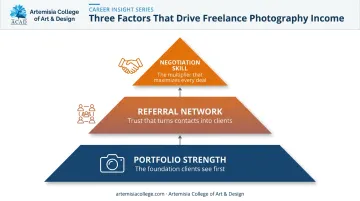
Freelancers, take note: your income depends far more on portfolio strength, referral networks, and negotiation than on any "standard" salary chart. Two photographers with identical skills can earn wildly different amounts based on how well they pitch and price themselves.
Non-Shooting Career Options
Not everyone who's visually inclined wants to be behind the camera full-time. Adjacent roles include:
- Photo editor - selecting, retouching, and preparing images for publication (average around ₹16,459/month in India, per Indeed data)
- Photo researcher - sourcing and licensing images for media and marketing use
- Curator - managing museum or gallery photography collections
- Archivist - preserving and cataloguing historical photographic records, often in government institutions
India's e-commerce market, valued at USD 125 billion (roughly ₹10.4 lakh crore) in 2024, is projected to reach USD 345 billion (about ₹28.6 lakh crore) by 2030, an 18.4% annual growth rate. Every product listed on those platforms needs a photograph, which keeps demand for commercial and product photographers climbing steadily.
Skills Required to Build a Successful Photography Career
Technical talent gets you in the door. Everything else keeps you employed.
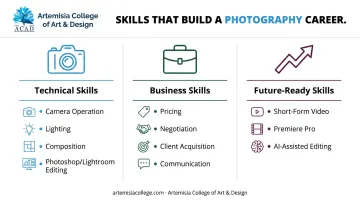
Technical and software skills form the non-negotiable basics:
- Camera operation across manual and auto modes
- Lighting control, both natural and artificial
- Composition and exposure management
- Editing fluency in Adobe Photoshop and Lightroom for colour correction, retouching, and file delivery
Clients rarely accept unedited RAW files. Post-processing skill often separates a hobbyist from someone who gets rebooked.
Business and soft skills matter just as much, since most photographers work as freelancers or small business owners rather than staff shooters. You also need:
- Pricing strategy and contract negotiation
- Client acquisition and self-promotion (social media matters here)
- Clear communication - directing subjects confidently during live shoots
- Patience, especially with events and unpredictable lighting conditions
Beyond today's toolkit, where the field is heading matters too. Two shifts are reshaping how photographers work:
- Hybrid content demand - job listings increasingly ask for photo and short-form video capability, alongside tools like Premiere Pro.
- AI-assisted editing - culling, retouching, and colour-grading tools are getting smarter, speeding up workflows without replacing core photographic judgement.
Photographers who add basic video skills to their toolkit position themselves for a wider range of paid work, since many clients now want stills and reels from the same shoot.
Photography Courses and Eligibility: Choosing the Right Path
Formal training isn't mandatory, but it accelerates skill-building and gives you structured feedback that self-teaching often lacks.
Course Formats in India
Three main paths exist:
- Certificate/foundation courses - short-term, focused on core camera and editing skills
- Diploma programmes - typically one year, more hands-on and practical
- Bachelor's degrees - three to four years, covering photography or broader visual arts with deeper theoretical grounding
Eligibility for most diploma and degree programmes is Class 12 completion in any stream, though some institutes ask for a portfolio review or entrance test.
What Courses Cost
Fee ranges vary considerably by format and institute. Recent examples from verified institute pages show costs from roughly ₹1.53 lakh for a one-year diploma to ₹2.80 lakh per year for a four-year bachelor's programme. Location, infrastructure, and equipment access all push these numbers up or down.
A strong foundational arts and design education pays off here too. Design-led programmes that teach composition, colour theory, and visual storytelling - such as those in Artemisia College's design and fine arts curriculum - build skills that transfer directly into photography practice.
What to Evaluate Before Enrolling
Before committing money and time, check for:
- Faculty with real industry experience, not just academic credentials
- Hands-on, live assignments rather than theory-only modules
- Access to professional equipment - cameras, lighting kits, studio space
- Structured placement support to help you transition into paid work
A course that ticks these boxes is worth the higher fee. One that doesn't will leave you reinventing the wheel after graduation.
How to Launch Your Photography Career: A Step-by-Step Roadmap
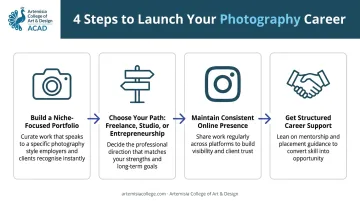
Getting your first paid photography gig is less about talent and more about sequencing. Here's a practical order:
- Build a niche-focused portfolio. Shoot personal projects, intern, or assist an established photographer to learn real workflows - lighting setups, client handling, and shot planning that no classroom fully replicates.
- Choose your path early. Freelancing, an in-house studio role, and entrepreneurship each demand different financial planning. Freelancing needs a cash buffer for lean months, a studio job offers stability but less creative control, and entrepreneurship requires upfront investment in gear and branding.
- Maintain a consistent online presence. Instagram and a simple portfolio website do more for client acquisition today than cold outreach ever will.
- Get structured career support during the transition. This is where a solid placement system helps. Artemisia College's Placement Cell, for example, guides creative students through portfolio finalisation, interview prep, and industry introductions - rather than leaving them to navigate alone.
The gap between talented amateur and working professional comes down to how deliberately you execute these steps, not raw skill.
About Artemisia College of Art & Design
Turning photography into an income is mostly about range, and range is what a structured course builds. Artemisia College of Art & Design is run under Tryambakam Education Foundation and was started to build a job-oriented degree college offering high quality art and design education at low cost. Around 90% of the faculty come from the animation, game, interior design and fashion industries, with five to thirty-five years of experience behind them.
Photography is taught through the one-year Certificate in Photography, covering wildlife, fashion, photojournalism, architectural and conceptual work. The college also awards B.Design degrees in Animation, Game Design, Interior Design and Fashion Design, and BFA and MFA routes in Painting and Sculpture.
Tuition is kept low compared with similar programmes elsewhere and scholarships are offered to bright and needy students. You can check the current fee structure or apply through early admission if you would rather submit a portfolio than sit an entrance test.
Frequently Asked Questions
Is photography a good career option?
Yes, given rising visual content demand across e-commerce, advertising, and social media. Success depends on building strong technical skills alongside genuine business sense, not talent alone.
Do photographers make good money?
Earnings vary widely by specialisation and experience. Entry-level pay is often modest, but skilled photographers in niches like fashion or commercial work can earn substantially more over time.
Which photography has the highest salary?
Fashion, commercial/advertising, and aerial photography typically command higher pay due to larger brand budgets and specialised technical requirements like studio lighting or drone certification.
What qualifications are needed to become a photographer?
Formal certificates or diplomas help build foundational skill, but a strong portfolio and demonstrable technical ability often matter more to clients and employers than the credential itself.
Can I become a photographer without a formal degree?
Yes. Many successful photographers are self-taught or trained through short certificate courses, provided they build strong technical skills and a portfolio that proves it.
How do I start a photography career with no experience?
Start with personal projects, assist an established photographer to learn real workflows, and gradually build a portfolio strong enough to land your first paid assignments.