Introduction
Animation is no longer a niche career choice in India. The country's animation and VFX segment grew 29% in 2022 to reach ₹107 billion, with FICCI and EY projecting it will hit ₹190 billion by 2025, a 21.1% compound annual growth rate.
That kind of momentum is pulling thousands of students toward creative degrees every year.
But choosing the right path isn't simple. Many students get stuck comparing a BFA in Animation against a BA or BSc in the same field, unsure which one actually builds job-ready skills.
Fee structures across colleges swing wildly too, with little clarity on what you're paying for.
This guide breaks down what a BFA in Animation actually involves: the syllabus, top colleges with fee ranges, admission process, and the career outcomes you can realistically expect after graduating.
Key Takeaways
- A BFA in Animation is a 4-year, studio-intensive degree in India, prioritizing hands-on skills over theory.
- Course fees range from ₹1.5 lakh to ₹6 lakh or more, depending on college reputation and location.
- Graduates work as animators, VFX artists, character designers, and game designers across film, gaming, and advertising.
- Placement support, not fees or syllabus, often determines how smoothly students land their first job.
What Is a Bachelor of Fine Arts in Animation?
A Bachelor of Fine Arts in Animation is a professional undergraduate degree built around studio-based practical training. Instead of spending most of your time in lecture halls, you're at a workstation, sketching, modelling, animating, and building a portfolio that studios actually want to see.
The degree typically blends:
- 2D and 3D animation techniques
- VFX and compositing fundamentals
- Multimedia production skills
- Foundational art, design, and storytelling courses
This studio-first structure is what separates a BFA from a generic design certificate. You're learning to think like an animator, frame by frame, not just learning software.
How Long Does a BFA in Animation Take?
In India, BFA Animation programs generally run for 4 years, with the first year typically serving as a foundation stage covering drawing, design basics, and art history.
Students then move into specialised animation modules. JNAFAU Hyderabad, for instance, structures its Bachelor of Fine Arts in Animation and VFX as a 4-year program open to students right after Class 12.
Internationally, BFA program lengths can range from 3 to 4 years depending on the country's higher education framework. India's UGC guidelines identify the 4-year route, built on 160 credits, as the preferred structure for undergraduate degrees.
BFA vs BA/BSc in Animation: What's the Real Difference?
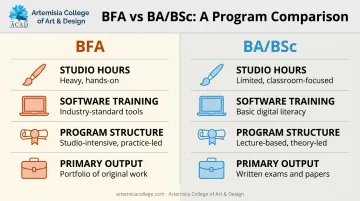
A BFA leans heavily into hands-on studio work and portfolio-building. A BA or BSc in Animation tends to be more theory-heavy and liberal-arts oriented.
Academic accreditation standards like NASAD, a US-based framework, draw a similar distinction, separating professional degrees such as the BFA from broader liberal arts degrees. In practice:
| Aspect | BFA | BA/BSc |
|---|---|---|
| Studio hours | Heavy, hands-on training | Limited, classroom-focused |
| Software training | Intensive, industry tools | Lighter, foundational |
| Program structure | Capstone-driven | Theory and elective-driven |
| Primary output | Strong portfolio or showreel | Broader liberal arts knowledge |
If your goal is walking into a studio job with a reel ready to show, a BFA's practical bias usually serves you better.
BFA Animation Syllabus & Curriculum
Every institute tweaks its own syllabus, but most BFA Animation programs in India follow a similar arc: foundation, then core animation skills, then digital tools, then advanced specialisation and a final project.
Foundation Year
The first year builds the visual vocabulary students will use for the rest of the course:
- Drawing and sketching fundamentals
- Colour theory
- Design principles and composition
- Art history
A typical BFA Animation programme opens with courses like Design for Animation, Geometrical Drawing and Perspective, and History of Art in semester one, followed by anatomical drawing and clay modelling in semester two.
Core Animation Modules
Once fundamentals are in place, the curriculum shifts toward animation-specific skills:
- 2D and 3D animation principles
- Character design
- Storyboarding
- Concept art development
For instance, JNAFAU's BFA Animation and VFX program covers this stage through character designing, digital imaging, and drawing for 2D animation, alongside domain areas like stop-motion and set modelling.
Digital Tools & Software Training
Most programs introduce industry-standard software progressively rather than all at once. Common tools across Indian animation courses include:
- Autodesk Maya for 3D modelling and rigging
- ZBrush for digital sculpting
- Adobe After Effects and Premiere for compositing and editing
- Substance Painter for texturing
Students also pick up lighting and rigging techniques alongside these tools, since a strong showreel needs technically polished work, not just good ideas. Exact software lists and the stage each is introduced vary by institute, so check a college's current syllabus before enrolling.
Advanced Techniques & Capstone Project
The final stretch usually covers VFX compositing, motion capture, and simulation, capped by a portfolio or showreel project. This capstone typically mirrors a real industry brief, giving students a taste of working to a client deadline before they graduate. Recruiters often weigh this reel more heavily than grades.
Top BFA Animation Colleges & Fees in India
Fee structures for BFA Animation programs in India vary enormously, sometimes by four times or more, for what looks like a similar 4-year course on paper. Here's a snapshot of fee ranges from a few established institutes:
| College | Duration | Approx. Total Fee | Type |
|---|---|---|---|
| Amity University, Noida | 4 years | ₹6.04 lakh | Private |
| JNAFAU, Hyderabad | 4 years | ₹2.8 lakh | Government |
| Dr. YSR Architecture & Fine Arts University | 4 years | ~₹1.48 lakh | Government |
| Amity University, Kolkata | 4 years | ~₹4.00 lakh | Private |
Figures are drawn from official and third-party fee listings current as of 2025. Confirm the latest structure directly with the college before applying.
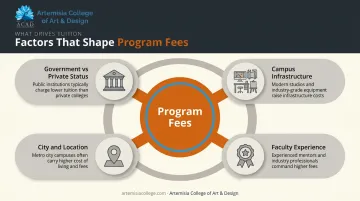
Why Fees Vary So Much
- Government vs private status: government-affiliated universities like JNAFAU charge a fraction of what private universities do
- Campus infrastructure: dedicated animation labs, render farms, and motion capture studios cost money to maintain
- Faculty experience: colleges with industry-veteran faculty often price accordingly
- City and location: metro-city campuses generally carry higher fees than smaller-city counterparts
Look Beyond the Fee Number
Fee amount alone doesn't determine program value. Before shortlisting, weigh the placement record, industry tie-ups, studio exposure, and access to updated software and hardware.
Artemisia College of Art & Design is one option worth exploring if you're weighing industry-integrated animation education alongside traditional university programmes.
The college structures its animation and VFX training around a year-by-year progression. Students move from foundational sketching and design toward professional tools and studio-style briefs, with faculty mentorship built into the process.
Whichever college you're considering, don't rely on aggregator listings alone. Visit official college websites or verified fee-comparison portals to confirm current numbers, since fee structures change year to year.
Admission Process & Eligibility for BFA Animation
Eligibility Criteria
Most BFA Animation programs share a baseline requirement: a Class 12 pass, in any stream. There's no mandatory subject requirement, but candidates with prior drawing practice, basic software familiarity, and a personal art portfolio tend to have a real edge during selection.
Entrance Exams & Selection Routes
Admission routes vary by institute type:
- National-level exams: CUET is accepted by several universities, though subject combinations and acceptance rules differ by institution.
- Design entrance exams: UCEED and NID's DAT apply only to BDes (Bachelor of Design) programs, not BFA Animation, so don't assume they're relevant here.
- Institution-specific tests: many colleges run their own entrance test, often combining a drawing round with a creativity or design-sensitivity assessment.
- Merit-based admission: some institutes admit students on Class 12 marks alone, paired with a portfolio review or short aptitude test.
Check each shortlisted college's official admission page before applying. Exam requirements and portfolio formats can differ significantly, even between colleges offering what looks like an identical BFA Animation program on paper.
Career Scope, Salary & Placements After BFA Animation
Where BFA Animation Graduates Work
A BFA in Animation opens doors across film, gaming, advertising, and streaming. Common roles include:
- Animator
- Character Designer
- Storyboard Artist
- VFX Artist
- Motion Graphics Designer
- Game Designer
Industry Demand Is Real
India's AVGC (Animation, Visual Effects, Gaming, and Comics) sector is growing fast, and training hasn't kept pace. The government's AVGC Promotion Task Force projected demand for roughly 24,000 graduate-or-higher professionals over a decade, against an expected supply of only about 16,000 graduates from recognised degree-awarding institutes. That gap is good news if you're the one holding a strong portfolio.
What You Can Expect to Earn
Salaries vary by role and experience. Here's a realistic entry-to-mid-career picture based on current market salary data:
| Role | Entry-Level (0-1 yr) | Experienced (4-6 yrs) |
|---|---|---|
| Animator | ₹1.44 to 3.60 LPA | ₹3 to 6 LPA |
| Motion Graphics Designer | ₹1.92 to 4.80 LPA | ₹5 to 8 LPA |
| Game Designer | ₹1.68 to 1.92 LPA | ₹6 to 24 LPA |
| VFX Artist | ~₹1.2 LPA | ~₹6.2 LPA |
These are indicative market averages, not guaranteed packages, and they can swing based on studio, city, and specialisation.
Why Placement Support Matters as Much as Salary Numbers
A great syllabus won't help much if you can't land the interview. Strong placement support, covering portfolio finalisation, mock interviews, and one-on-one mentoring, often makes the difference between a graduate who struggles for months and one who walks into a studio role within weeks.
This is one area where Artemisia College's approach stands out. Its dedicated Placement Cell works with students at every stage of the journey, from CV and portfolio building through interview preparation and offer negotiation.
Its campus hiring network includes global studios and brands such as Rockstar Games, Electronic Arts, Ubisoft, and Krafton, giving students a genuine shot at well-known creative studios rather than just local production houses.
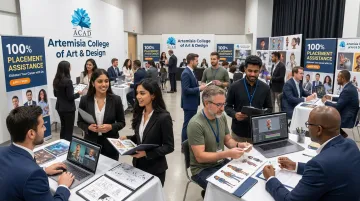
If you're comparing colleges, ask direct questions. How many recruiters visited campus last year? What roles did graduates actually land? A vague answer tells you more than any brochure.
About Artemisia College of Art & Design
Artemisia awards its animation degree as a four-year B.Design rather than a BFA, with BFA reserved for Painting and Sculpture. Artemisia College of Art & Design is run under Tryambakam Education Foundation and was started to build a job-oriented degree college offering high quality art and design education at low cost. Around 90% of the faculty come from the animation, game, interior design and fashion industries, with five to thirty-five years of experience behind them. It is the only college in India with its own animation and game production studio, where students work as paid interns on films, series and games from the fourth semester.
Animation runs at three levels: the Certificate in 2D & 3D Animation, the Diploma in 3D Animation & VFX and the four-year B.Design in Animation. Alongside it the college awards B.Design degrees in Game Design, Interior Design and Fashion Design, BFA and MFA routes in Painting and Sculpture, and a Certificate in Photography.
Tuition is kept low compared with similar programmes elsewhere and scholarships are offered to bright and needy students. You can check the current fee structure or apply through early admission if you would rather submit a portfolio than sit an entrance test.
Frequently Asked Questions
What is a BFA in Animation?
A BFA in Animation is a practical, studio-based undergraduate degree focused on building practical skills in animation, VFX, and multimedia production. It emphasises portfolio-building over classroom theory.
How long does it take to get a BFA in Animation?
Most BFA Animation programs run 3-4 years, with India generally following a 4-year structure that includes a foundation year before specialised training begins.
Is it better to get a BA or a BFA in Animation?
A BFA suits students who want hands-on studio training aimed at animation careers. A BA offers a broader, theory-based art education, better suited to keeping design options open.
Is a BFA in Animation worth it?
Given India's growing AVGC sector and the current gap between industry demand and graduate supply, a BFA can be a strong investment, especially when the college prioritises practical portfolio work.
What is the average fee for a BFA in Animation in India?
Fees vary widely by institute type and location, ranging from roughly ₹1.5 lakh at government universities to over ₹6 lakh at some private institutions. Confirm current fee structures from official college sources.
What jobs can I get after completing a BFA in Animation?
Graduates typically move into roles such as Animator, VFX Artist, Character Designer, Storyboard Artist, and Game Designer across film, gaming, and advertising industries.