As digital marketing and e-commerce keep expanding, demand for people who can build banners that actually convert is growing alongside it. But aspiring designers often get stuck at the first step: should you take a quick banner-specific course, enrol in a broader graphic design certification, or commit to a full design degree?
This guide breaks down what banner design actually involves, the skills and software training programmes teach, the types of courses available, and how to pick a path that leads somewhere.
Key Takeaways
- Banner design blends art and marketing strategy across digital ads and signage
- Core training covers composition, colour theory, typography, and tools like Photoshop
- Programme options range from short certificates to full design diplomas
- Mentorship, critique sessions, and placement support set strong programmes apart
- Graduates move into in-house design roles, agency creative jobs, or freelance work
What Is Banner Design and Why It Matters
Banner design covers two distinct but related categories. Digital banners include web ad units, social media creatives, and website headers. Print banners cover hoardings, event standees, backdrops, and retail signage. Both rely on the same foundation: layout, typography, and colour theory borrowed from broader graphic design practice.
The difference lies in execution. A digital banner needs to load fast and read clearly on a phone screen. A print banner needs to hold up at ten times the size, viewed from a moving car.
Why This Skill Is in Demand
The numbers behind digital advertising explain the pull toward this career: U.S. internet-advertising revenue hit $258.6 billion in 2024, up 14.9% year-on-year, according to a 2025 IAB/PwC report. That growth translates directly into demand for people who can produce banner creatives at scale.
But growth in ad spend doesn't automatically mean banners perform well: WordStream's benchmark data puts the median click-through rate for Google Display ads at just 0.46% across industries. That's a low bar, which is exactly why design quality matters. A well-composed banner with clear hierarchy and a strong call-to-action can outperform a cluttered one by a wide margin.
Banner design skills apply well beyond advertising agencies:
- E-commerce brands need product banners for sales campaigns
- Gaming studios promote launches with eye-catching creatives
- Fashion labels design lookbook-style digital banners and in-store signage
- Interior design firms need marketing collateral for showrooms and social campaigns
This range of use cases makes banner design a practical entry point into a design career.
Skills and Tools You Learn in a Banner Design Course
A solid banner design course teaches you to think like a marketer and a visual artist at the same time. Here's what that actually looks like in practice.
Design Fundamentals That Make Banners Work
- Composition: arranging elements so the eye moves where you want it to
- Colour theory: choosing palettes that grab attention without clashing with brand identity
- Typography: picking fonts and sizing that stay legible at a glance
- Visual hierarchy: making sure the headline, offer, and call-to-action don't compete
Software You'll Actually Use
Most training programmes cover a mix of tools, each suited to different tasks:
| Software | Typical use |
|---|---|
| Adobe Photoshop | Photo editing, layered composites, retouching |
| Adobe Illustrator | Vector graphics, logos, scalable artwork |
| Canva | Quick social media banners, templated layouts |
| CorelDRAW | Vector illustration, often used in print workflows |
These four tools show up again and again in graphic design job postings and course syllabi alike, which is why most training programmes teach at least two or three of them in depth.
Sizes, Specs, and File Prep
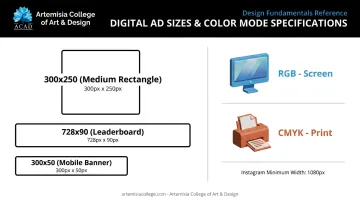
This is where theory meets technical reality. You'll learn standard dimensions such as the IAB's fixed ad units: 300x250 (medium rectangle), 728x90 (leaderboard), and 300x50 (mobile banner), plus platform-specific specs like Instagram's minimum 1080px width requirement.
The course also covers the RGB versus CMYK distinction: RGB for anything viewed on a screen, CMYK for anything sent to a printer, whether that's a hoarding or a retail standee. Getting this wrong is one of the most common beginner mistakes, and it's usually the first thing a good instructor corrects.
By the end of a proper course, you should have a small portfolio of sample banners, both digital and print, ready to show employers or freelance clients.
Types of Banner Design Courses and Training Formats
Not all training paths look the same, and picking the wrong format can waste months.
Short Certificate Courses vs Comprehensive Diplomas
Short certificate courses run from a few weeks to a couple of months and focus narrowly on banner or graphic design basics. They're mostly online, and platform examples vary wildly in depth: a Skillshare class on layout principles can run just 35 minutes, while a full Udemy graphic design masterclass stretches to 31.5 hours.
Diploma and degree programmes take a different approach. Rather than isolating banner design as a standalone topic, they build it into a broader Fine Arts or design foundation.
At Artemisia College, for instance, foundational subjects like Graphics and Basic Design appear in the first year of programmes such as the B.Des in Interior Design. Students move into specialised studio work only after this groundwork is laid. The college's own approach puts it plainly: building strong fundamentals matters more than jumping straight into software training.
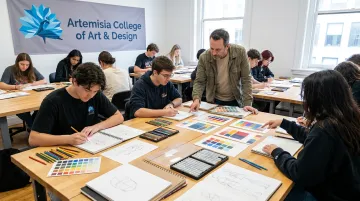
That grounding matters because banner design rarely exists in isolation on the job. A designer who understands composition and colour theory at a deeper level adapts faster when a brief shifts from a web banner to a fashion lookbook or a game promo asset.
Self-Paced Online vs Mentor-Led Programmes
How you learn matters as much as what you learn, and three formats dominate this space:
- Self-paced platforms (Udemy, Coursera, Skillshare) offer flexibility and lifetime access to video content
- Mentor-led offline or hybrid programmes add structured feedback, critique sessions, and real project practice
- Software-only workshops suit people who already know design theory and just need tool fluency
Self-Taught vs Structured Learning
Free YouTube tutorials and design blogs can teach individual techniques well. What they typically lack is accountability, sequencing, and access to real client-style feedback — the things that turn scattered skills into a coherent portfolio.
How to Choose the Right Banner Design Training Programme
Picking a programme comes down to a handful of practical checks rather than gut feeling.
Curriculum coverage:
- Does it teach both digital and print banner design, not just one?
- Is there hands-on software training, not just theory slides?
- Do projects mirror real client briefs, with constraints and deadlines?
Feedback and mentorship:
- Are there critique sessions where an instructor reviews your work directly?
- Is it project-based, or mostly passive video-watching?
- Does feedback happen throughout the course, or only once at the end?
Placement support and industry connections: Beyond critique and mentorship, colleges with active placement cells and industry partnerships make the jump from student project to paid design work far smoother.
Artemisia College's placement cell, for example, supports students at every stage:
- Finalises your portfolio and CV for real hiring briefs
- Runs mock interviews and one-on-one mentoring before the real thing
- Guides you on which companies to target and how to approach them
- Coordinates interview scheduling and offer negotiation
This structured support closes a gap that self-taught learners often struggle with alone.
Career Opportunities After Banner Design Training
Banner design training rarely leads to just one job title. It opens several doors at once.
Roles and Industries Hiring
Common entry points include:
- Junior graphic designer
- Digital marketing creative
- Social media content designer
- Print production designer
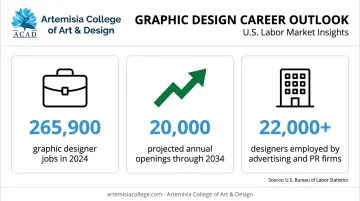
The broader graphic design occupation gives a useful sense of scale, even though the numbers come from the U.S. market.
According to the U.S. Bureau of Labor Statistics Occupational Outlook Handbook, graphic designer jobs numbered 265,900 in 2024, with roughly 20,000 openings projected each year through 2034. Advertising and PR firms alone employed over 22,000 graphic designers as of May 2024.
Industries actively hiring for these skills include e-commerce brands, marketing agencies, and fashion or interior design firms that need constant marketing collateral.
Artemisia College's placement cell works directly with several of these companies, including e-commerce and interior brands like HomeLane, Livspace, and FirstCry, plus fashion names such as Arvind Fashions, Raymond, and Fabindia.
The same network also opens doors into gaming and entertainment studios like Rockstar Games, Electronic Arts, and Ubisoft, where design-trained graduates often grow into broader creative roles. Technical Artist Prince Choudhary, for example, landed his internship at Electronic Arts through this guidance.
Freelance and Growth Paths
- Platforms like Fiverr and Upwork carry steady demand for banner and graphic design gigs
- Building an independent client base is realistic once you have a solid portfolio
- Banner design often becomes a stepping stone into branding, UI/UX, or full creative direction roles over time
Skill progression matters here. Few designers stay purely focused on banners for their whole career — most use it as the entry point, then build outward.
About Artemisia College of Art & Design
Artemisia does not run a standalone graphic design course; layout and visual communication are taught inside its animation, game and interior design programmes. Artemisia College of Art & Design was set up under Tryambakam Education Foundation to make high quality art and design education affordable without thinning it out. Roughly 90% of the teaching staff come from working industry, bringing between five and thirty-five years of practice into the studio.
The college awards four-year B.Design degrees in Animation, Game Design, Interior Design and Fashion Design, BFA and MFA routes in Painting and Sculpture, and shorter certificate and diploma routes including the Certificate in 2D & 3D Animation, the Certificate in Game Design, the Certificate in Interior Design, the Certificate in Fashion Design and the Certificate in Photography.
Fees are deliberately low so cost is not what decides whether a creative student can study, and scholarships are available. Have a look at the fee structure, or go through early admission if a portfolio suits you better than an entrance test.
Frequently Asked Questions
How do I learn banner design?
Start with fundamentals like colour theory, typography, and composition, then practise with tools such as Photoshop or Canva. Enrolling in a structured course or diploma adds guided, project-based learning that self-teaching often misses.
Is graphic design a 2-year course?
It depends on the format. Certificate courses run a few weeks to months, while diplomas or degrees that include design fundamentals typically run 1 to 3 years, depending on depth.
What software is commonly used for banner design?
Adobe Photoshop handles photo editing and composites, Illustrator handles vector graphics, Canva suits quick social banners, and CorelDRAW is common in print-focused workflows.
Can banner design be learned online?
Yes, though results vary widely by format. Video-only platforms can cover the basics, but mentor-led or campus-based programmes offer more feedback, accountability, and hands-on project guidance.
What's the difference between banner design and general graphic design?
Banner design is a focused application of graphic design principles aimed specifically at promotional and advertising visuals. General graphic design covers a much wider scope, including branding, packaging, and UI work.
Is banner design a good career option?
Demand for visual marketing content keeps growing across digital and print media. Banner design skills also transfer easily into broader graphic design or digital marketing roles, making it a practical entry point into the field.