
But the moment you start researching, the acronyms pile up fast. MA, MFA, MSc, thesis-track, non-thesis, one year, two years. Many prospective students struggle to figure out which path actually leads to the classroom, museum, or studio role they want.
This guide breaks down what a Master's in Art Education actually involves, how it differs from an MFA or MSc, what you'll study, who gets admitted, and where the degree can take you. We'll also cover why your undergraduate foundation matters more than most applicants realise.
Key Takeaways
- MA in Art Education trains teachers; MFA is a terminal studio-practice degree
- Most programs take 1-2 years full-time (30-60 credits), with part-time and online options
- Admissions typically require a portfolio, statement of purpose, and recommendation letters
- Career paths span K-12 teaching, higher education, museum education, and ed-tech curriculum design
- A strong undergraduate portfolio improves your odds of admission to competitive programs
What Is a Master's Degree in Art Education?
A Master's in Art Education is a graduate-level qualification built around advanced study of visual arts pedagogy, curriculum development, art history and theory, and creative practice. It's designed for people who want to teach, research, or lead in arts-focused institutions rather than simply produce studio work.
Most programmes combine four elements:
- Coursework in pedagogy, art history, and educational theory
- Studio practice to keep creative skills sharp
- A supervised teaching practicum in a real classroom, museum, or community setting
- A thesis or capstone project that ties research to practice
At the School of the Art Institute of Chicago, the MA in Art Education runs on 36 credit hours across three or four semesters, with a Thesis I, Fieldwork, and Thesis II sequence built directly into the structure. That's a useful benchmark for what "full-time" actually means in practice.
MA vs MFA vs MSc: Which Path Fits Art Education?
This is where most confusion happens, so let's settle it once and for all.
- MA in Art Education — theory and pedagogy-focused. Best for teaching, curriculum design, and academic research roles.
- MFA — a terminal, practice-based degree centred on studio work and a strong portfolio. Often the minimum hiring requirement for studio practice or faculty studio-teaching roles.
- MSc — rarely used in art education specifically. It's more common in art/education technology or research-heavy STEAM programmes, such as museum education courses that blend pedagogy with digital tools.
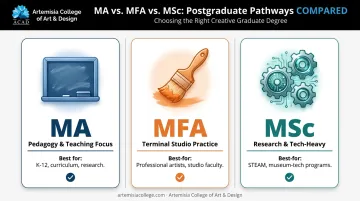
For most people entering teaching, curriculum work, or arts leadership, MA remains the standard choice. The MFA path makes sense only if your career goal is professional studio practice or a faculty studio-teaching post.
How Long Does a Master's in Art Education Take?
Expect 1-2 years full-time, roughly 30-60 credits depending on the institution and country. Thesis-track programmes sometimes extend slightly, since research, fieldwork, and a defence take time to complete properly.
Working teachers and professionals increasingly have flexible options too:
- Part-time tracks stretched over 2-4 years
- Evening or weekend cohorts
- Hybrid or fully online delivery for theory-heavy coursework
Popular Specializations Within Art Education Master's Programs
Not every Master's in Art Education looks the same. Many programmes let you shape your degree around a specific direction:
- Studio Art Education: painting, sculpture, and printmaking pedagogy aimed at K-12 or higher-ed teaching roles
- Art Therapy & Community Arts: using creative practice in therapeutic, social, or community-based learning environments (often a separate MS degree at some institutions)
- Museum & Gallery Education: training for curatorial education, public programming, and arts administration positions
- Digital & Media Arts Education: an emerging area covering animation, design, and game-based learning pedagogy for tech-integrated classrooms
- Curriculum & Instructional Design: building art curricula, assessment frameworks, and policy for schools, districts, or ed-tech platforms
These aren't always separate degree titles. Often, they show up as elective concentrations, fieldwork placements, or thesis focus areas within a broader MA. If digital pedagogy interests you, look for programmes that explicitly list modules on virtual museum experiences or AI-assisted creative teaching, since these vary widely between institutions.
Curriculum, Coursework & Skills You'll Gain
Core coursework across most programmes covers similar ground, even if course names differ:
- Art history and theory — understanding movements, context, and critical frameworks
- Educational psychology — how learners at different ages engage with creative material
- Pedagogy and assessment methods — designing lessons and measuring learning outcomes
- Research methodology — arts-based research approaches used in thesis work
Beyond lectures, most degrees include hands-on components:
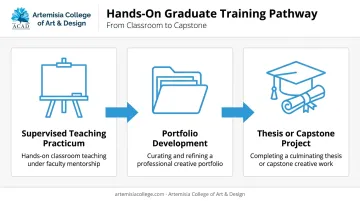
- Supervised teaching practicum — placements can happen in schools, museums, or community arts organisations
- Portfolio development — an ongoing requirement, not a one-time submission
- Thesis or capstone project — often defended before a faculty panel, sometimes paired with a public presentation or exhibition
By the end, graduates typically walk away with:
- Curriculum design skills applicable across age groups and settings
- Classroom technology integration know-how
- Sharper critical and creative thinking
- Mentorship and supervisory capability, useful for leadership roles later
Eligibility & Admission Requirements
Admission standards vary by school, but the common thread is a background in fine arts or a related creative field, paired with tangible proof you can create original work.
Typical requirements include:
- A bachelor's degree in fine arts, art education, or a related creative discipline
- A portfolio of original work — this matters more than most applicants expect
- A statement of purpose outlining your goals and teaching philosophy
- Letters of recommendation, usually two
- Sometimes an admissions interview in place of standardised test scores
Portfolio Expectations
Portfolio requirements can be surprisingly specific. SAIC's application, for instance, asks for up to 20 images or up to 10 minutes of time-based work, representing your strongest area of achievement, whether that's studio practice, creative writing, or documented education projects in schools or museums.
There's no published numeric "weighting," but portfolios are evaluated alongside your statement and references as a package, not as a checkbox.
Practical advice: don't submit your broadest range of work. Submit your best, most focused body of work instead. Admissions committees are looking for depth and clear intent, not variety for its own sake.
Career Opportunities & Growth After a Master's in Art Education
This is usually the deciding factor for most applicants, so let's get specific about where the degree actually leads.
K-12 Teaching Certified art teacher roles remain the most common outcome. Licensure requirements vary by country and state, and public schools almost always require certification on top of the degree. Private schools are sometimes more flexible on this front.
Higher Education Positions like art lecturer or studio instructor typically require a terminal degree (an MFA, not an MA) alongside classroom experience. If your goal is a university studio-teaching post, plan your degree path accordingly early on.
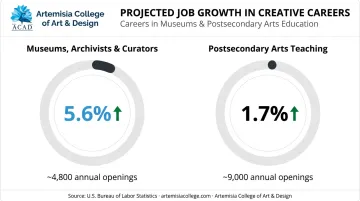
Museum & Arts Administration Museum educator, arts programme coordinator, and cultural institution roles are growing steadily. The museum, archivist, and curator sector is projected to grow 5.6% through 2034, with roughly 4,800 annual openings, according to US Bureau of Labor Statistics data. That's a sector-wide figure, not an isolated museum-educator forecast — but it's a useful directional signal.
Emerging Creative Industry Roles This is where things get interesting for graduates with a design or animation background:
- Corporate art education consultants
- Ed-tech curriculum designers
- Training leads for animation and game studios
Postsecondary arts teaching specifically (art, drama, and music combined) is projected to grow 1.7% with about 9,000 annual openings through 2034. Not explosive growth, but steady demand for qualified educators in a field that isn't shrinking.
Building a Strong Creative Foundation Before Your Master's
Here's something applicants underestimate: your undergraduate foundation shapes your graduate options far more than most people realise. A rigorous, portfolio-driven undergraduate degree in Fine Arts, Animation & VFX, or Design gives you a real advantage when applying to competitive Art Education Master's programmes.
Why does this matter so much? Graduate admissions committees read your portfolio for evidence of sustained creative growth. A handful of strong pieces rushed together before a deadline rarely convinces them.
At Artemisia College, this preparation happens well before graduation. The college's industry-integrated approach includes:
- Dedicated placement support connecting students with real creative-industry employers
- Portfolio finalisation guidance so your best work is presented with clarity and intent
- Mentorship throughout the final years of study, not just at graduation
Artemisia's placement relationships span gaming studios like Rockstar Games, Electronic Arts, and Ubisoft, plus animation houses and interior design firms such as Livspace and HomeLane.
This exposure sharpens the same portfolio and presentation skills that graduate admissions committees look for, regardless of whether the next step is a Master's in Art Education or direct industry entry.
You don't have to choose one path over the other too early. A strong foundation just needs to keep both doors open.
About Artemisia College of Art & Design
For artists weighing up postgraduate study, it is worth knowing what a fine arts master's involves day to day. Artemisia College of Art & Design was set up under Tryambakam Education Foundation to make high quality art and design education affordable without thinning it out. Roughly 90% of the teaching staff come from working industry, bringing between five and thirty-five years of practice into the studio.
Fine arts runs from the Certificate in Painting and Diploma in Painting through the BFA in Painting and BFA in Sculpture, up to MFA in Painting and MFA in Sculpture. The college also awards four-year B.Design degrees in Animation, Game Design, Interior Design and Fashion Design, plus a Certificate in Photography.
Fees are deliberately low so cost is not what decides whether a creative student can study, and scholarships are available. Have a look at the fee structure, or go through early admission if a portfolio suits you better than an entrance test.
Frequently Asked Questions
What is a master's in art education?
A master's in art education is a graduate degree focused on art pedagogy, curriculum design, and creative practice, built for people pursuing teaching, arts leadership, or research careers. It typically combines coursework, a teaching practicum, and a thesis.
How many years is a master of arts in education?
Most full-time programmes take 1-2 years, roughly 30-60 credits. Thesis-track routes or part-time study can extend this timeline to three or four years.
Which is better, MSc or MA?
MA is the standard degree for art education careers, focused on pedagogy and teaching practice. MSc is uncommon in this field and tends to appear in research or technology-heavy adjacent programmes instead.
What is the difference between an MA and an MFA in art?
An MA is theory and teaching-focused, ideal for classroom or curriculum roles. An MFA is a terminal, studio-practice degree meant for professional artists or higher-education studio faculty positions.
Do I need a teaching licence after completing a Master's in Art Education?
Public K-12 teaching almost always requires separate state or country certification alongside your degree. Higher-education, museum, and arts administration roles typically don't require this licence.
Can I pursue a Master's in Art Education without a fine arts undergraduate degree?
Some programmes accept related backgrounds if you submit a strong portfolio demonstrating creative ability. That said, a fine arts foundation is generally preferred and makes the application noticeably stronger.