But here's the catch: there are dozens of course formats out there, and picking the wrong one wastes both time and money. A six-week certificate won't prepare you for a studio job, and a four-year degree might be overkill if you just want to shoot weddings on weekends.
This guide breaks down photography courses by duration and by specialisation, then walks you through how to actually choose one that fits your goals.
Key Takeaways
- Courses vary by qualification level (certificate, diploma, degree) and by genre (fashion, wildlife, wedding, and more)
- Your career goal, budget, and available time outweigh a course's brand name
- Practical shoots, portfolio support, and placement guidance count as much as the syllabus
- Short certificates suit hobbyists and side-income seekers; degrees suit long-term, formal careers
What Is a Photography Course & Why It Matters
A photography course is a structured, mentor-led programme, not casual practice with a camera. It covers three layers: technical skill (camera handling, lighting, composition), creative judgement, and business know-how, such as pricing, client communication, and contracts.
The "right" course depends entirely on intent. Are you learning photography as a hobby? A freelance side-income? Or a full-time profession? Each answer points to a different course type.
Why a Structured Course Matters
The job market backs this up. The US Bureau of Labor Statistics projects 2% employment growth for photographers from 2024 to 2034, with roughly 12,700 openings expected annually, largely because corporations keep needing commercial photographers for advertising and product content.
India's ad ecosystem tells a related story. IBEF reported that digital advertising spending was expected to grow about 17% in 2024, with digital's share of total ad spend rising from 40% to 42%. That growth is fuelled by social media, e-commerce, and video content, all of which need photographers.
Without structured training, most self-taught shooters run into the same walls:
- Inconsistent technical grasp (guessing at settings instead of controlling them)
- Weak, unfocused portfolios that don't target any specific market
- No understanding of client handling, contracts, or pricing
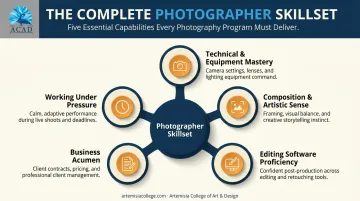
Core Skills a Good Course Should Build
A quality programme, regardless of format, should build:
- Technical and equipment mastery: cameras, lenses, lighting gear, and modifiers
- Composition and artistic sense: framing, colour, contrast, and visual storytelling
- Editing software proficiency: Lightroom, Photoshop, or similar tools
- Business acumen: pricing, client briefs, contracts, and negotiation
- Ability to work under pressure: tight deadlines, live events, unpredictable conditions, and last-minute client changes
Types of Photography Courses by Education Level & Duration
Courses vary hugely in how much time and formal qualification they demand, ranging from a weekend workshop to a four-year degree. Here's how the main levels stack up.
Certificate & Short-Term Courses
These are skill-specific programmes lasting a few weeks to a few months, with minimal eligibility criteria (often just basic schooling and interest).
Best suited for:
- Hobbyists exploring photography before committing further
- Working professionals adding a skill for freelance work
- Beginners testing genre interest, such as fashion or food photography
Limitation: Certificates build specific skills fast, but rarely provide enough depth for a standalone career without a strong, self-built portfolio to back it up.
Diploma Courses (UG & PG Level)
Diplomas run from 3 months to 2 years and come in two flavours: UG diplomas (open after 10+2) and PG diplomas (open after graduation). Both lean heavily on practical, hands-on training.
Real fee benchmarks from Indian institutions include:
| Programme | Duration | Fee (approx.) |
|---|---|---|
| MIT-WPU Diploma in Photography | 1 year, part-time | ₹1,30,000 per year |
| JMI PG Diploma in Still Photography | 2 semesters | ₹76,720 total |
Eligibility typically requires 50% aggregate in Class 12 (UG diploma) or a bachelor's degree in any discipline (PG diploma), though this varies by institution.
Best suited for: Students wanting faster industry entry without a multi-year commitment.
Undergraduate Degree (BFA/BSc/BA in Photography)
A 3-4 year full-time degree combining technical training, art history and theory, and elective specialisations. This is the most comprehensive foundation available.
Admission processes vary by institution:
- Entrance exam plus personal interview, such as MIT-WPU's CET model
- Portfolio submission and interview only, such as SSVAP's CVPI process
- A combination of both methods
Best suited for: Students wanting a well-rounded foundation, plus eligibility for postgraduate study or corporate roles that specifically require a formal degree.
Postgraduate Degree (MFA/MSc/MA in Photography)
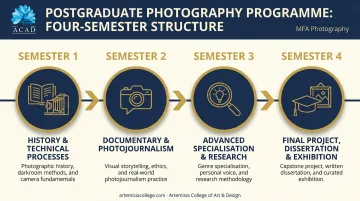
A 2-year advanced programme for degree-holders, built around deep specialisation, research, and mastery of a chosen genre. Verified examples, including AAFT's MA and IIP's MFA, both run two years across four semesters.
The typical progression looks like this:
- Semester 1: Photographic history, philosophy, and technical processes
- Semester 2: Documentary practice, photojournalism, and practical submission
- Semester 3: Advanced specialisation, research methodology, professional practice
- Semester 4: Final project, dissertation, viva, portfolio, and exhibition
Best suited for: Candidates targeting academic careers, senior studio roles, or advanced creative specialisation.
Types of Photography Courses by Specialisation/Genre
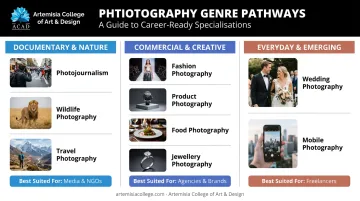
Beyond duration, courses are also built around specific genres, so learners graduate with focused, job-ready expertise rather than generalist skills.
Documentary & Nature-Based Genres
Photojournalism courses cover news, feature, and sports photography, along with timeliness, objectivity, narrative structure, ethics, and photo essays.
Wildlife, travel, and nature courses teach fieldcraft: observation, patience, telephoto and macro techniques, dawn shoots, habitat awareness, and ethical practices like maintaining safe distances and avoiding baiting.
Best suited for: Those targeting media houses, NGOs, or conservation organisations.
Commercial & Creative Genres
This cluster trains students for brand and agency work:
- Fashion photography: mood boards, styling, creative direction, editorial and campaign shoots
- Product/e-commerce photography: lighting for reflective and transparent materials, catalogue work
- Food photography: multi-light setups, prop styling, hero shots
- Jewellery photography: reflective surface control and retouching for brand-ready output
Best suited for: Students aiming to work with agencies, e-commerce brands, or fashion houses.
Everyday & Emerging Genres
Wedding photography remains a huge, steady market. Grand View Research estimated India's wedding services market at USD 103.93 billion (roughly ₹8.6 lakh crore) in 2024, projecting a 14.3% annual growth rate through 2030. That's the broader wedding economy, not photography training specifically, but it signals just how much opportunity exists for freelance shooters entering this space.
Mobile photography courses have grown in relevance as smartphone camera quality keeps improving. Adobe notes that smartphone image quality now gives DSLRs "a run for their money" in many situations, even though phones still can't match a DSLR's full manual control.
Best suited for: Freelancers and entrepreneurs seeking quick, flexible market entry.
How to Choose the Right Photography Course
The right course depends on your goals, budget, and available time, not on which institute has the flashiest Instagram page.
Factors to Consider
Weigh these before enrolling:
- Career goal — hobby, freelance side-income, or full-time profession
- Duration and mode — full-time degree, short certificate, or online course
- Budget — fees vary from a few thousand rupees for certificates to lakhs for degree programmes
- Practical exposure — real shoots, internships, and studio access matter more than classroom theory
- Placement support and mentorship — often overlooked, yet critical to landing your first paid assignment
Institutions that run a dedicated placement cell, one that finalises portfolios, runs mock interviews, and maintains industry connects, give students a noticeably stronger transition into professional work. Artemisia College, for example, builds this structure into its Fine Arts and Animation & VFX programmes, guiding students from portfolio readiness through to interview preparation. Photography aspirants should look for this same level of structured placement support when comparing institutes.
Common Mistakes to Avoid
- Choosing the most expensive or advanced course when a shorter one would meet your actual goal
- Ignoring practical exposure and portfolio-building opportunities
- Overlooking placement and post-course career support entirely
- Picking a course based on popularity rather than genre-fit or personal interest
Conclusion
Photography courses span a wide spectrum, from short certificates to full degrees, and from broad technical foundations to sharply focused genre specialisations. There's no single "best" option here.
The right choice comes down to matching course type to your career goals, budget, and time commitment, not chasing prestige. Whatever photography course you're evaluating, prioritise institutions offering structured mentorship and placement support. Artemisia College applies this approach across its creative programs, from animation to fashion design, and it's a standard worth holding any photography programme to.
About Artemisia College of Art & Design
If you are weighing up which type of photography course to take, it helps to know what a full programme actually contains. Artemisia College of Art & Design was set up under Tryambakam Education Foundation to make high quality art and design education affordable without thinning it out. Roughly 90% of the teaching staff come from working industry, bringing between five and thirty-five years of practice into the studio.
Photography is taught through the one-year Certificate in Photography, covering wildlife, fashion, photojournalism, architectural and conceptual work. The college also awards B.Design degrees in Animation, Game Design, Interior Design and Fashion Design, and BFA and MFA routes in Painting and Sculpture.
Fees are deliberately low so cost is not what decides whether a creative student can study, and scholarships are available. Have a look at the fee structure, or go through early admission if a portfolio suits you better than an entrance test.
Frequently Asked Questions
What are the different types of photography courses?
Courses fall into two categories: by duration/qualification (certificate, diploma, undergraduate degree, postgraduate degree) and by specialisation (wildlife, fashion, wedding, food, and more). Most learners choose based on both dimensions together.
What is a good photography course?
A good course balances solid technical training with hands-on practice, portfolio guidance, and placement or mentorship support. Curriculum alone isn't enough; practical exposure and career support matter just as much.
What are the 7 basics of photography?
The seven basics are aperture, shutter speed, ISO, composition, lighting, focus, and framing. Every course, regardless of genre, builds on these fundamentals first.
Which photography course is best for beginners?
Foundation or certificate courses work best for beginners, since they build core technical basics before you commit to a specific genre or a longer degree programme. This lets you test your interest with lower financial risk.
Is a formal degree necessary to become a professional photographer?
No. A degree offers structured learning and added credibility, but many working professionals build careers through diplomas, certificates, and a strong, focused portfolio instead. What matters most is demonstrable skill and client-ready work.
How long does a photography course usually take?
Certificates typically run around 3 months, diplomas range from 6 months to 2 years, undergraduate degrees take 3-4 years, and postgraduate degrees run about 2 years. Choose based on how much depth your career goal actually requires.