Introduction
Every app icon you tap, every poster that stops you mid-scroll, every brand you recognise before you even read its name — someone trained in graphic design and UX shaped that. That someone could be you.
Prospective students often get stuck at the first hurdle: BA, BFA, or B.Des? And does a graphic design degree even matter anymore if it doesn't teach UX?
Fair questions. Digital interface design roles are projected to grow 7% between 2024 and 2034 in the US, more than triple the 2% growth forecast for generalist graphic design roles, according to the U.S. Bureau of Labor Statistics. India's design and gaming studios show the same shift, prioritizing UX hires over traditional graphic roles. That gap is reshaping how design schools build their curricula.
This guide breaks down what a BA in Graphic Design (with UX exposure) actually covers: curriculum, eligibility, careers, salaries, and how to pick a program that won't leave you underprepared.
Key Takeaways
- BA Graphic Design programs run 3-4 years, increasingly weaving in UX modules
- BA is theory-driven; BFA and B.Des are studio-intensive, yet all lead to similar roles
- Some Indian universities offer BA programs titled BA Animation & Graphic Design
- Portfolio strength and placement support matter more than your degree title
- NID DAT and UCEED apply to B.Des admissions, not BA; check each institute's rules
What Is a BA in Graphic Design & UX?
A BA in Graphic Design is an undergraduate program built around visual communication, design history, and applied technology. Increasingly, colleges fold in foundational UX training so graduates aren't limited to print and branding work alone.
In India, this usually shows up as BA Animation & Graphic Design, offered through university-affiliated colleges, with UX/UI appearing as a listed field of study rather than a universal core module. It's a real, widely available credential, just not always under the exact phrase "Graphic Design & UX."
BA vs. BFA: Which Is Actually Better?
Neither, honestly. It depends on what you want out of four years.
- BA programs: More room for liberal arts, design history, and cultural context alongside studio work
- BFA programs: Roughly half the coursework is studio practice, often ending in a capstone thesis exhibition
- Employer reality: Recruiters consistently weigh portfolio strength over which acronym sits after your name
Why UX Is Creeping Into Every Curriculum
Businesses need designers who understand how people use things, not just how things look. That's the demand signal behind the 7% vs. 2% growth split mentioned earlier: digital interface design roles are outpacing traditional graphic design hiring in occupational projections.
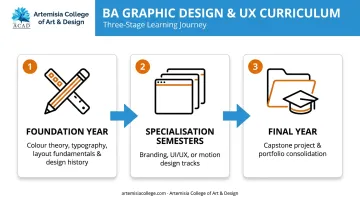
Most BA programs structure this as:
- Foundation year: colour theory, typography, layout fundamentals, design history
- Specialisation semesters: branding, UI/UX, or motion design tracks
- Final year: capstone project and portfolio consolidation
Curriculum & Skills You'll Gain
A well-built BA Graphic Design program covers two parallel tracks: classic visual communication and digital interface skills.
Foundational subjects:
- Colour theory and typography
- Layout, composition, and visual hierarchy
- Design history and visual communication principles
- Branding and identity design
UX-specific modules typically added in later semesters:
- User research basics
- Wireframing and low-fidelity prototyping
- Information architecture
- Interaction design fundamentals
Software you'll actually use:
Print and branding work still runs on the Adobe suite. UI/UX prototyping has largely shifted toward Figma, especially since Adobe has placed XD into maintenance mode rather than active development.
| Purpose | Tools |
|---|---|
| Image editing | Adobe Photoshop |
| Vector/identity design | Adobe Illustrator |
| Print/publication layout | Adobe InDesign |
| UI/UX prototyping | Figma |
The Portfolio Matters More Than Your Transcript
Recruiters at design portfolio reviews consistently say they're there to spot hireable talent, not to check GPAs. Most reviews recommend showing 8-12 of your strongest pieces, sometimes trimmed to 3-5 for short interview slots. Your final-year capstone project is what gets you in the door.
Soft skills built alongside the technical training:
- Creative problem-solving under real constraints
- Client communication and presenting design rationale
- Defending design decisions in a review or critique
- Managing multiple deadlines across projects
Eligibility & Admission Process
Getting in is less about prior art training and more about curiosity and a willingness to learn.
Baseline eligibility:
- Completion of Class 12 from any stream — arts, commerce, or science
- Minimum aggregate requirements vary widely by institute, falling between 45% and 60%
- Some colleges simply ask for a Class 12 pass with no percentage cutoff at all
Admission routes also differ by institute type. Design institutes such as NID and UCEED run entrance tests, but these lead to B.Des admissions rather than BA programs. Most private colleges instead base admission on Class 12 marks, an institute-specific aptitude test, and a personal interview.
That same logic carries into the interview: evaluators look for observational thinking and problem-solving instincts, not a finished art portfolio.
Career Options & Salary After BA Graphic Design & UX
Graduates don't get boxed into one job title. Common paths include:
- Graphic Designer
- UX/UI Designer
- Visual Designer
- Art Director
- Brand Designer
- Web Designer
What the Numbers Actually Say
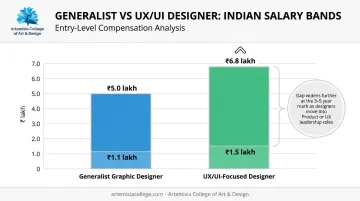
Entry-level graphic designers in India with around one year of experience earn between ₹1.1 lakh and ₹5.0 lakh per year, based on over 12,000 salary records tracked by AmbitionBox. That's a wide range, and specialisation is a big reason why.
UX/UI-focused roles tend to command a premium over generalist graphic design pay bands at nearly every career stage. This reflects stronger market demand for digital interface skills compared to traditional graphic design work. The gap widens further at the 3-5 year mark, once designers move into product or UX leadership tracks.
Is the Degree Worth It?
Yes, with a caveat: outcomes depend more on portfolio quality than the degree title itself.
- Freelance and remote work options are broad and genuinely accessible in this field
- Career paths extend into Creative Director or Head of Design roles with enough experience
- Hiring isn't limited to ad agencies
Industries actively hiring graphic design and UX talent:
- Gaming studios and animation houses
- E-commerce platforms
- Fashion brands
- Interior design firms
- Digital media companies
This breadth is what makes the degree portable. Artemisia College's placement cell maintains ties with 100+ studios across these industries, including gaming majors like Ubisoft and Electronic Arts, so graduates aren't locked into one sector the moment they finish the program.
How to Choose the Right BA Graphic Design & UX Program
Not all programs are built equally, even when they look similar on paper. Before enrolling, dig into these specifics.
Evaluate the curriculum's currency:
- Are UX and AI-assisted design tools actually taught, or just mentioned in a brochure?
- Do faculty have real industry experience, or purely academic backgrounds?
- Are you working on live client-style briefs, or only theoretical assignments?
Curriculum quality is only half the equation. Placement support matters more than prestige: a well-known college name won't get you hired if your portfolio is weak and nobody's connecting you to actual employers.
Colleges built around an industry-integrated model tend to produce stronger outcomes. Artemisia College of Art & Design, for instance, runs a dedicated Placement Cell that works through:
- Portfolio finalisation and CV creation
- Mock interviews and one-on-one mentoring
- Direct coordination with hiring partners like Ubisoft, Electronic Arts, Krafton, and HomeLane
Look for this kind of structured, ongoing support rather than a placement office that only shows up in your final semester.
About Artemisia College of Art & Design
Artemisia does not award a graphic design or UX degree; those skills are taught inside its animation, game design and interior design programmes. Artemisia College of Art & Design runs under Tryambakam Education Foundation, built around one idea: strong fundamentals make a designer, software familiarity makes a computer operator. Around 90% of its faculty come from the animation, game, interior and fashion industries.
The college awards four-year B.Design degrees in Animation, Game Design, Interior Design and Fashion Design, BFA and MFA routes in Painting and Sculpture, and shorter certificate and diploma routes including the Certificate in 2D & 3D Animation, the Certificate in Game Design, the Certificate in Interior Design, the Certificate in Fashion Design and the Certificate in Photography.
The college keeps tuition low and offers scholarships to bright and needy students. The current fee structure is published online, and early admission lets you apply on a portfolio and interview instead of an entrance test.
Frequently Asked Questions
Is a BA or BFA better for graphic design?
Neither is objectively better. BA suits students who want theoretical and contextual grounding, while BFA suits those who want studio-intensive practice. Employers generally weigh portfolio quality over degree type.
Is getting a bachelor's degree in graphic design worth it?
Yes, industry demand remains strong, and many designers move into freelance work or creative leadership roles over time. That said, portfolio strength drives outcomes more than the degree alone.
What is the average salary for graduates with a bachelor's in graphic design?
Entry-level graphic designers in India typically earn between ₹1.1 lakh and ₹5.0 lakh annually. The range widens considerably with UX specialisation and added experience.
Can you get a Bachelor of Arts (BA) in graphic design?
Yes. Dedicated BA programs in Graphic Design, often titled BA Animation & Graphic Design, are offered at multiple Indian universities. These programs are distinct from BFA and B.Des routes, frequently with a UX/UI elective track.
What is the difference between a BA in Graphic Design and a BA focused on UX Design?
A general BA covers branding, print, and visual communication broadly. A UX-focused track makes user research, wireframing, and interface prototyping core coursework rather than optional electives.
Which entrance exams are required for a BA in Graphic Design?
NID DAT and UCEED are common at top design schools, but they're tied to B.Des admissions. Most private colleges offering BA programs admit based on Class 12 marks plus a portfolio or interview review.