That's where the confusion usually begins. Should you go for a BFA, a BDes, a diploma, or a quick certificate course? After Class 12, this decision feels bigger than it should, especially with so many overlapping options and unclear differences between them.
This guide breaks down degree types, what you'll actually study, eligibility rules, realistic salary expectations, and how to pick a college that delivers on its placement promises — not just its brochure.
Key Takeaways
- BFA, BDes, and BA (Hons) programs run 3-4 years and accept students from any academic stream.
- Degrees offer deeper specialisation and stronger placement support than diplomas or certificates.
- Careers range from junior designer to creative director, with pay climbing alongside specialisation.
- Hiring managers weigh portfolio quality as heavily as your degree title.
What Is a Graphic Design Degree? Exploring Degree Types & Formats
A graphic design degree is a structured, multi-year academic programme. It combines design theory, hands-on software training, and studio-based practice, offering a different depth than a six-week skill course can provide.
Unlike short certificates that teach you one tool quickly, a degree builds visual thinking over several years: how typography works, how brands communicate, how a poster or app screen guides someone's eye. That depth is what employers look for once you move beyond entry-level work.
Popular Graphic Design Degree Programs You Can Pursue
Three main routes dominate in India:
- BFA in Graphic Design: A 3-4 year undergraduate programme focused on visual communication, typography, and illustration, structured like Delhi University's four-year, eight-semester programme with two foundation semesters before specialisation.
- BDes in Graphic/Communication Design: The design-school route, a four-year programme emphasising studio work and industry-linked projects over classroom theory.
- BA (Hons) Graphic Design: A liberal-arts-style degree blending design theory with practical tracks like web design, UI/UX, and digital publishing, though structures vary by institution.
Degree vs Diploma vs Certificate: Which Path Fits You
Not everyone needs the same commitment. Here's how the three formats generally compare:
| Format | Typical Duration | Best Suited For |
|---|---|---|
| Degree (BFA/BDes/BA Hons) | 3-4 years | Deep specialisation + placement support |
| Diploma | Shorter, tool-focused | Faster entry into the job market |
| Certificate | Weeks to months | Testing interest before committing |
Under India's national qualifications framework, an honours bachelor's degree corresponds to 160 credits, while a standard bachelor's runs on 120 credits. This formal difference reflects the extra depth an honours track demands, according to the UGC's National Higher Education Qualifications Framework.
If you're unsure whether design is truly for you, a certificate is a low-risk way to find out. If you already know you want a creative career with real placement backing, a degree is worth the extra years.
Graphic Design Degree Curriculum & Core Skills You'll Gain
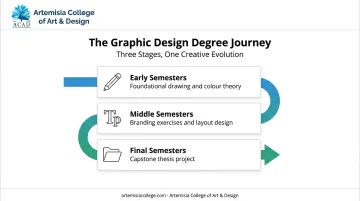
Most degree programmes follow a similar arc, even if exact subject names differ between colleges:
- Early semesters cover foundational drawing, colour theory, and design fundamentals.
- Middle semesters shift toward typography, branding exercises, and layout design.
- Final semesters culminate in a portfolio project or thesis, where you apply everything to a self-directed brief.
Software and Technical Skills You'll Actually Use
Across most reviewed syllabi, three tools show up consistently:
- Adobe Photoshop: image editing and raster-based concept work
- Adobe Illustrator: vector drawing, typography, and logo design
- Adobe InDesign: page layout for print and digital publications
Some newer programmes are also introducing Figma for collaborative prototyping and AI-assisted tools like Adobe Firefly for generative image work. Not every college has adopted these yet, so it's worth asking during admissions whether the curriculum reflects current industry workflows or still leans on older software-only training.
Soft Skills That Matter After You're Hired
Technical skill gets you the interview. What keeps you employed is different:
- Explaining your design rationale clearly to a client or creative director
- Handling revision feedback without getting defensive
- Presenting concepts persuasively in a room full of stakeholders
Strong programmes build these into studio critiques and mock client briefs, not just as an afterthought before graduation.
Eligibility Criteria & Admission Process for Graphic Design Degrees
The baseline requirement is straightforward: a Class 12 pass from any stream: Arts, Commerce, or Science all qualify.
A word of caution here: while many colleges ask for a minimum aggregate somewhere in the 45-50% range, there's no single national rule enforcing this.
Official 2026 eligibility documents for major entrance exams don't prescribe a fixed percentage cutoff. Treat this as a general guideline rather than a hard rule, and always confirm requirements with your shortlisted college.
What most degree programmes do require, beyond marks, is proof of visual thinking:
- Portfolio submission: sketches, personal projects, or other creative work
- Design aptitude test: evaluates curiosity and observation rather than formal training
- Interview or studio test: common at design-focused institutes
Entrance Exams Worth Knowing
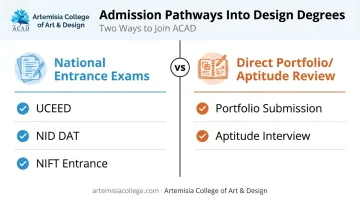
If you're aiming for top design schools, these three exams come up repeatedly:
- UCEED (Undergraduate Common Entrance Examination for Design) is conducted by IIT Bombay
- NID DAT (Design Aptitude Test) feeds into NID's BDes programmes
- NIFT Entrance determines admission to NIFT's design-related BDes tracks
Both UCEED and NID DAT officially allow candidates from any academic stream in their 2026 eligibility documents, according to NID's Admissions Handbook 2026-27. Plenty of private colleges skip these national exams entirely, admitting instead on the basis of marks plus an internal portfolio or aptitude review. Artemisia College follows this route too, evaluating applicants through their portfolio and aptitude rather than a standalone entrance exam.
Career Scope, Job Roles & Salary After a Graphic Design Degree
A degree opens more doors than most students expect at the outset.
Career Paths & Job Roles After Graduation
Common entry points and progression roles include:
- Graphic designer — the standard starting role across agencies and studios
- Visual content creator — for brands, social media, and digital marketing teams
- UI/UX designer — a specialised, higher-paying branch focused on app and product interfaces
- Art director — overseeing visual direction for campaigns or publications
- Creative director / head of design — the senior leadership track after years of experience
The skills you build also transfer into adjacent creative fields. Many graduates move into animation, advertising, and multimedia production, where visual storytelling and brand consistency skills apply directly.
Salary Expectations by Experience Level
Here's where realistic numbers matter more than hype. Based on Naukri's 2023 salary data for graphic designers in India:
| Experience | Average Annual Pay | Reported Range |
|---|---|---|
| Fresher | ₹1.8 lakh | ₹0.1-4.0 lakh |
| 3 years | ₹2.9 lakh | ₹1.4-6.5 lakh |
| 5 years | ₹3.3 lakh | ₹1.4-6.5 lakh |
| 10 years | ₹3.8 lakh | ₹1.6-8.0 lakh |
These figures represent generalist graphic design roles. Specialisation changes the math: UX designers in India reportedly average closer to ₹8 lakh annually, citing Glassdoor data via a 2025 Coursera report. That gap is exactly why so many designers pivot toward UI/UX or motion design once they've built a solid portfolio.
Senior roles like creative director or head of design carry even wider pay bands, largely driven by studio size, industry, and individual reputation rather than a fixed formula. Specialisation and experience compound your earning potential far more than the degree title does.
How to Choose the Right College for Your Graphic Design Degree
Picking a college shouldn't come down to brochure photos or a famous name alone. A few practical checks matter more.
Check curriculum currency. Ask directly whether the syllabus includes current tools and AI-assisted workflows, or whether it's still built around software that's a decade old. A quick way to test this: ask a current student what they used in their last project.
Look for a dedicated placement cell, not a one-off campus drive once a year. A genuinely useful placement cell should support:
- Portfolio finalisation and CV building
- Mock interviews and interview coaching
- Salary negotiation guidance
- Post-placement coordination with employers
Verify industry partnerships. Active ties with recognised studios signal real hiring pipelines, not just marketing claims.
Artemisia College of Art & Design, for instance, maintains placement relationships with names like Rockstar Games, Electronic Arts, Ubisoft, and Krafton across its creative programmes — the kind of industry-integrated ecosystem worth looking for when you're comparing colleges.

Ask about live briefs and mentorship. Programmes that simulate real client work, complete with revisions and deadlines, prepare you far better for interviews than theory-only coursework ever will.
Confirm accreditation. Under Section 22 of the UGC Act, only legally recognised universities and empowered institutions can award valid degrees. Check which university actually confers the qualification, not just which brand runs the campus.
Ask for year-wise placement records too, rather than accepting a vague headline placement percentage.
About Artemisia College of Art & Design
Artemisia does not award a graphic design degree; visual communication is taught within its animation, game design and interior design programmes. Artemisia College of Art & Design was set up under Tryambakam Education Foundation to make high quality art and design education affordable without thinning it out. Roughly 90% of the teaching staff come from working industry, bringing between five and thirty-five years of practice into the studio.
The college awards four-year B.Design degrees in Animation, Game Design, Interior Design and Fashion Design, BFA and MFA routes in Painting and Sculpture, and shorter certificate and diploma routes including the Certificate in 2D & 3D Animation, the Certificate in Game Design, the Certificate in Interior Design, the Certificate in Fashion Design and the Certificate in Photography.
Fees are deliberately low so cost is not what decides whether a creative student can study, and scholarships are available. Have a look at the fee structure, or go through early admission if a portfolio suits you better than an entrance test.
Frequently Asked Questions
How long does a graphic design degree take?
Most degree programmes, including BFA, BDes, and BA (Hons), run 3 to 4 years. Compare that to 1-2 years for diplomas and just a few months for standalone certificates.
What degree is best for graphic design?
It depends on your direction: BFA and BDes suit brand and communication design careers most directly. Programme quality and placement support, however, often matter as much as the degree title itself.
Is a graphic design degree useful?
Yes, particularly for structured skill-building, portfolio development, and placement access. That said, a strong portfolio often carries as much weight as the credential during actual hiring.
Is a graphic design degree well paid?
Pay varies widely by specialisation and experience. Entry-level roles start modest, but specialised paths like UI/UX design or senior creative direction can pay considerably more over time.
What is the difference between a graphic design degree and a diploma?
A degree offers greater depth, longer duration, and stronger placement infrastructure. A diploma moves faster and focuses more narrowly on practical tool training.
Which entrance exams are required for top graphic design degree colleges?
UCEED, NID DAT, and NIFT Entrance are the key national exams for top design schools. Many private colleges, however, admit students based on marks plus a portfolio or aptitude review instead.